Client Work Overload: How Agencies and Service Businesses Can Reduce Delivery Bottlenecks With AI
For many agencies, consultancies and service businesses, growth creates a strange problem.

For many agencies, consultancies and service businesses, growth creates a strange problem.
You win more clients.
Revenue increases.
The team gets busier.
And somehow the business becomes harder to run.
More clients create more meetings. More deliverables create more status updates. More team members create more handoffs. More projects create more approvals, dashboards, documents, messages and deadlines.
Eventually, the people who should be thinking about customers, strategy and growth spend most of their time coordinating work.
This is client work overload.
Client work overload occurs when the volume and complexity of client delivery exceed an organization's effective capacity to coordinate, execute and make decisions.
Importantly, this does not always mean the company has too little headcount.
Often, it means the operating model contains too much work around the work.
And that distinction matters.
Because if the problem is simply treated as a capacity shortage, the default solution is hiring.
If the real problem is structural, hiring may make it bigger.
The emerging alternative is not simply to give every employee an AI assistant.
It is to redesign client delivery so that unnecessary work disappears, deterministic work is automated, coordination is increasingly handled by AI agents, and humans spend more of their time on the decisions and relationships that actually require them.
That is a much bigger shift.
Why Client Work Becomes Overwhelming
A service business typically begins with a simple operating model.
A client needs something.
Someone on the team understands the requirement.
The work gets completed.
The client reviews it.
The process repeats.
As the organization grows, layers appear.
There is an account manager, specialist, project manager, analyst, strategist, designer, approver and leadership team.
Work starts moving between systems.
Briefs live in documents.
Conversations happen in Slack or Teams.
Client history sits in email.
Tasks live in project-management software.
Assets are stored elsewhere.
Performance data sits inside analytics platforms.
The CRM contains another part of the customer relationship.
None of these tools is necessarily the problem individually.
The problem is that humans become the connective tissue between them.
Someone has to remember the context.
Someone has to transfer information.
Someone has to notice the deadline.
Someone has to check whether another person finished their task.
Someone has to turn the data into a client update.
Someone has to realize that something has gone wrong.
Someone has to tell everyone else.
The team therefore performs two jobs simultaneously:
the client work and the coordination of the client work.
As client volume increases, the second category can grow surprisingly quickly.
The Hidden Client Delivery Tax
A useful way to think about service delivery is:
Total Client Work = Value-Creating Work + Coordination + Information Retrieval + Rework + Reporting + Context Switching
Only the first category directly creates what the customer bought.
The rest may be necessary, but it represents what we might call the client delivery tax.
Consider a marketing agency producing a campaign.
Creating the strategy is work.
Writing the campaign is work.
Designing the creative is work.
But so are:
checking whether the latest brand deck has been uploaded;
asking the account manager which offer the client approved;
finding the previous campaign results;
transferring comments from an email into a project-management system;
asking for an overdue asset;
preparing a status document;
attending a meeting to explain the status document;
reminding someone about an approval;
and rebuilding work because an outdated version of the brief was used.
None of those activities independently looks catastrophic.
At scale, they can consume the organization.
Microsoft's workplace research has described an increasingly fragmented workday in which digital communication and interruptions continuously compete with focused execution. Its 2026 research takes the argument further: AI delivers more value when organizations redesign how work happens instead of simply inserting AI into existing processes.
That principle is especially important for client-service businesses.
If you automate a bad operating model without redesigning it, you may simply produce bad work faster.
Eight Signs You Have a Client Work Overload Problem
Client overload does not always appear as an obvious capacity crisis.
Sometimes revenue is growing and clients are still relatively happy.
But underneath that performance, several warning signals begin appearing.
- 1Senior people increasingly become project coordinators instead of strategic thinkers.
- 2Employees spend significant time asking for status rather than progressing work.
- 3Client knowledge exists primarily inside individual employees' heads.
- 4The same information is manually copied across multiple systems.
- 5Work regularly requires last-minute interventions from founders or managers.
- 6Small client requests frequently interrupt larger strategic priorities.
- 7Adding clients almost always requires adding people.
- 8Everyone appears busy, but margins, speed or quality are not improving proportionally.
The final signal is particularly important.
Busyness is not the same as productive capacity.
A team can be operating at maximum activity while the underlying system is operating inefficiently.
Why Hiring More People Doesn't Always Solve Client Overload
Hiring is sometimes exactly the right answer.
A design agency needs designers. A consulting firm needs expertise. A technology company needs engineers.
But hiring should add productive capacity—not compensate indefinitely for unnecessary coordination.
Imagine a ten-person business with poorly defined workflows.
You add five people.
There are now more people capable of completing work.
But there are also more potential communication paths, more handoffs, more project updates, more documentation and more management requirements.
Without redesigning the operating model, headcount can increase both capacity and complexity.
This is one reason service businesses frequently encounter a scaling ceiling.
Revenue and headcount rise together.
Management complexity rises.
Margins stop improving.
The founder becomes more involved rather than less.
Eventually the organization realizes that scaling delivery cannot mean replicating the same human-intensive workflow indefinitely.
The question becomes:
How much of the current workflow actually requires a human?
Start With Workflow Elimination, Not AI
One of the biggest mistakes businesses can make in the AI era is automating everything they already do.
Some work should not be automated.
It should disappear.
Before introducing AI, take a client workflow and ask five questions:
1. Eliminate: Does this activity need to exist at all?
2. Simplify: Can the number of steps, approvals or handoffs be reduced?
3. Automate: Is the activity predictable enough for deterministic software?
4. Agentize: Does the activity require interpretation, monitoring, reasoning or coordination that an AI agent could perform?
5. Keep Human: Does the activity require judgment, relationship management, creativity, accountability or a consequential decision?
This produces a fundamentally different operating model.
Instead of trying to make humans slightly faster at every task, the company redesigns who—or what—should perform each type of work.
Automation and AI Agents Solve Different Problems
Traditional automation remains extremely valuable.
If X always leads to Y, conventional automation may be all you need.
For example:
When a contract is signed, create a project.
When an invoice becomes overdue, send a notification.
When a lead submits a form, update the CRM.
When a campaign reaches a predefined threshold, trigger an alert.
These are deterministic processes.
AI agents become more interesting when work is less predictable.
An agent could potentially:
read a new client brief;
retrieve relevant historical information;
identify missing requirements;
prepare questions;
monitor project progress;
compare deliverables against the brief;
summarize client feedback;
detect a risk;
route work to the relevant specialist;
prepare a status update;
and escalate decisions when human judgment is required.
The distinction matters.
Automation follows a predefined path.
An AI agent can increasingly determine what path should be taken within defined boundaries.
This does not mean everything should become autonomous.
It means coordination itself can increasingly become software.
The AI-Native Client Delivery Model
The traditional client-service organization often places humans at every layer.
Humans receive requests.
Humans interpret requests.
Humans retrieve information.
Humans allocate work.
Humans perform work.
Humans check progress.
Humans prepare reporting.
Humans identify problems.
Humans coordinate revisions.
Humans decide what happens next.
An AI-native model begins separating these responsibilities.
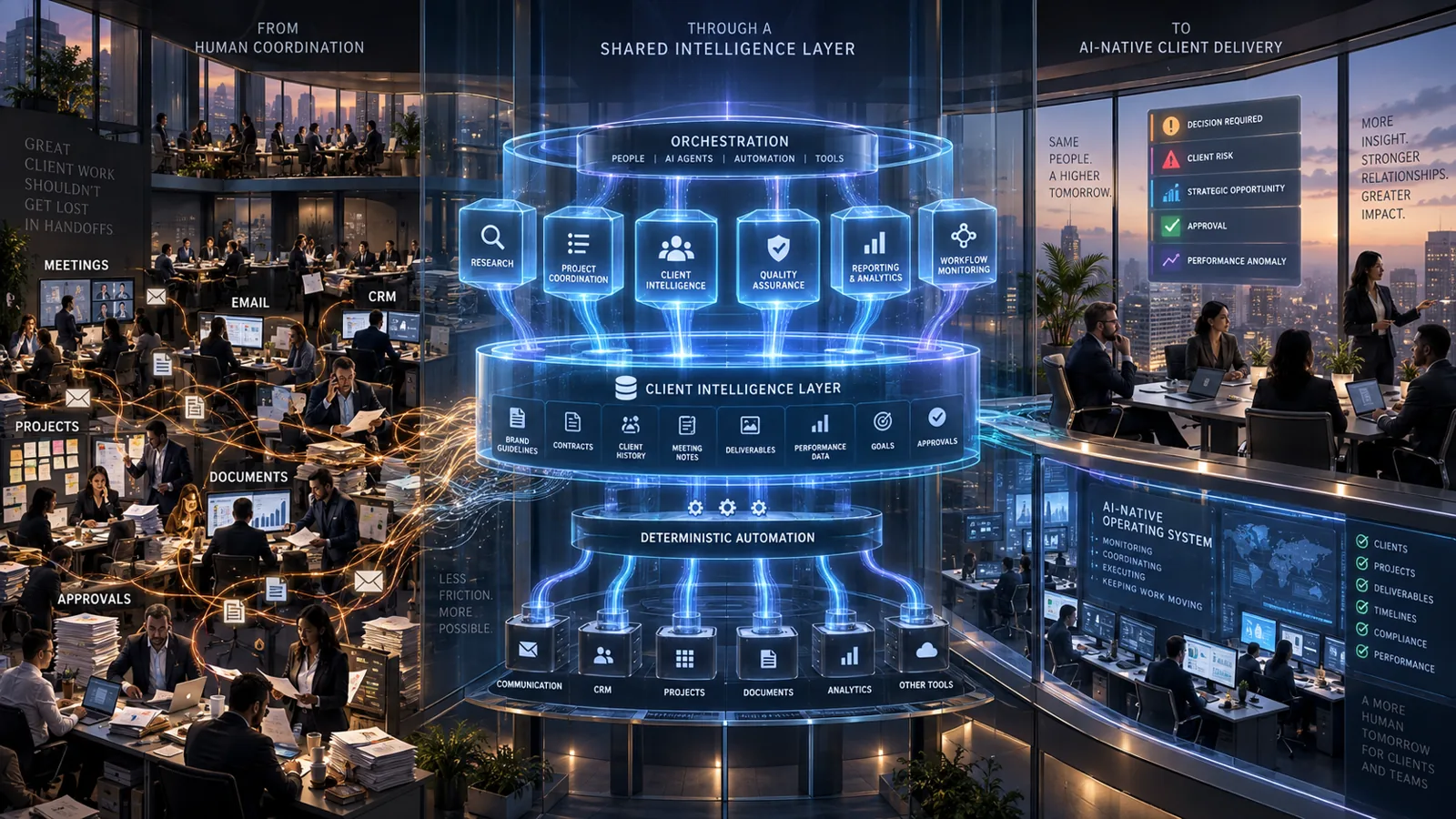
Layer 1: Shared Client Intelligence
Every client should have accessible, structured organizational memory.
That could include:
brand guidelines, contracts, previous deliverables, customer information, meeting history, feedback, campaign performance, approved messaging, product information, key stakeholders, business goals and important decisions.
Instead of employees repeatedly reconstructing context, authorized AI systems can retrieve relevant knowledge when needed.
This may be one of the most important foundations of AI-enabled service delivery.
Without shared context, every AI interaction starts close to zero.
With persistent client intelligence, AI can work from organizational memory rather than isolated prompts.
Layer 2: Deterministic Automation
Stable, repetitive processes should continue moving through conventional automation.
Project creation.
File routing.
Data synchronization.
Notifications.
Scheduling.
Standard reports.
Billing triggers.
Permissions.
These workflows do not necessarily require sophisticated reasoning.
Layer 3: Specialized AI Agents
AI agents can then operate across more dynamic work.
A research agent might continuously collect relevant customer or market information.
A project coordination agent might monitor dependencies and deadlines.
A reporting agent might turn project and performance data into a client-ready summary.
A quality-control agent might compare an output against predefined standards.
A customer-intelligence agent might surface changes in client or audience behavior.
Different businesses will require different agents.
The important architectural idea is specialization.
Do not build one giant chatbot and expect it to run the company.
Layer 4: Orchestration
As multiple humans, systems, automations and agents become involved, something needs to coordinate them.
That orchestration layer can manage:
workflow state, dependencies, priorities, permissions, agent selection, escalation and completion.
Instead of a project manager manually chasing every step, the underlying system increasingly understands where the work stands.
Layer 5: Human Judgment
Humans remain essential where the cost of being wrong is high or where value comes from distinctly human capabilities.
Client relationships.
Strategic judgment.
Negotiation.
Creative direction.
Commercial decisions.
Sensitive communication.
Complex trade-offs.
Final approvals.
The objective is not a human-free service company.
It is a company where human attention is allocated intentionally.
What Happens to the Account Manager?
This transformation has interesting implications for client-service roles.
Consider the traditional account manager.
A significant portion of the job may involve gathering updates, sending reminders, preparing meeting notes, searching for information, communicating deadlines and translating activity into status reports.
Those activities are important.
But they are not necessarily where the account manager creates the most value.
If systems increasingly handle operational coordination, the role can move upward.
The account manager can spend more time understanding the client's business, spotting opportunities, improving relationships, challenging weak assumptions and ensuring that delivery creates actual outcomes.
AI should not necessarily remove the human.
It can remove low-leverage work surrounding the human.
Microsoft's 2026 Work Trend Index found that 66% of surveyed AI users said AI had enabled them to spend more time on higher-value work. That is a useful way to think about this transition: the strategic objective is not simply faster output, but better allocation of human attention.
A Client Campaign Before and After AI
Consider a client asking a marketing agency to launch a new campaign.
Traditional model
The request reaches the account manager.
The account manager schedules a call.
Notes are manually converted into a brief.
The strategist searches previous campaign files.
Someone asks the client for missing information.
The strategist writes the plan.
Content receives the strategy.
Creative receives the content.
Campaign operations waits for creative.
Approvals happen through email.
The account manager repeatedly checks status.
Performance data is manually collected.
A report is prepared.
A meeting is scheduled to explain what happened.
There may be excellent people at every step.
But a substantial amount of human capacity is consumed moving information between them.
AI-native model
The client request enters a shared workflow.
An AI system retrieves relevant client history and identifies missing information.
Research agents gather market, customer and competitive context in parallel.
A strategy specialist reviews synthesized intelligence.
Approved strategy triggers downstream content and creative workflows.
Automation handles predictable routing.
Agents monitor dependencies and identify delays.
Quality systems compare outputs against the brand and brief.
Humans approve consequential creative and strategic decisions.
Campaign performance is continuously analyzed.
An analytics agent surfaces anomalies and opportunities rather than forcing the team to constantly inspect dashboards.
Leadership receives prioritized decisions rather than raw operational noise.
The same humans may remain involved.
But they operate at a different altitude.
AI Can Also Make Client Overload Worse
There is an important warning here.
AI increases production capacity.
That does not automatically reduce workload.
A team capable of creating ten pieces of content may suddenly generate one hundred.
A strategist capable of producing three concepts may generate thirty.
A company may launch more experiments, more campaigns, more reports and more variations simply because creating them became cheaper.
This creates a new type of overload:
AI-generated work about AI-generated work.
More production creates more review.
More outputs create more approvals.
More experiments create more analysis.
More agents create more supervision.
If the organization does not redesign decision rights and workflows, AI can actually increase the amount of work humans have to process.
The goal should therefore not be maximum output.
It should be maximum useful outcome per unit of human attention.
That may become one of the most important productivity metrics of the AI era.
How to Reduce Client Work Overload
The transition does not require rebuilding the entire company overnight.
Start with one high-volume client workflow.
Map every step from request to completion.
For each activity, identify:
who performs it;
what information they need;
which system holds that information;
how long the activity takes;
what triggers the next step;
where work normally waits;
where errors occur;
and whether human judgment is genuinely necessary.
Then apply the five-part test:
Eliminate → Simplify → Automate → Agentize → Keep Human.
Do not begin by asking:
"Where can we use AI?"
Ask:
"If we were designing this workflow today, with humans, software automation and AI agents all available, how should it work?"
That question produces much more interesting answers.
Measure Capacity Differently
Organizations redesigning client delivery should also reconsider how they measure productivity.
Traditional utilization remains useful, but it does not reveal whether people are spending their time on valuable work.
Better operational indicators can include:
Client cycle time: How long does work take from request to completion?
Work in progress: How many client deliverables are simultaneously open?
Rework rate: How often is work repeated because of missing or incorrect context?
Coordination hours: How much human time is spent managing work rather than completing or improving it?
Escalation rate: How frequently do routine workflows require senior intervention?
On-time delivery: What percentage of commitments are completed when promised?
Gross margin per client: Is operational efficiency actually improving economics?
Strategic time: How much of senior employees' capacity is available for high-value thinking, client development and decisions?
AI implementation should improve these metrics.
If the organization deploys twenty AI tools but the team remains overwhelmed, the transformation has not worked.
The Future Service Business May Scale Differently
For decades, many professional-service businesses have scaled primarily through headcount.
More clients required more people.
More work required more people.
More people required more managers.
That model will not disappear.
Expert human talent will remain extremely valuable.
But the relationship between revenue and headcount may gradually change.
A service organization built around shared intelligence, deterministic automation, specialized AI agents and human judgment may be capable of serving more customers without increasing coordination overhead at the same rate.
That changes more than productivity.
It can change margins.
Team structures.
Pricing.
Job descriptions.
Management.
Competitive advantage.
And eventually the definition of what a service business is.
The strongest companies may not be those that use the most AI.
They may be the ones that redesign work most intelligently around what humans and machines each do best.
Frequently asked questions
What is client work overload?
Client work overload occurs when client delivery demands exceed a team's effective capacity to execute, coordinate and make decisions. It can result from excessive workload, but it can also come from fragmented systems, unnecessary meetings, manual handoffs, poor processes, missing information and excessive context switching.
How can agencies reduce client workload?
Agencies can reduce workload by eliminating unnecessary steps, standardizing common processes, automating deterministic tasks, centralizing client knowledge, using AI for appropriate coordination and analysis, and reserving human attention for strategic and relationship-driven work.
Can AI help agencies manage more clients?
Yes, but the largest gains are likely to come from redesigning workflows rather than simply giving employees AI writing tools. AI can help retrieve client context, summarize information, monitor projects, prepare reports, identify risks, coordinate workflows and support decision-making.
What is the difference between AI automation and AI agents?
Traditional automation generally executes predefined rules and workflows. AI agents can interpret information, reason about a task, choose among permitted actions and coordinate multi-step work within defined boundaries.
Will AI replace account managers and client-service teams?
Some administrative and coordination responsibilities are likely to become automated or agent-assisted, but high-value client roles still require relationship management, judgment, strategic understanding, negotiation and accountability. The more likely shift is that these roles move away from manual coordination toward higher-value client work.
Why doesn't hiring more people solve client overload?
Hiring increases capacity, but it can also increase communication, management and coordination requirements. When the underlying workflow is inefficient, adding headcount may scale both productive work and operational complexity.
What should a business automate first?
Start with workflows that are high-frequency, repetitive, measurable and relatively low-risk. Before automating them, remove unnecessary steps and clarify which decisions genuinely require a human.