The New Content Bottleneck: AI Made Creation Easy. Now Marketing Is Stuck in Review, Governance and Distribution
Only so many landing pages, emails, social posts and campaign variations a marketing team could create within a quarter.

For years, content marketing had an obvious bottleneck.
Production.
There were only so many articles a writer could produce.
Only so many campaigns a creative team could design.
Only so many videos a company could shoot.
Only so many landing pages, emails, social posts and campaign variations a marketing team could create within a quarter.
Content capacity was scarce.
Then generative AI changed the economics of creation.
Research that once took hours can happen in minutes.
A first draft can appear in seconds.
One asset can become 20 variations.
A webinar can become an article, email sequence, social campaign, video clips and sales collateral.
Localization can happen dramatically faster.
Creative concepts can multiply almost instantly.
The production bottleneck has not disappeared completely.
But it is no longer the constraint it once was.
And that has revealed a much bigger problem underneath it.
Marketing can increasingly create content faster than organizations can decide, validate, approve, distribute, measure and learn from it.
That is the new content bottleneck.
Forrester described this shift directly in July 2026, arguing that enterprise marketers increasingly face a constraint not around content generation itself, but around scaling content without losing quality, trust and control.
The implications are significant.
The next generation of content marketing will not be won by the company capable of generating the most content.
Almost everyone will eventually have that capability.
The advantage will come from building the best content operating system around generation.
What Is a Content Marketing Bottleneck?
A content marketing bottleneck is a stage in the content lifecycle where work accumulates because the organization's ability to process, decide, approve or distribute content is slower than its ability to create it.
Historically, that bottleneck was frequently production.
Today it is increasingly shifting toward:
- strategy;
- differentiation;
- context;
- review;
- quality assurance;
- approvals;
- governance;
- distribution;
- personalization;
- measurement;
- and decision-making.
This is an important change.
If creation is the bottleneck, the obvious solution is more production capacity.
Hire writers.
Hire designers.
Hire an agency.
Use templates.
Buy content tools.
Use generative AI.
But if creation is no longer the primary constraint, adding more generation can actually make the system worse.
You create more work for every stage downstream.
AI Solved One Bottleneck and Exposed Six Others
Adobe's 2026 research found that 76% of surveyed organizations reported moderate or significant improvements in content ideation and production volume and speed from generative AI.
Yet 53% still characterized their content supply chain as largely linear and resource-intensive.
That is the paradox of modern content operations.
The engine became faster.
The road did not.
Content can now arrive at the next stage faster than the organization can process it.
Imagine increasing the capacity of a factory's first production line tenfold while leaving inspection, packaging and distribution unchanged.
You would not necessarily ship ten times more product.
You might simply create a much larger queue.
That is increasingly what is happening in marketing.
AI accelerated creation.
But it did not automatically redesign everything that happens before and after creation.
Bottleneck #1: Knowing What Is Worth Creating
When production was expensive, scarcity forced prioritization.
If your team could only produce four major articles a month, you had to think carefully about which four deserved to exist.
AI changes that constraint.
Now a team can theoretically produce:
50 articles;
200 social posts;
30 email sequences;
100 ad variations;
multiple landing pages;
dozens of videos;
and countless campaign concepts.
But the ability to create more ideas does not mean more ideas deserve resources.
This moves the bottleneck upstream.
From:
Can we make this?
to:
Should we make this?
That is a strategy problem.
What customer problem does the content address?
Which audience does it serve?
Where does it sit in the buying journey?
What business objective does it support?
What insight do we possess that competitors do not?
Why should someone consume this instead of the thousands of alternatives already available?
What should happen after they consume it?
These questions become more important when content becomes cheaper to produce.
AI lowers the cost of creation.
It does not lower the value of strategic judgment.
Bottleneck #2: Having Something Distinctive to Say
Generative AI gives everyone access to remarkably similar underlying capabilities.
That creates another problem.
If everyone can produce competent content quickly, competent content becomes less differentiated.
A 2026 B2B content study involving 53 content professionals reported that 85% of participating teams had increased publishing volume, while nearly half of teams that significantly increased volume reported no noticeable improvement in results. Generic content was also identified as a major new problem.
This is predictable.
Ask similar models similar questions based on broadly available information and you will often receive broadly similar answers.
The scarce resource therefore moves away from words.
It moves toward proprietary context.
Original customer research.
Product knowledge.
Founder experience.
Internal data.
Subject-matter expertise.
Strong opinions.
Customer conversations.
Experiments.
Failed strategies.
Successful campaigns.
Unique methodologies.
Actual business experience.
AI can help articulate these things.
It cannot manufacture genuine organizational experience that never existed.
In the AI era, your content advantage may increasingly come from what your organization knows, not from how quickly it can write.
Bottleneck #3: Turning AI Output Into Content You Can Stand Behind
A first draft is not necessarily a finished asset.
AI output may need to be checked for:
accuracy;
source quality;
brand consistency;
tone;
claims;
product terminology;
legal requirements;
customer relevance;
duplication;
originality;
and strategic alignment.
Forrester identifies this enterprise context as a central issue: content systems need access to approved messaging, brand standards, product terminology, supporting evidence, regulatory requirements and reusable knowledge if companies want to scale content they can confidently publish.
This is where many organizations misunderstand AI productivity.
Suppose AI reduces drafting time from four hours to 20 minutes.
That is impressive.
But then the output requires:
45 minutes of fact-checking;
30 minutes of brand editing;
an hour of subject-matter review;
legal approval;
executive review;
and two rounds of revisions.
Did the content workflow become dramatically faster?
Or did the bottleneck simply move?
Recent marketing-production research reflects this problem. Knak reports that 88% of surveyed teams say AI-generated content still needs moderate or substantial editing before it is usable.
The challenge is no longer simply generating a draft.
It is generating something launch-ready.
Bottleneck #4: Review and Approval
This may become one of the biggest constraints in AI-powered marketing.
AI can generate 50 variations.
But who approves them?
AI can produce five campaign concepts.
But who selects one?
AI can adapt messaging for 15 audiences.
But who checks all 15?
AI can generate personalized creative at enormous scale.
But what governance rules determine whether each variation is acceptable?
The faster content production becomes, the more pressure moves onto reviewers.
The organization may save hours creating something only to spend days waiting for approval.
Knak's current marketing-production research reports that 85% of surveyed teams missed at least one campaign launch in the previous 12 months because of workflow constraints, with approvals and sign-off identified as the largest factor.
That means the question is no longer:
How fast can AI create the asset?
It is:
How fast can the organization confidently make a decision about the asset?
Those are very different problems.
Bottleneck #5: Distribution
Creating content and getting content in front of the right person are different capabilities.
AI has dramatically increased supply.
Human attention has not increased with it.
There are still only:
24 hours in a day;
limited search results;
limited social-feed attention;
limited inbox attention;
limited buyer attention;
and limited customer interest.
This creates an uncomfortable reality.
As content supply approaches infinity, distribution becomes more valuable.
A company can produce an excellent article and receive almost no traffic.
Create a useful video and receive 300 views.
Publish an insightful LinkedIn post and have the algorithm barely distribute it.
Produce an excellent report that never reaches the buying committee.
The content exists.
The marketing outcome does not.
Brightspot's 2026 content trends research reports that 60% of respondents still identify manual syndication as a significant bottleneck, describing coordination rather than creation as the emerging constraint.
Future content systems therefore need to think beyond creation.
What channels should receive this?
Which audience should see it?
What format belongs on each channel?
When should it be published?
Should it be repurposed?
Should sales receive it?
Should it enter a nurture journey?
Should it become part of customer onboarding?
Should it be surfaced to AI search systems?
Should it be refreshed six months later?
Content does not create value merely because it exists.
It creates value when it moves.
Bottleneck #6: Knowing What Actually Worked
AI can also increase the measurement burden.
Imagine a marketing team previously running:
10 campaigns;
40 major content assets;
and 100 meaningful creative variations.
Now AI allows them to produce ten times that amount.
The analytics system suddenly contains exponentially more activity.
More campaigns.
More variants.
More audiences.
More experiments.
More channels.
More signals.
More dashboards.
More potential interpretations.
Humans cannot continuously analyze everything.
This creates another bottleneck:
decision intelligence.
What changed?
Why?
Which content influenced pipeline?
Which audience responded?
Which creative should be scaled?
Which content should be retired?
Which insight should influence future strategy?
Which results are meaningful rather than noise?
eMarketer's 2026 content research describes a similar transition: AI is increasing creation efficiency and scale, but differentiation, trust and measurement are increasingly important constraints on sustainable performance.
The future content organization cannot simply produce automatically.
It must also learn automatically.
More Content Is Not the Same as More Marketing
This distinction deserves emphasis.
Marketing teams often measure content operations using production metrics:
articles published;
posts created;
videos produced;
emails sent;
campaigns launched;
assets generated.
Those metrics made sense when production capacity was scarce.
But when AI makes production abundant, output alone becomes less useful as an indicator of organizational performance.
A company could double content volume while:
traffic remains flat;
pipeline declines;
engagement falls;
brand differentiation weakens;
customer acquisition costs increase;
and employees become more overwhelmed.
The content machine became more productive.
The business did not.
That is why AI-era marketing requires shifting from output optimization toward outcome optimization.
The question is not:
"How much can we publish?"
It is:
"What is the smallest amount of high-quality content required to create the greatest business impact?"
That produces a completely different content strategy.
The AI Content Flywheel Should Replace the Content Factory
Traditional content operations often resemble a factory:
Brief → Create → Review → Publish → Repeat
The organization continuously feeds new assignments into production.
AI makes that factory dramatically faster.
But an intelligent content system should work more like a flywheel:
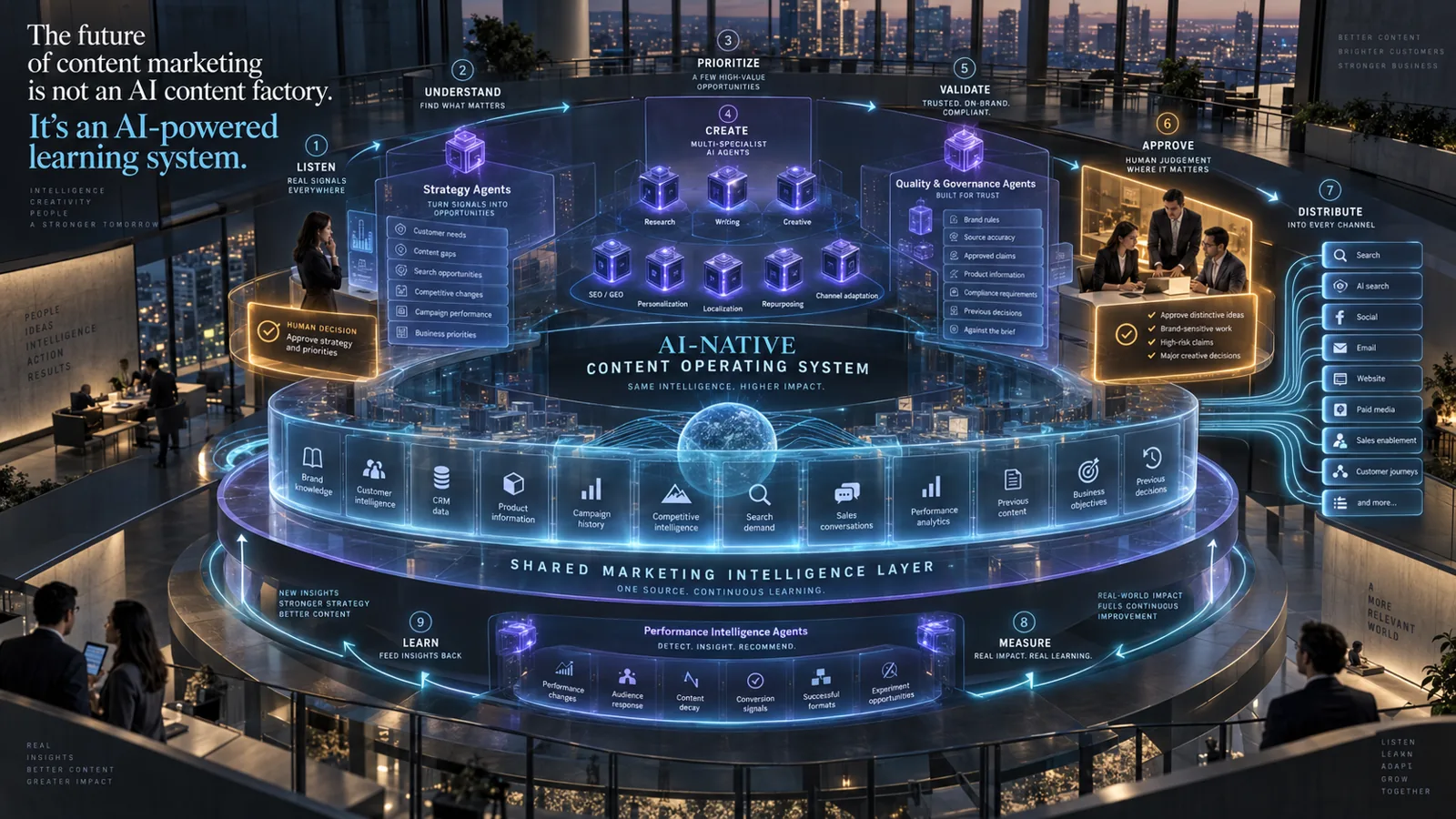
Listen↓Understand↓Prioritize↓Create↓Validate↓Approve↓Distribute↓Measure↓Learn↓Update Shared Intelligence↓Decide What to Do Next
The final step is critical.
The system learns.
Every campaign should create intelligence that improves the next campaign.
Every content interaction should potentially improve customer understanding.
Every approved asset should strengthen organizational memory.
Every failed experiment should influence future decisions.
Without this loop, AI simply helps companies produce more isolated content.
What an AI-Native Content Operating System Could Look Like
Instead of putting one AI writing tool in front of every marketer, imagine content operating through several connected layers.
1. Shared Intelligence Layer
This contains the context required to make good marketing decisions:
brand knowledge;
customer research;
CRM insights;
product information;
campaign history;
performance data;
market intelligence;
competitive intelligence;
approved claims;
previous decisions;
content history;
business objectives.
This gives AI something more valuable than a blank prompt.
It gives it organizational context.
2. Strategy and Prioritization Agents
Before content is created, specialized AI agents could continuously analyze:
customer questions;
search demand;
sales conversations;
competitive changes;
campaign performance;
content gaps;
social conversations;
CRM signals;
and business priorities.
Instead of marketers brainstorming endlessly about what to publish, AI can surface evidence-backed opportunities.
Humans still decide what matters.
But they make the decision with richer intelligence.
3. Specialized Production Agents
Once strategy is approved, specialized agents can handle:
research;
content development;
SEO/GEO optimization;
creative adaptation;
personalization;
localization;
repurposing;
and channel formatting.
Not one giant content chatbot.
A coordinated system of specialized capabilities.
4. Quality and Governance Agents
Before work reaches human reviewers, AI can check:
brand consistency;
accuracy;
approved terminology;
source quality;
brief adherence;
duplicate content;
claims;
compliance rules;
SEO/GEO requirements;
and previous decisions.
This reduces the amount of low-value checking humans need to perform.
5. Human Decision Gates
High-value decisions remain human.
Is this strategically right?
Is the idea distinctive enough?
Does it represent our point of view?
Should we publish this claim?
Does this creative feel right?
Is the potential reputational risk acceptable?
AI should reduce what leadership must review.
Not eliminate leadership.
6. Distribution Orchestration
Once approved, content can move intelligently into:
search;
social;
email;
paid media;
sales enablement;
customer success;
web experiences;
AI-search optimization;
and other relevant channels.
The system should know what belongs where.
7. Performance and Learning Agents
After publishing, AI can continuously evaluate performance.
Not merely report metrics.
Interpret them.
Identify patterns.
Compare audiences.
Detect anomalies.
Recommend experiments.
Surface underperforming assets.
Identify content worth repurposing.
Feed learnings back into the intelligence layer.
At that point, content marketing stops being a collection of disconnected production tasks.
It becomes a learning system.
The Role of the Content Marketer Changes
If AI handles more production, does that make content marketers less valuable?
Not necessarily.
But their highest-value work changes.
The traditional content marketer may have spent significant time:
researching;
drafting;
editing;
formatting;
repurposing;
uploading;
and reporting.
The AI-native content strategist increasingly becomes responsible for:
choosing problems worth addressing;
extracting proprietary organizational knowledge;
developing differentiated points of view;
understanding customers;
building editorial strategy;
setting quality standards;
designing content systems;
evaluating AI output;
making trade-offs;
and connecting content to business outcomes.
The role moves upward.
From content producer to content decision maker and system designer.
This pattern will likely occur across many knowledge-work roles.
As execution becomes cheaper, judgment becomes more valuable.
Content Teams Need Different Metrics
If volume becomes abundant, content KPIs should evolve.
Instead of only tracking:
How much did we publish?
Track:
Content Cycle Time
How long does an idea take to move from opportunity to publication?
Time Waiting for Approval
How much of that cycle is actual work versus waiting?
Launch-Ready Rate
What percentage of AI-generated assets meet quality standards without substantial human rework?
Content Utilization
How much created content actually gets distributed and used?
Content Reuse Rate
How effectively is high-value intellectual property adapted across formats and channels?
Content-to-Outcome Rate
What percentage of content contributes to meaningful engagement, pipeline, conversion, retention or other strategic objectives?
Decision Time
How quickly can marketers determine what deserves to be produced, improved or stopped?
Learning Velocity
How quickly do performance insights influence the next campaign?
These metrics reveal bottlenecks far more effectively than counting words.
The Content Bottleneck Will Keep Moving
There is a broader lesson here.
Every time technology removes one constraint, another becomes more visible.
When websites were difficult to build, publishing infrastructure was the constraint.
CMS platforms reduced it.
Then content production became the constraint.
Agencies, freelancers and larger teams expanded production.
Generative AI dramatically reduced that constraint.
Now strategy, context, governance, distribution and decision-making are becoming more important.
Agentic AI may reduce some of those constraints next.
AI agents could coordinate approvals.
Automate quality assurance.
Manage distribution.
Monitor performance.
Retrieve organizational context.
Identify content opportunities.
Then another bottleneck will appear.
Perhaps the ultimate constraint will be something technology cannot manufacture easily:
original thinking.
The Future Competitive Advantage Is Not Content Volume
There is going to be an extraordinary amount of content.
More articles.
More videos.
More advertising.
More personalized messaging.
More synthetic media.
More automated campaigns.
More content created specifically for AI search.
More variations for increasingly narrow audiences.
Competing by volume will therefore become extremely difficult.
The companies that win will be the ones with better:
customer understanding;
proprietary intelligence;
ideas;
distribution;
brand;
judgment;
systems;
and learning loops.
AI can amplify all of those.
But it cannot substitute for a company having something valuable to amplify.
Frequently asked questions
What is a content bottleneck?
A content bottleneck is a stage of the content lifecycle where work accumulates because the organization cannot process that stage as quickly as other parts of the workflow. Bottlenecks can occur in strategy, production, review, approvals, governance, distribution or measurement.
Is content creation still the biggest marketing bottleneck?
Increasingly, no. Generative AI has dramatically increased content-production capacity. For many organizations, the larger constraints are now strategy, differentiation, quality control, approvals, distribution, governance and measurement.
How has AI changed content marketing?
AI has made research, drafting, repurposing, personalization and creative production significantly faster. This increases content supply while shifting competitive advantage toward proprietary knowledge, brand differentiation, governance, distribution and decision-making.
Why doesn't creating more content automatically improve marketing results?
More content only creates value if it reaches the right audience, communicates something useful or distinctive and contributes to a desired business outcome. Increasing volume without improving strategy, distribution or quality can simply create more noise.
What is an AI-native content workflow?
An AI-native content workflow connects shared organizational intelligence, strategy, specialized AI agents, content production, quality assurance, human approvals, distribution and performance analysis into a continuous learning system.
Can AI solve content approval bottlenecks?
AI can reduce approval workload by performing preliminary quality, brand, factual and compliance checks, consolidating feedback and routing only consequential decisions to humans. High-risk strategic and reputational decisions should still receive appropriate human oversight.
What should marketers focus on when AI can generate unlimited content?
Marketers should focus increasingly on customer intelligence, original insight, strategic prioritization, brand differentiation, quality, distribution, experimentation and learning rather than maximizing raw content volume.