AI Marketing Agents vs Marketing Automation: What's Actually Different in 2026?
So when the technology industry says that AI agents will transform marketing, a reasonable question follows:
Marketing has been automated for a long time.
Email sequences trigger when someone fills out a form.
Leads move between lifecycle stages.
Advertisements pause when budgets hit limits.
Sales teams receive notifications when prospects reach a certain score.
Customers receive abandoned-cart reminders.
None of this required AI agents.
So when the technology industry says that AI agents will transform marketing, a reasonable question follows:
What is actually new?
If an AI system sends an email automatically, is that an agent?
If software analyzes campaign performance and changes a bid, is that agentic AI?
If ChatGPT writes a copy that is inserted into an automated workflow, is that an AI agent?
Usually, no.
The fundamental difference is not whether software performs work automatically.
The difference is how the system determines what work to perform next.
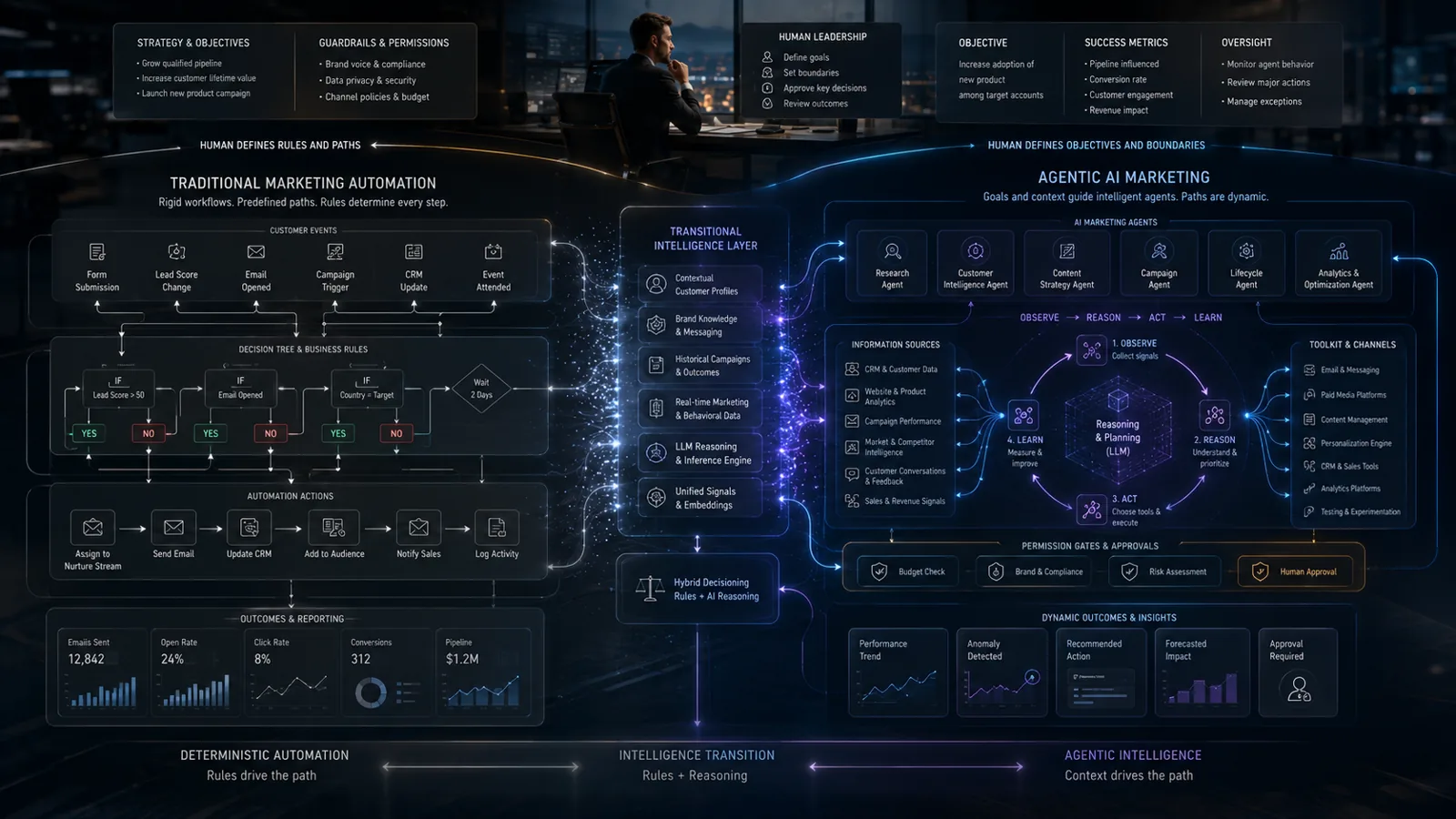
Traditional marketing automation primarily follows predefined rules and workflows.
AI agents can potentially interpret objectives, reason about changing circumstances, select tools, decide between possible actions, inspect outcomes and adapt their approach within defined boundaries.
Anthropic makes a similar architectural distinction: workflows follow predefined code paths, whereas agents dynamically direct their own processes and tool usage.
That distinction may sound technical.
For marketing leaders, it is strategic.
Because agentic AI does not simply introduce another marketing tool.
It introduces a different way to design marketing work.
What Is Marketing Automation?
Marketing automation is the use of software to execute predefined marketing actions, rules and workflows automatically based on configured conditions, schedules or triggers.
For example:
IF a visitor downloads an ebookTHEN add the visitor to a nurture sequence.
IF the lead opens three emailsTHEN increase the lead score.
IF the lead reaches 80 pointsTHEN notify sales.
The system is automated.
But the logic was largely determined in advance by a human.
Traditional automation is especially effective when:
- the workflow is predictable
- inputs are structured
- rules are known
- outcomes need consistency
- exceptions are limited
- compliance requires deterministic behavior
This is why marketing automation remains extremely valuable.
Predictability is not a weakness.
For many processes, it is exactly what companies want.
What Is an AI Marketing Agent?
An AI marketing agent is an AI-powered system that can pursue a marketing objective by reasoning about context, selecting tools or actions, performing multi-step tasks and adapting its process based on what happens during execution.
Instead of being given every step, the agent may receive an objective.
For example:
Identify why qualified pipeline from organic search has declined and recommend the highest-priority actions.
The agent could potentially:
- 1inspect analytics
- 2compare traffic sources
- 3review search visibility
- 4identify pages losing performance
- 5inspect competitor changes
- 6analyze conversion rates
- 7determine likely causes
- 8prioritize interventions
- 9draft recommendations
- 10escalate decisions requiring human approval
The important difference is that the entire sequence did not necessarily have to be explicitly programmed in advance.
Google Cloud describes agentic workflows as dynamic AI-driven processes in which agents use reasoning, planning and external tools to perform complex tasks, contrasting them with traditional scripts that follow fixed paths.
OpenAI similarly describes agents as systems capable of independently accomplishing tasks using models, tools and orchestration, with production infrastructure including handoffs, guardrails and tracing.
The shift is from:
“Follow these steps.”
toward:
“Achieve this objective within these constraints.”
That is the architectural leap.
AI Agents vs Marketing Automation: The Core Differences
The difference becomes clearer through practical examples.
Example 1: Email Nurturing
Traditional Automation
A prospect downloads a whitepaper.
The system:
- 1waits one day
- 2sends email A
- 3waits three days
- 4checks whether email A was opened
- 5sends email B
- 6changes lead score
- 7alerts sales if the score crosses a threshold
This is an automated workflow.
Agentic Version
An AI lifecycle agent receives the objective:
Move this qualified prospect toward a product conversation without over-communicating.
The agent may evaluate:
- which content the prospect consumed
- company size
- industry
- prior email engagement
- website activity
- CRM history
- relevant product features
- other active campaigns
It could then choose whether to:
- send an educational email
- delay communication
- recommend a case study
- personalize a message
- notify sales
- take no action yet
The workflow changes according to context.
That is more agentic.
Example 2: Campaign Performance
Traditional Automation
A campaign has a predefined rule:
If cost per acquisition exceeds ₹5,000 for three days, pause the campaign.
Clear.
Predictable.
Useful.
Agentic System
An AI performance agent notices CPA has increased.
Instead of immediately pausing the campaign, it investigates.
It might discover:
- conversions dropped
- traffic quality remained stable
- the checkout page became slower
- one audience still performs well
- another audience deteriorated
- the campaign contributes disproportionately to high-value customers
The agent could recommend reducing spend on one segment while preserving another.
Same marketing problem.
Different operating logic.
Why AI-Powered Automation Is Not Automatically Agentic
This is where terminology gets messy.
Many systems now incorporate AI into automation.
For example:
A marketing platform may use machine learning to predict the best send time.
An LLM may create personalized subject lines inside a predefined email sequence.
AI may classify leads before a deterministic routing rule executes.
These are valuable AI capabilities.
But they do not necessarily make the entire workflow an AI agent.
A useful spectrum is:
Level 1 — Manual Workflow
Humans perform each action.
Level 2 — Rule-Based Automation
Software executes predefined steps.
Level 3 — AI-Enhanced Automation
AI improves individual steps inside a predefined workflow.
Level 4 — Agentic Workflow
AI has flexibility over parts of the process and can dynamically select actions.
Level 5 — Autonomous Agent System
Agents coordinate extended workflows with broader decision authority, tools and escalation rules.
The industry is gradually moving upward through these levels.
But organizations should not assume Level 5 is always better.
Agents Are Not Automatically Better Than Automation
One of the biggest mistakes companies can make is turning every workflow into an agent.
Anthropic explicitly recommends using the simplest architecture that successfully handles the task, noting that agentic systems can trade additional cost and latency for flexibility and better performance on tasks that require model-driven decision-making.
Consider a newsletter subscription.
A user clicks:
Unsubscribe.
Should an intelligent agent investigate the customer's history, reason about retention and decide whether unsubscribing is strategically optimal?
No.
The software should unsubscribe them.
Immediately.
Deterministically.
Many workflows are better as rules.
Use Traditional Automation When:
- the steps are known
- reliability is essential
- the process is repetitive
- inputs are structured
- there is little ambiguity
- compliance demands consistent behavior
Consider Agents When:
- conditions change frequently
- large amounts of unstructured information must be interpreted
- the correct next action cannot easily be predetermined
- multiple tools may need to be used
- research or reasoning is required
- exceptions are common
- the workflow involves multiple possible paths
The goal is not maximum autonomy.
It is appropriate autonomy.
What Makes Marketing Agents Powerful?
Several capabilities separate modern agents from conventional automation.
1. Reasoning
The agent can evaluate context rather than simply match a condition.
2. Tool Use
Agents can interact with external systems.
OpenAI's agent tooling, for example, supports capabilities such as web search, file search and computer interaction alongside orchestration and tracing.
In a marketing environment, tools might include:
- CRM
- analytics
- advertising platforms
- CMS
- research tools
- project management systems
- email systems
- customer databases
3. Multi-Step Execution
An agent can potentially continue working until it reaches a result rather than returning after one model response.
4. Adaptation
The agent can inspect what happened and adjust its next action.
Anthropic describes trustworthy agents as operating through a loop in which the system plans, acts, observes results and adjusts until the task is complete or human input is needed.
5. Memory and Context
Agentic systems can incorporate relevant context across a workflow rather than treating every action independently.
6. Collaboration
Multiple specialized agents may cooperate.
For example:
Research Agent
↓
Strategy Agent
↓
Content Agent
↓
Review Agent
↓
Distribution Workflow
↓
Performance Agent
This begins to look less like traditional marketing software and more like an operating team.
Where AI Agents Fit Into the AI CMO
This distinction is especially important when thinking about an AI CMO.
An AI CMO should not replace traditional automation.
It should orchestrate intelligence and decision-making above it.
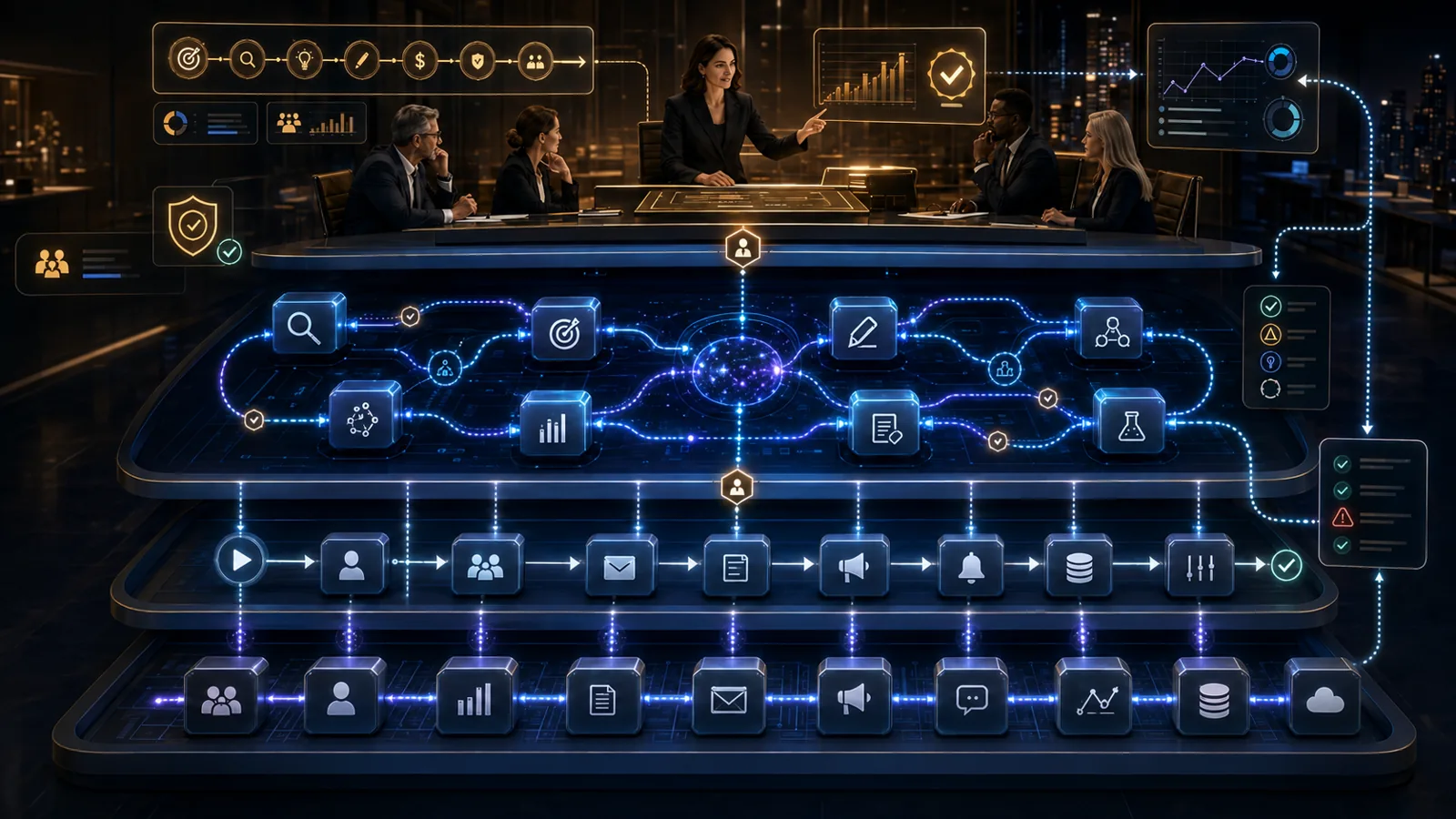
A useful architecture looks like:
Human Leadership Layer
Defines:
- strategy
- objectives
- budgets
- brand direction
- permissions
↓
AI CMO Intelligence Layer
Understands:
- brand
- customers
- products
- market
- campaign history
- business context
↓
Marketing Agents
Reason across:
- research
- content
- campaigns
- lifecycle
- SEO/GEO
- analytics
- experimentation
↓
Automation Layer
Reliably executes:
- emails
- triggers
- CRM updates
- scheduled publishing
- notifications
- data synchronization
↓
Marketing Systems
CRM, CMS, analytics, ad platforms, CDP and other MarTech infrastructure.
The key idea is simple:
Agents decide dynamically where reasoning is needed. Automation executes predictably where rules are sufficient.
They are complementary.
The Future Is Hybrid: Agents + Automation + Humans
The future marketing organization is unlikely to choose between traditional automation and AI agents.
It will combine them.
Consider a future campaign workflow.
Human:
Defines the objective:
Generate qualified demand for our new enterprise product among financial-services companies.
Research Agent:
Analyzes:
- customer conversations
- competitor positioning
- market changes
- search demand
- existing campaign data
Strategy Agent:
Develops several campaign approaches.
Human:
Selects the positioning and budget.
Content Agent:
Creates channel-specific briefs and assets.
Review System:
Checks:
- factual accuracy
- brand alignment
- compliance requirements
Human:
Approves high-impact creative.
Traditional Automation:
Schedules approved emails, publishes assets and synchronizes CRM records.
Performance Agent:
Continuously monitors results.
Agent:
Finds an unexpected performance anomaly and investigates.
Human:
Receives:
- what changed
- likely reason
- business impact
- recommended action
This workflow uses all three operating modes.
Human judgment.
Agentic reasoning.
Deterministic automation.
That combination is much more powerful than attempting to replace everything with agents.
Agents Change the Role of the Marketer
Traditional marketing automation changed how marketers execute processes.
AI agents could change what marketers themselves manage.
Microsoft's 2026 Work Trend research describes a progression in human-AI work from author, to editor, to director, and eventually orchestrator, where people design systems in which multiple agents handle execution and escalate exceptions.
Marketing maps naturally onto that evolution.
Marketer as Author
The marketer creates everything manually.
Marketer as Editor
AI creates drafts.
The marketer reviews them.
Marketer as Director
The marketer specifies an objective.
An AI agent executes a larger assignment.
Marketer as Orchestrator
The marketer oversees a network of agents and workflows.
This does not make humans less important.
It moves their value upward.
Less time performing repetitive coordination.
More time defining:
- objectives
- quality
- brand direction
- priorities
- constraints
- trade-offs
The Hidden Challenge: Agents Are Harder to Govern
Traditional automation can be complicated.
But at least the workflow is generally inspectable.
If:
A happens → B happens → C happens.
Agents are less deterministic.
That flexibility is what makes them useful.
It is also what makes governance more important.
Organizations need to answer:
- What systems may the agent access?
- What customer data may it see?
- What actions may it perform?
- How much money may it spend?
- What can it publish?
- What requires approval?
- How are failures detected?
- How can an action be reversed?
- How is agent behavior evaluated?
OpenAI's production agent tooling includes guardrails and tracing specifically because developers need visibility into agent execution, while Anthropic notes that agents are more challenging to evaluate precisely because they operate across multiple turns, call tools, modify state and adapt based on intermediate outcomes.
Marketing organizations therefore need something they did not require to the same degree with simple AI content generation:
AI operations governance.
A Practical Decision Framework
Before converting a marketing workflow into an agentic system, ask five questions.
1. Can the workflow be fully defined in advance?
Yes: automation may be better.
No: continue evaluating an agent.
2. Does the task require interpretation?
If the system needs to understand customer language, research, creative information or ambiguous business context, agents become more useful.
3. Are there multiple valid actions?
Agents add value when deciding between actions is part of the task.
4. What happens if the AI is wrong?
The higher the consequence, the stronger the approval layer should be.
5. Does autonomy create measurable value?
If a rule-based workflow solves the problem perfectly, introducing an agent may add complexity without meaningful business benefit.
That final question is critical.
Do not deploy agents because agentic AI is fashionable.
Deploy them because flexible reasoning improves the workflow.
Will AI Agents Replace Marketing Automation Platforms?
Probably not in the simple sense.
A more likely outcome is that the boundary between the two gradually changes.
Traditional automation engines remain excellent at reliable execution.
Agents increasingly become the intelligence layer deciding:
- which workflow should run
- what information should populate it
- whether conditions require an exception
- what should happen next
- when humans should intervene
That means existing MarTech can increasingly become execution infrastructure beneath an AI intelligence layer.
Microsoft's own marketing organization provides an early example of the direction: its Azure AI marketing team has been developing agent-based tools through Microsoft Foundry to automate workflows and augment marketers rather than simply replacing its underlying marketing systems.
The transition therefore may not be:
marketing automation → disappears → agents replace everything
It may be:
marketing automation
↓
AI-enhanced automation
↓
agent-supervised workflows
↓
AI marketing operating systems combining agents and deterministic systems
That is a much more realistic evolution.
Conclusion
AI marketing agents and marketing automation share one important characteristic:
Both can perform work without a human manually executing every step.
But beneath that similarity is a fundamental difference.
Marketing automation follows predetermined logic.
AI agents can reason about objectives, dynamically select actions, use tools and adapt as a workflow unfolds.
That makes agents better suited to ambiguity, research, complex decision-making and changing environments.
It does not make them better for everything.
Some marketing processes should remain deterministic.
Some should be AI-enhanced.
Some should become agentic.
And some should always require human judgment.
The most advanced marketing organizations will therefore not ask:
“Should we replace automation with AI agents?”
They will ask:
“Which parts of marketing require rules, which require reasoning, and which require human judgment?”
That architectural distinction is the foundation of agentic marketing.
It is also one of the core principles behind the AI CMO.
FAQs
1. What is the difference between AI marketing agents and marketing automation?
Marketing automation generally executes predefined rules and workflows. AI marketing agents can interpret objectives, reason about context, select tools and dynamically adjust their actions as a task progresses.
2. Is an AI workflow the same as an AI agent?
Not necessarily. A workflow may include AI while still following predetermined steps. Anthropic distinguishes workflows with predefined execution paths from agents that dynamically control their own process and tool use.
3. Are AI agents replacing marketing automation?
Not entirely. Agents and automation are complementary. Agents can handle reasoning and dynamic decisions, while traditional automation remains valuable for predictable, repeatable execution.
4. What are examples of AI marketing agents?
Potential examples include research agents, customer-intelligence agents, campaign agents, content-strategy agents, SEO/GEO agents, lifecycle agents, analytics agents and experimentation agents.
5. When should marketers use AI agents instead of automation?
Agents are most useful when tasks involve ambiguity, multiple possible actions, changing conditions, unstructured information, tool use or reasoning that cannot easily be represented through fixed rules.
6. Is ChatGPT an AI marketing agent?
A basic ChatGPT conversation is better understood as an AI assistant interaction. It becomes part of an agentic system when the model is connected to tools, objectives, workflows, memory and the ability to perform multi-step actions.
7. What is agentic marketing?
Agentic marketing is an operating model in which AI agents can perform and coordinate multi-step marketing tasks toward defined objectives while operating within permissions, governance rules and human oversight.
8. Do AI agents need human approval?
The appropriate level depends on risk. Low-risk analytical tasks may run autonomously, while actions involving public publishing, significant advertising spend, sensitive customer communication or strategic decisions should typically include stronger human controls.