By 2027, the Best Marketing Teams Won’t Be Larger. They’ll Be More Agentic.
For most of the last twenty years, growing marketing capability meant growing the marketing organization.
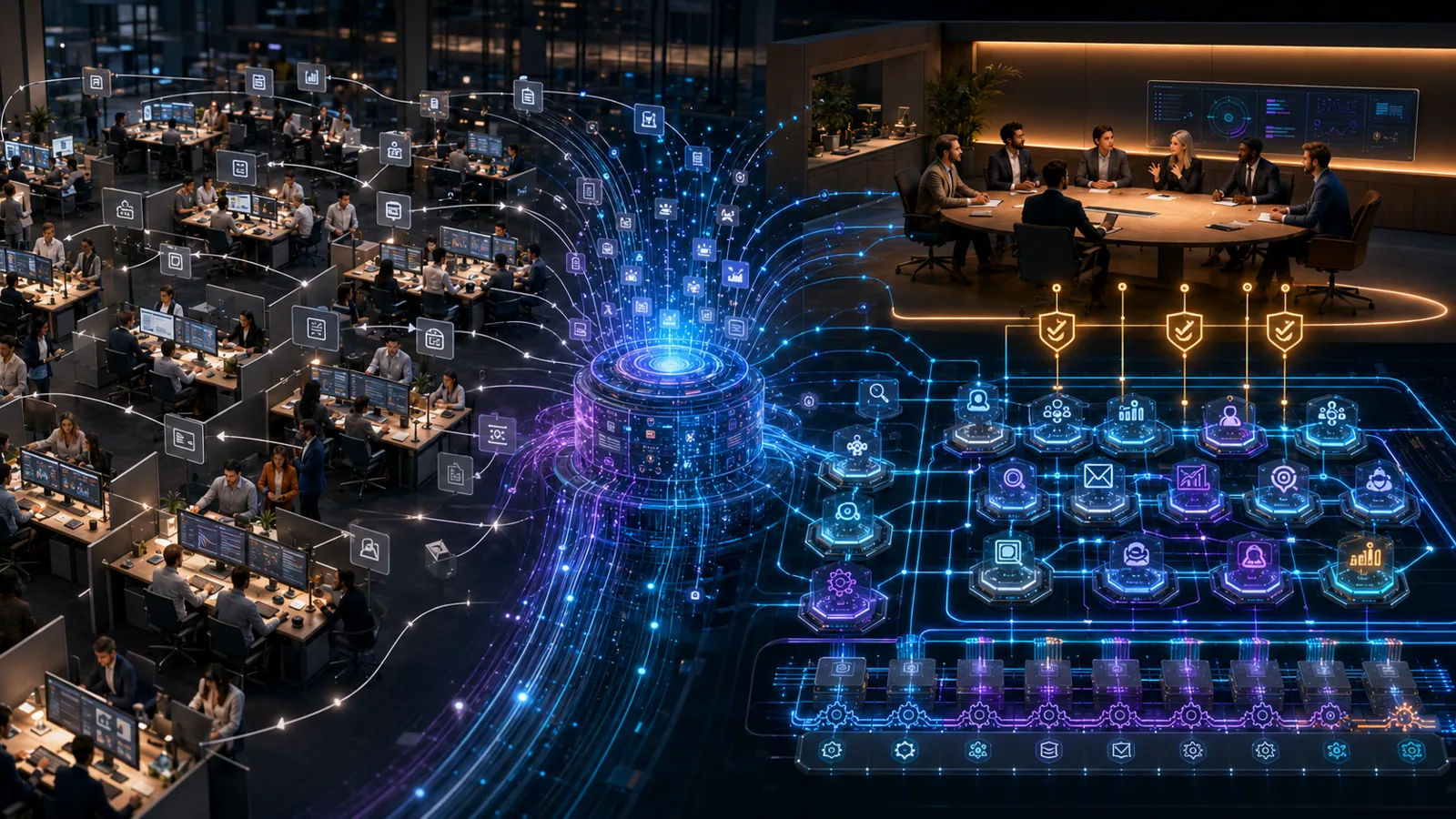
For most of the last twenty years, growing marketing capability meant growing the marketing organization.
More channels meant more specialists.
More content meant more writers.
More campaigns meant more campaign managers.
More customer data meant more analysts.
More technology meant more marketing operations.
Capability expanded roughly alongside headcount.
AI agents challenge that assumption.
Not because companies will suddenly operate marketing departments without humans.
And not because ten digital workers will simply replace ten employees.
The more interesting possibility is that the unit of marketing capacity changes.
Instead of asking:
How many people are on the marketing team?
organizations may increasingly ask:
How much intelligent work can this team orchestrate?
That is the idea behind an agentic marketing team.
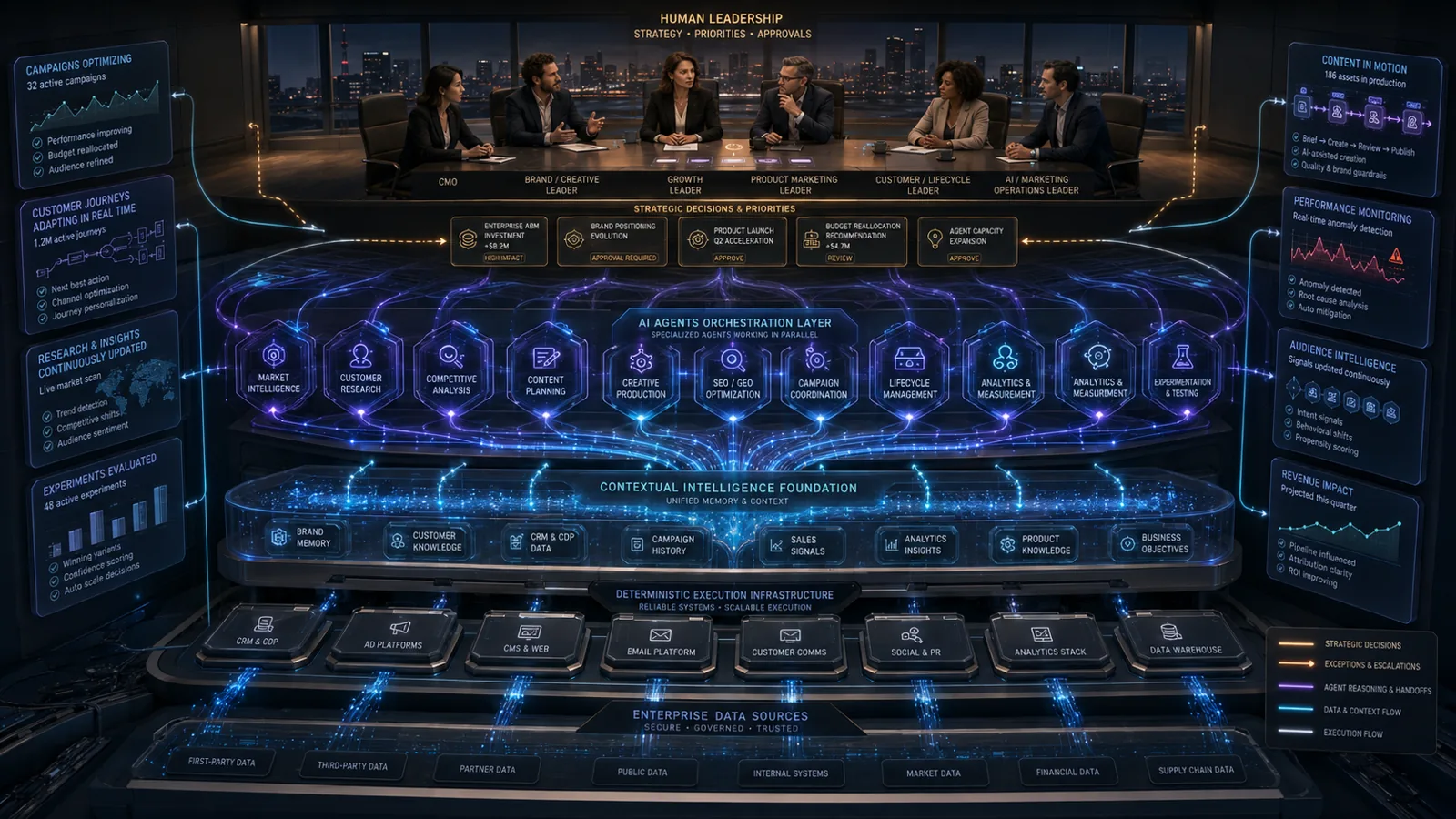
An agentic marketing team combines human marketers with AI agents, automation, shared organizational context and workflow orchestration so a relatively small human team can manage substantially more execution than it could through human labor alone.
By 2027, the strongest marketing organization may therefore not be the one with the largest headcount.
It may be the one with the highest human-to-agent leverage.
That prediction is not based solely on theoretical AI capabilities.
The organizational shift is already beginning.
Microsoft's 2026 Work Trend Index argues that as agents take on more execution, people gain more room to direct work and own outcomes—but organizations must redesign work itself rather than merely deploy new tools.
McKinsey makes an even more direct argument for marketing: it describes emerging hybrid human-agentic workforces in which people design and oversee networks of AI agents that perform significant portions of execution.
The question is no longer whether marketers will use AI.
The question is what happens to the structure of the marketing team once AI begins doing persistent work.
What Is an Agentic Marketing Team?
An agentic marketing team is a hybrid marketing organization in which humans define objectives, strategy and judgment while specialized AI agents independently perform or coordinate portions of research, execution, monitoring and optimization within defined boundaries.
That is different from a traditional team using ChatGPT.
Consider the difference.
AI-Assisted Team
A marketer:
- 1identifies a task
- 2opens an AI tool
- 3writes a prompt
- 4reviews the response
- 5moves the output somewhere else
- 6performs the next task
- 7prompts again
The human remains the primary workflow engine.
Agentic Team
A marketer defines an outcome.
Agents can then:
- gather relevant context
- perform research
- call tools
- coordinate with other agents
- prepare work
- monitor results
- escalate exceptions
The human increasingly manages the system of work rather than every task inside it.
That distinction changes how teams scale.
Marketing Has Traditionally Scaled Through Specialization
Modern marketing departments became large partly because digital marketing fragmented the function.
A mature organization might have people responsible for:
- brand
- communications
- social media
- paid media
- SEO
- content
- product marketing
- lifecycle
- CRM
- analytics
- marketing operations
- growth
- design
- video
- events
- partnerships
- experimentation
Specialization improved expertise.
But it also increased coordination.
Every additional specialist creates another potential:
- meeting
- handoff
- approval
- dependency
- communication loop
This becomes particularly expensive when the work spans functions.
A product launch might require:
strategy → research → product marketing → content → design → paid media → lifecycle → CRM → analytics.
Each specialist may perform their job well.
But the campaign still has to move through the organization.
Agentic AI could change the economics of that coordination layer.
Why Agentic Teams Can Scale Differently
AI agents introduce a form of capacity that behaves differently from human headcount.
A person works limited hours.
An agent can monitor a defined system continuously.
A person may research one market at a time.
Agents may conduct several bounded research tasks in parallel.
A person may need to manually rebuild context before each project.
An agent can potentially access shared organizational context.
A person needs to repeatedly inspect dashboards.
An analytics agent can watch metrics continuously and escalate meaningful changes.
This does not make an agent equivalent to an employee.
Humans have capabilities AI does not replicate cleanly:
- accountability
- social intelligence
- judgment
- taste
- lived experience
- leadership
- political awareness
- empathy
But AI has different strengths.
The organizational opportunity comes from combining the two.
Microsoft describes the broader shift as an environment where agents increasingly take on execution while humans direct work and retain judgment around consequential outcomes.
That produces a different scaling equation.
Traditional model:
More work → more people.
Agentic model:
More work → more automation + agent capacity + selective human expansion.
Headcount stops being the only mechanism for increasing marketing throughput.
The 2027 Marketing Team Could Look Smaller From the Outside
Consider two hypothetical organizations.
Both need to support:
- multiple products
- three geographic markets
- paid campaigns
- lifecycle marketing
- SEO
- social
- content
- research
- analytics
Company A: Traditional Scale
The team grows by hiring additional specialists.
Its structure might include:
- 1 CMO
- 3 directors
- 8 managers
- 15 specialists
- multiple external agencies
Marketing capability increases.
But so does managerial overhead.
Company B: Agentic Scale
The human team might include:
- CMO
- growth leader
- brand/creative leader
- product marketer
- lifecycle/customer leader
- marketing systems leader
Underneath them sits a persistent layer of agents for:
- research
- customer intelligence
- competitive intelligence
- content
- SEO/GEO
- campaigns
- lifecycle execution
- analytics
- experimentation
The second organization may appear smaller on an org chart.
But its effective operating capacity could be much larger than its human headcount suggests.
That is the important shift.
Smaller Does Not Mean Understaffed
This prediction can easily be misunderstood.
The argument is not:
Cut the marketing department because AI is cheaper.
A starved team plus a collection of AI subscriptions is not an agentic organization.
Agentic teams require stronger foundations:
- clean data
- shared context
- clear objectives
- reliable integrations
- well-designed workflows
- explicit permissions
- evaluation
- human oversight
McKinsey notes that realizing value from agentic marketing requires workflow redesign and technical foundations such as unified data, identity and reliable systems through which agents can act.
A small team without these foundations could easily perform worse than a larger traditional organization.
The objective is not minimal headcount.
It is maximum leverage per human.
The New Shape of Marketing Work
As AI absorbs more execution, the human distribution of work changes.
McKinsey's June 2026 research on marketing organization design says some marketing organizations may become smaller, while roles shift away from purely executional work toward orchestration, judgment, integration and AI management.
That is probably a better prediction than “AI will replace marketers.”
Roles will be recomposed.
Consider a campaign manager.
Today, that person may spend time:
- chasing assets
- checking timelines
- updating project management
- transferring information
- pulling reports
- coordinating teams
In an agentic system, more of that work can happen underneath the person.
The campaign manager's role moves upward toward:
- objective definition
- prioritization
- creative review
- exception handling
- decision-making
The job becomes less about manually moving work through the system.
It becomes more about directing intelligence and capacity.
Five Human Roles Become More Important
An agentic marketing organization increases the value of certain human capabilities.
1. Strategist
Someone still has to determine:
- where to compete
- who to prioritize
- what to stand for
- what outcomes matter
Agents can support strategy.
Humans remain accountable for it.
2. Creative Director
AI can produce extraordinary amounts of creative variation.
That makes taste more important.
Someone needs to decide:
What is distinctive?
What feels like us?
What should never be published?
3. Orchestrator
The marketer increasingly designs:
- agent responsibilities
- workflow structure
- approval rules
- escalation
- context
This becomes a new managerial discipline.
4. Integrator
AI insights need to connect across:
- product
- sales
- customer success
- finance
- leadership
Human organizational intelligence still matters.
5. Decision Owner
Someone needs to remain accountable when:
- budgets change
- campaigns fail
- customers are affected
- strategic bets are made
AI can recommend.
Responsibility cannot become ambiguous.
Executional Roles Will Change the Most
This is where the transition will create tension.
Many marketing jobs currently contain large amounts of:
- drafting
- research
- summarization
- reporting
- formatting
- basic analysis
- campaign setup
- project coordination
These tasks are increasingly susceptible to AI assistance and agentic execution.
That does not mean every person doing them disappears.
But the proportion of their role devoted to direct production may decline.
A content marketer may manage:
- one persistent research agent
- one content-production workflow
- one distribution system
instead of manually producing each item.
An analyst may spend less time constructing dashboards and more time validating AI-generated interpretations.
A marketing operations specialist may become responsible for agent governance and workflow infrastructure.
The team does not simply shrink.
It changes shape.
The Best Teams Will Organize Around Outcomes, Not Channels
Traditional marketing departments often mirror channels.
SEO team.
Email team.
Social team.
Paid media team.
Events team.
But customers do not experience organizations as channels.
They experience journeys.
Agentic systems make it easier to build around outcomes.
For example:
Outcome: Enterprise Pipeline
Human owner:
Growth leader.
Agents:
- market intelligence
- account research
- content
- campaign
- performance
Systems:
CRM, ads, CMS, analytics.
Outcome: Customer Retention
Human owner:
Lifecycle leader.
Agents:
- customer intelligence
- lifecycle
- content
- analytics
Systems:
CRM, support, product data, email.
This organizational model is more fluid.
McKinsey's broader work on the “agentic organization” similarly anticipates movement toward flatter, outcome-aligned teams built around AI-first workflows rather than rigid functional silos.
That is a major change.
Marketing may increasingly organize around objectives supported by reusable agents, rather than permanent teams built around every individual channel.
The Manager-to-Agent Ratio Becomes a New Design Question
Today companies think about manager-to-employee ratios.
Agentic organizations may introduce another metric:
human-to-agent leverage.
Imagine one marketer overseeing:
- a research agent
- a content agent
- a campaign agent
- an analytics agent
That does not mean the marketer actively manages four chat windows.
A mature system should hide most of that complexity.
The human might define:
Increase awareness among enterprise finance leaders this quarter without weakening our premium positioning.
The system coordinates the relevant agent capabilities.
The marketer receives:
- plans
- recommendations
- exceptions
- decisions
This is where the AI CMO becomes useful.
The AI CMO acts as the orchestration layer between human strategic intent and a network of specialized capabilities.
More Agents Can Also Create More Complexity
There is a trap here.
Organizations could simply recreate bureaucracy digitally.
Instead of:
ten employees needing coordination,
they create:
twenty agents needing coordination.
That is not progress.
An agentic marketing team only creates leverage if:
- agents share context
- responsibilities are clear
- handoffs are automatic
- workflows are observable
- humans do not micromanage every step
The system should reduce coordination overhead.
Otherwise, agents become another software layer employees must manage.
The Strongest Teams Will Have Shared Organizational Memory
A major advantage of agentic systems comes from shared context.
Today, marketing knowledge often sits inside people's heads.
One strategist knows why a campaign failed.
One salesperson understands an objection.
One analyst remembers how a metric changed.
One founder knows the product's real story.
When employees leave or teams change, context disappears.
An AI-native marketing organization can create a more persistent intelligence layer containing:
- brand positioning
- campaign history
- customer insights
- previous experiments
- approved claims
- performance patterns
- product information
- strategic decisions
That memory can support every agent.
This turns organizational knowledge into infrastructure.
The consequence could be significant.
A smaller team with stronger shared memory may outperform a larger team that continuously loses and reconstructs context.
Agentic Teams Are Not Fully Autonomous Teams
It is important not to confuse agentic with humanless.
The strongest architecture is likely to combine:
humans above the loop
for strategy and governance,
humans in the loop
for important decisions,
and:
humans outside the loop
for low-risk processes that no longer require manual involvement.
Consider:
Research Monitoring
AI can operate autonomously.
Routine CRM Updates
Automation can operate autonomously.
Campaign Budget Reallocation
AI can recommend or act within predefined limits.
New Brand Positioning
Humans should lead.
Crisis Communication
Humans should retain strong control.
This is not technological conservatism.
It is good system design.
The Best Marketer May Become the Person With the Best Team of Agents
AI changes the definition of individual performance.
Historically, a strong marketer might be exceptional at:
- writing
- analysis
- research
- campaign execution
In an agentic environment, another skill becomes increasingly important:
delegation to machines.
Can you define a good objective?
Can you provide sufficient context?
Can you distinguish between a task and an outcome?
Can you evaluate agent output?
Can you design approval boundaries?
Can you build reusable workflows?
A marketer with these capabilities may supervise dramatically more execution than someone relying entirely on personal production.
The question becomes less:
How fast can you do the task?
and more:
How well can you design a system that repeatedly accomplishes the task?
That is managerial leverage applied to AI.
What Should Marketing Leaders Do Before 2027?
Do not begin by reducing headcount.
Begin by understanding work.
1. Map the Marketing Work
Identify:
- recurring tasks
- workflows
- handoffs
- decisions
- information requirements
2. Separate Four Categories
Human-owned
Strategy, judgment, relationships.
Agentic
Reasoning-heavy, dynamic work.
Automated
Predictable execution.
Eliminate
Work that no longer needs to exist.
3. Build Shared Context
Agents need consistent access to brand, customer and business intelligence.
4. Introduce Agents Into Complete Workflows
Do not optimize random tasks.
Redesign outcomes.
Microsoft's 2026 research emphasizes exactly this: organizations need to rearchitect work because AI value depends more on how humans and agents collaborate than on individual AI usage alone.
5. Redesign Human Roles
Ask what marketers should stop doing.
Not just what AI should start doing.
6. Measure Leverage
Measure:
- cycle time
- campaign throughput
- quality
- decisions per marketer
- human intervention
- business outcomes
Do not measure AI transformation through prompt volume.
Why 2027 Is a Useful Milestone, Not a Certainty
The title makes a prediction.
It should be treated as one.
No credible source can guarantee that the best marketing teams in 2027 will all be smaller or agentic.
AI capabilities, regulation, organizational adoption and customer expectations will continue evolving.
But signals visible in 2026 support the direction.
Microsoft is explicitly framing future organizations around human agency plus agent execution.
Its own Azure AI marketing organization is already building agent-based tools intended to automate workflows and amplify human impact.
McKinsey is describing hybrid human-agentic marketing workforces and expects workflow redesign to alter role distribution, with fewer purely executional roles and more emphasis on orchestration and judgment.
The precise speed is uncertain.
The structural direction is increasingly difficult to ignore.
Conclusion
Marketing has traditionally increased capability by increasing organizational size.
AI agents create another path.
A marketing team can increasingly expand its capacity through:
- persistent intelligence
- specialized agents
- automation
- workflow orchestration
- shared memory
- continuous monitoring
That does not eliminate the need for talented marketers.
It changes where talented marketers create value.
Humans move toward:
- strategy
- judgment
- creativity
- orchestration
- relationships
- accountability
Agents absorb more:
- research
- analysis
- preparation
- monitoring
- coordination
- execution
The result may be a marketing organization that looks surprisingly lean on an org chart while operating with enormous effective capacity underneath it.
That is why the best team of 2027 may not be the one that can say:
“We have 100 marketers.”
It may be the one that can say:
“Six exceptional marketers can direct an intelligent system that operates like 60.”
Not because headcount stopped mattering.
Because leverage started mattering more.
The future marketing organization will still be human-led.
But it will increasingly be agent-operated.
And the competitive advantage will belong to teams that learn how to combine the two.
FAQs
1. What is an agentic marketing team?
An agentic marketing team combines human marketers with AI agents, automation and shared organizational intelligence. Humans define strategy and judgment, while agents perform increasing amounts of research, coordination, monitoring and execution.
2. Will marketing teams become smaller because of AI?
Some may. Current research suggests AI could reduce the amount of purely executional work while increasing demand for orchestration, judgment, integration and AI-management skills. The precise impact will vary by organization.
3. What jobs will humans perform in agentic marketing teams?
Human marketers are likely to remain especially important in strategy, creative direction, judgment, stakeholder management, relationships, governance, resource allocation and accountability.
4. What jobs can AI marketing agents perform?
Agents can potentially support market research, customer intelligence, competitive monitoring, content, campaign execution, SEO/GEO, lifecycle marketing, analytics and experimentation.
5. Are agentic marketing teams fully autonomous?
No. Mature agentic teams use different levels of autonomy. Low-risk work can run automatically, while consequential decisions remain under human oversight.
6. How are agentic marketing teams different from teams using ChatGPT?
In an AI-assisted team, humans repeatedly prompt AI for individual tasks. In an agentic team, persistent agents can own bounded responsibilities, use tools and coordinate multi-step workflows toward objectives.
7. What skills will marketers need for agentic teams?
Important skills will include strategic thinking, AI orchestration, workflow design, judgment, creative direction, evaluation, data literacy and the ability to manage human-agent systems.
8. How should companies prepare for agentic marketing teams?
Start by redesigning high-value workflows, building shared context, identifying responsibilities suitable for agents or automation, defining human decision rights and measuring business outcomes rather than simply adding AI tools.