How Marketing Teams Will Work With AI: The Future Is Humans Working Above AI
For the last two years, much of the AI conversation has been framed as a competition.
For the last two years, much of the AI conversation has been framed as a competition.
Will AI replace copywriters?
Will AI replace analysts?
Will AI replace designers?
Will AI replace agencies?
Will AI replace the CMO?
The framing is understandable.
AI can perform an increasing number of tasks that used to require people.
It can research.
Write.
Analyze.
Design.
Summarize.
Monitor.
Recommend.
And increasingly, AI agents can use tools and execute multi-step workflows.
But I think AI vs humans is becoming the wrong way to think about the future of marketing.
The more interesting shift is not humans disappearing from marketing.
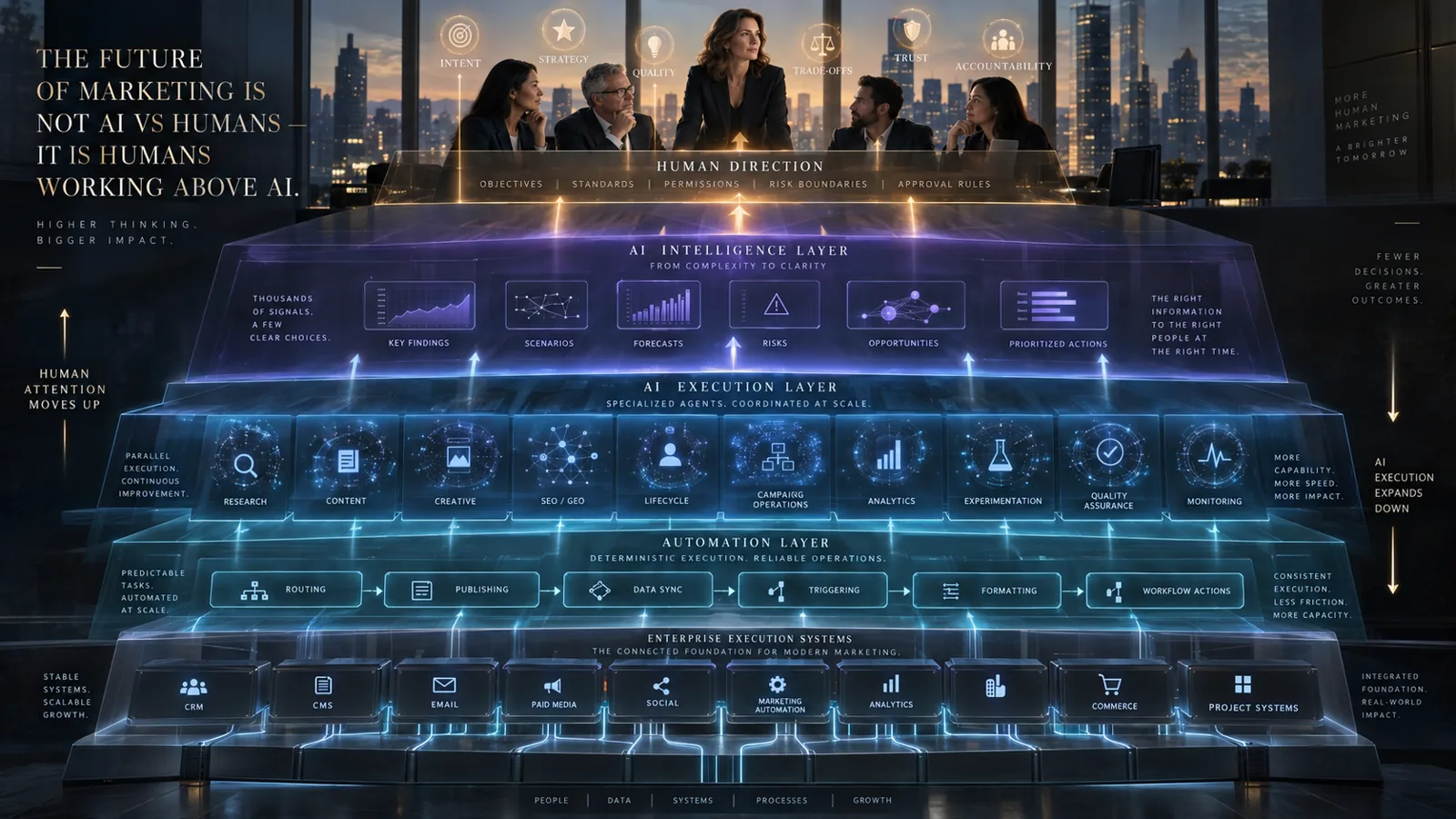
It is humans moving above the execution layer.
AI increasingly performs the work underneath:
research;
production;
monitoring;
analysis;
coordination;
and low-risk optimization.
Humans increasingly operate above it:
defining the objective;
setting the standard;
making trade-offs;
deciding what deserves attention;
applying taste;
managing risk;
and owning the outcome.
This is what I mean by:
Humans working above AI.
Not above in the sense of human superiority.
Above in the architecture of work.
Human intent↓AI reasoning and agents↓Automation and software↓Execution
The marketer stops being required to manually perform every task in order to create value.
Their value increasingly comes from directing a much larger intelligent system.
That may be the defining shift in marketing work over the next few years.
What Does “Humans Working Above AI” Mean?
Humans working above AI means people operate primarily at the level of objectives, judgment, standards, constraints and accountability while AI increasingly performs the research, generation, analysis, coordination and execution required to pursue those objectives.
Consider the difference between these two workflows.
AI-Assisted Marketing
Human researches.
Human prompts AI.
AI drafts.
Human edits.
Human sends to designer.
Human uploads.
Human launches.
Human checks dashboard.
Human analyzes results.
Human decides what happens next.
AI made several tasks faster.
But the human still operates inside almost every step.
Human-Directed Agentic Marketing
Human defines the objective.
AI research agents investigate in parallel.
AI synthesizes relevant intelligence.
Human chooses the strategy.
Agents execute approved production workflows.
Quality agents validate predictable requirements.
Automation handles routine activation.
Analytics agents continuously monitor performance.
AI investigates significant changes.
Human receives important recommendations and decisions.
Humans operate mainly where their judgment changes the outcome.
The person is no longer doing every task.
They are directing the system that does the work.
The Job Is Moving From Tasks to Outcomes
Most jobs have historically been defined by activities.
A content marketer writes content.
An analyst creates reports.
A media buyer manages campaigns.
A marketing operations manager configures workflows.
AI makes those definitions increasingly unstable.
If an AI agent can create a first draft, does writing disappear?
No.
But perhaps the content marketer's job shifts from:
produce 20 articles
toward:
build the strongest possible editorial system for this audience and business objective.
That involves:
deciding which topics matter;
extracting proprietary insight;
determining what deserves publication;
setting quality;
directing distribution;
and evaluating whether the content produced meaningful results.
The role has moved upward.
The same happens with analytics.
The traditional analyst may spend substantial time:
collecting data;
cleaning spreadsheets;
building reports;
updating dashboards;
and writing summaries.
AI increasingly performs portions of those tasks.
The analyst can spend more time asking:
Are we measuring the right thing?
What caused this result?
Can we establish causality?
Which experiment would reduce uncertainty?
What should the business do?
Again, the work moves upward.
Microsoft's 2026 Work Trend Index describes exactly this shift. Its research argues that the most effective AI users will increasingly define their value around setting clear intent, defining quality, designing human-AI work, applying judgment and taste, building trust and owning outcomes.
AI Makes Intent More Important, Not Less
When execution is expensive, organizations spend enormous energy on producing things.
When execution becomes cheap, the quality of the instruction becomes more important.
Imagine an AI system capable of producing 1,000 campaign variants.
That sounds powerful.
But first:
Which customer are we trying to influence?
Why?
What behavior should change?
What is our proposition?
What do we believe?
What shouldn't we say?
How much should we spend?
How will we know whether it worked?
Those are intent questions.
Without strong intent, AI simply generates more activity.
An agent can optimize an objective extraordinarily well while the organization has chosen the wrong objective.
So one of the highest-value future marketing skills may be the ability to turn ambiguity into clear objectives.
Not:
"Create more engagement."
But:
"Increase qualified enterprise demand among CFOs without diluting our premium positioning."
Not:
"Create content about AI."
But:
"Build category authority around AI CMO architecture among enterprise marketing leaders evaluating agentic operating models."
AI can do far more with the second instruction.
Human clarity becomes leverage.
Humans Will Set the Quality Bar
Generative AI produces competent work remarkably easily.
That creates a new problem.
Competence becomes abundant.
When everyone can create:
acceptable copy;
reasonable presentations;
polished graphics;
adequate research;
and plausible strategies,
the difference between average and exceptional shifts toward evaluation.
Someone must know:
This is technically correct but boring.
This is polished but generic.
This idea is interesting but strategically irrelevant.
This recommendation looks rational but conflicts with our brand.
This creative deserves another $1 million.
This should never be published.
The system can generate options.
Humans determine what good means.
Microsoft found that 50% of surveyed AI users said quality control of AI output is becoming more important, while 46% pointed to critical thinking. And 86% said they regard AI output as a starting point rather than the final answer and remain responsible for the thinking.
That is an important clue about the future of knowledge work.
The scarce skill may increasingly be less:
Can you produce something?
and more:
Can you recognize what deserves to exist?
Humans Will Design the Constraints
Intelligent systems need boundaries.
A marketing agent might be capable of:
publishing content;
changing budgets;
contacting customers;
modifying CRM;
launching experiments;
and adjusting campaigns.
Capability does not automatically imply permission.
Humans need to determine:
which systems the agent can access;
what information it can use;
which actions it can execute;
how much money it can allocate;
what claims it can make;
when it must stop;
and what requires approval.
This creates an increasingly important role for marketers:
designing the space within which AI is allowed to operate.
Imagine a paid-media agent.
It might have authority to:
rotate previously approved creative;
pause technically broken ads;
or shift up to 5% of budget between approved audiences.
But a 30% reallocation requires a person.
Why?
Because the second decision carries larger financial consequences.
This is bounded autonomy.
Humans do not micromanage every action.
They design the guardrails.
Humans Will Make the Trade-Offs
Optimization assumes an objective.
Leadership chooses between objectives.
That difference matters.
Suppose AI determines:
Discounting the product by 25% will maximize quarterly acquisition.
Should the company do it?
Maybe.
But perhaps leadership believes premium positioning is more valuable over five years.
Suppose hyper-personalized messages increase conversion.
But customers find the level of personalization uncomfortable.
Should marketing use it?
Suppose AI discovers that fear-based messaging produces stronger engagement.
Should the brand adopt it?
Those are not technical questions.
They involve:
values;
brand;
risk;
time horizon;
customers;
and competing business priorities.
AI can surface the trade-off.
Humans should decide which side of the trade-off the organization chooses.
This is why strategy remains fundamentally different from optimization.
AI may become extraordinarily good at answering:
How do we achieve X?
Humans remain responsible for asking:
Should X be the thing we optimize?
AI Will Become the Execution Layer
This does not mean AI's role remains small.
Quite the opposite.
A mature marketing organization may eventually have specialized agents handling significant portions of:
market research;
customer intelligence;
competitive analysis;
content strategy;
content creation;
creative production;
SEO/GEO;
campaign operations;
lifecycle marketing;
analytics;
experimentation;
quality assurance;
and monitoring.
BCG's 2026 CMO research found a significant gap between ambition and current operating reality: although 96% of surveyed CMOs say AI is driving end-to-end transformation, 42% still primarily use generative AI for individual human-assisted tasks and only 8% report campaigns where multiple agents operate autonomously.
That gap illustrates where the transition is heading.
From:
Human performs task with AI assistance
toward:
Human defines outcome → agents perform more of the workflow
The second model changes organizational structure.
The Future Marketing Manager Manages Capability
Today's manager primarily manages people.
A future marketing manager may manage a portfolio containing:
humans;
AI agents;
automation;
agencies;
data;
and enterprise systems.
Consider a growth leader.
Their "team" might include:
three human specialists;
a research agent;
customer intelligence agent;
campaign agent;
analytics agent;
content agent;
experimentation agent;
and several deterministic automation workflows.
The leader's job is not to perform all of those functions.
It is to ensure the system collectively achieves the objective.
That requires new managerial skills.
Objective Design
Can you define the outcome clearly enough for humans and agents to pursue it?
Delegation Architecture
What should the human do?
What should an agent do?
What should automation do?
Quality Design
What standards determine acceptable output?
Governance
Where are the risk boundaries?
Exception Management
Which situations deserve human intervention?
Evaluation
Is the system producing the desired business outcome?
Learning
How should performance improve the workflow next time?
This is management at a higher abstraction layer.
Gartner's 2026 research explicitly argues that AI-powered marketing requires teams to move away from structures built for human-led task execution toward flexible hybrid human-AI organizations, where people focus more heavily on decisions and oversight as AI scales execution.
Marketers Need to Stop Being the API Between Tools
A surprising amount of modern marketing work consists of humans connecting software.
Download the data.
Put it into a spreadsheet.
Copy it into a presentation.
Send the presentation to someone.
Paste the decision into project management.
Move the brief into another system.
Upload the asset.
Update CRM.
Check analytics.
Tell someone what happened.
AI agents and orchestration increasingly make this unnecessary.
The human should not need to manually carry information through the stack.
An intelligent system can increasingly:
retrieve context;
select tools;
move workflow state;
monitor dependencies;
and route outputs.
Humans then intervene when meaning, judgment or accountability is required.
This is one of the clearest examples of what “working above AI” means.
Stop operating the plumbing. Start directing the outcome.
Human Attention Becomes the Scarce Resource
AI changes the economics of marketing production.
Content becomes cheaper.
Analysis becomes cheaper.
Research becomes cheaper.
Creative variation becomes cheaper.
But human attention does not become infinite.
A CMO still has limited capacity.
A strategist still has limited attention.
A creative director can evaluate only so much work thoughtfully.
That means a good AI system should not maximize what it sends to humans.
It should minimize it.
An analytics agent that produces 200 alerts has failed.
A content agent that generates 100 concepts and asks the creative director to choose one has transferred the burden rather than solved it.
The better system performs more work before escalation.
For example:
100 possibilities generated↓30 fail objective fit↓20 fail brand criteria↓25 are insufficiently differentiated↓15 have weak evidence↓7 survive deeper evaluation↓3 recommended to human leadership
Now AI has increased human leverage.
The leader sees three meaningful decisions.
Not 100 machine-generated possibilities.
The Human-AI Stack
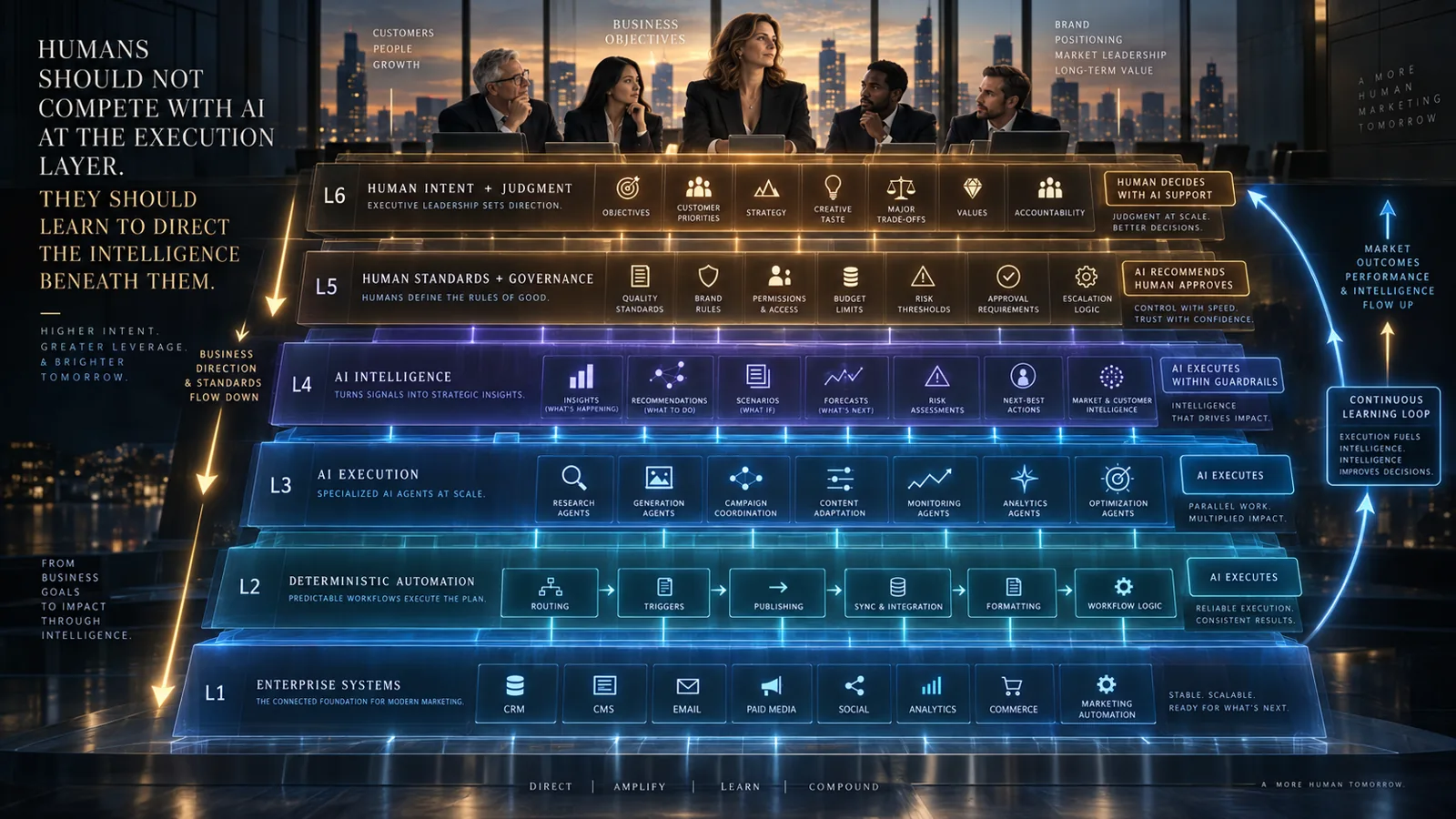
A useful model for future marketing looks like this.
Layer 1 — Human Intent
Humans define:
business objectives;
customers;
positioning;
values;
risk appetite;
and desired outcomes.
Layer 2 — Human Standards and Governance
Humans establish:
quality;
brand rules;
permissions;
decision thresholds;
and escalation boundaries.
Layer 3 — AI Intelligence
Agents:
research;
analyze;
synthesize;
forecast;
generate options;
and make recommendations.
Layer 4 — AI Execution and Coordination
Agents:
create;
monitor;
coordinate;
investigate;
optimize;
and manage workflow state.
Layer 5 — Deterministic Automation
Software executes predictable processes reliably.
Layer 6 — Enterprise Systems
CRM.
CMS.
Email.
Paid media.
Analytics.
Commerce.
Marketing automation.
The stack does not remove humans.
It changes their position within the stack.
“Above AI” Does Not Mean Humans Approve Everything
This is an important distinction.
If a marketer needs to approve every action an AI agent takes, the organization has not created much leverage.
Human oversight should be risk-based.
Consider four levels.
Level 1 — AI Executes
Low risk.
Reversible.
Predictable.
For example:
formatting an approved asset.
Level 2 — AI Executes Within Guardrails
The system has defined boundaries.
For example:
rotating approved campaign creatives when fatigue crosses a threshold.
Level 3 — AI Recommends, Human Approves
Meaningful impact.
For example:
a significant campaign-budget reallocation.
Level 4 — Human Owns the Decision
High ambiguity, consequence or strategic importance.
For example:
changing company positioning.
The goal is not keeping humans involved everywhere.
It is putting humans where they create the most value.
The Best Marketer May Become the Best Director of Intelligence
For years, career progression in marketing often rewarded executional expertise.
Write better.
Design better.
Analyze better.
Manage campaigns better.
Those capabilities will remain valuable.
But another capability is emerging:
directing intelligence.
Can you ask the right question?
Can you frame the problem?
Can you give agents enough context?
Can you distinguish strong output from plausible nonsense?
Can you synthesize multiple perspectives?
Can you design a workflow?
Can you set constraints?
Can you make the final decision?
Can you turn machine capability into a business outcome?
Those skills create leverage across many forms of execution.
The best marketer may not be the person who personally completes the most tasks.
It may be the person capable of directing the strongest combination of:
humans;
agents;
data;
and systems
toward the right objective.
AI Makes Taste More Valuable
Generative systems make imitation easier.
They can reproduce:
formats;
styles;
structures;
patterns;
and familiar ideas.
That makes another human capability increasingly important:
taste.
Taste answers:
Is this differentiated?
Is this worth our audience's attention?
Does this feel like us?
Is the idea memorable?
Is the execution emotionally right?
Should we deliberately violate the obvious best practice?
There may be no reliable quantitative answer.
Taste develops from:
experience;
culture;
customer understanding;
references;
pattern recognition;
and judgment.
As machine-generated production becomes abundant, selection becomes a strategic capability.
AI can expand the search space.
Humans determine where to place the bet.
AI Makes Accountability More Important
There is another reason humans remain above the system.
Responsibility cannot simply disappear into automation.
Imagine an AI agent launches a campaign that damages the brand.
Who is accountable?
Not the language model.
The organization.
Someone must own:
the objective;
the permissions;
the quality standard;
the decision boundary;
and ultimately the outcome.
This means agentic marketing requires clearer responsibility, not less.
A mature system should be able to answer:
Who owns this business outcome?
Which actions can AI take?
Who approved the boundaries?
When should the system escalate?
Who can override it?
Who reviews failures?
The more autonomous execution becomes, the more explicit human accountability must become.
Work Becomes More About Exceptions
Traditional managers spend enormous time checking normal work.
Has this been completed?
Did the campaign launch?
Did the report update?
Did the asset publish?
Is the budget pacing correctly?
Intelligent systems can monitor routine conditions continuously.
Human attention can then shift toward exceptions:
Something unexpected happened.
An assumption failed.
A customer pattern changed.
A major opportunity appeared.
Two objectives conflict.
The system is uncertain.
The risk exceeds its authority.
This may become one of the most important characteristics of future marketing organizations:
AI handles the normal. Humans handle the meaningful exceptions.
Marketing Careers Will Become Less Linear
The shift also changes specialization.
Imagine a talented product marketer.
Historically their output is constrained partly by how much they can personally research, write, analyze and coordinate.
With agents, that person may gain access to:
continuous customer synthesis;
competitive monitoring;
content production;
campaign analysis;
and experimentation.
Their impact expands.
The employee's expertise becomes the layer that directs those capabilities.
This could allow people to operate across broader domains.
Microsoft found 58% of surveyed AI users say they are producing work they could not have produced a year earlier, rising to 80% among its more advanced “Frontier Professionals.”
The boundary of a job becomes less about what one person can manually execute.
It becomes more about what outcomes that person can responsibly direct.
Organizations Need to Redesign Around This Model
There is a problem.
Many companies are introducing agents into organizational structures designed for humans performing tasks.
That creates tension.
Microsoft's 2026 research found that organizational conditions—culture, manager support and talent practices—are more strongly associated with reported AI impact than individual AI behaviors. Its model attributes 67% of the relative importance to organizational factors versus 32% to individual ones.
The lesson is significant.
Teaching everyone prompting is not enough.
Organizations need to reconsider:
job descriptions;
performance measurement;
management;
approval systems;
workflow design;
governance;
training;
and team structure.
Gartner's 2026 leadership guidance likewise describes AI transformation as strategic, structural and cultural—not merely technological.
You cannot build agentic marketing while keeping every assumption of the pre-agentic organization unchanged.
How to Start Working Above AI
Marketing teams do not need to wait for fully autonomous agents.
The transition can begin now.
Take one recurring workflow.
Perhaps:
content production;
campaign reporting;
customer research;
paid-media optimization;
or product launches.
Then ask five questions.
1. What Outcome Does the Human Own?
Define the desired business result.
2. What Information Does AI Need?
Connect the relevant:
customer;
brand;
product;
campaign;
and performance context.
3. What Work Can Move Below the Human?
Research?
Drafting?
Monitoring?
Coordination?
Quality checks?
Analysis?
4. Where Must Human Judgment Remain?
Strategy?
Taste?
Budget?
Relationship?
Risk?
5. What Should the System Learn?
Capture outcomes so the next workflow begins smarter.
Repeat this across important workflows.
Eventually, the organization stops asking:
“Where can we use AI?”
And starts asking:
“At what layer should the human operate?”
That is a much more powerful question.
What Skills Will Marketers Need?
The emerging skill set becomes clearer through this model.
Strategic Framing
Defining the right problem.
AI Delegation
Knowing what should be assigned to machines.
Critical Thinking
Evaluating recommendations and evidence.
Taste
Distinguishing competent output from valuable output.
Systems Thinking
Understanding how information, agents and workflows connect.
Decision-Making
Making trade-offs under uncertainty.
Governance
Understanding risk and appropriate autonomy.
Customer Understanding
Maintaining connection to actual people rather than optimizing exclusively through machine-generated abstractions.
Leadership
Taking responsibility for the outcome.
Interestingly, many of these are not “AI skills” in the conventional sense.
They are human skills whose value increases because AI exists.
Frequently asked questions
How will marketing teams work with AI?
Marketing teams will increasingly use AI agents for research, production, analysis, monitoring, coordination and low-risk execution, while humans concentrate more heavily on objectives, strategy, creative judgment, customer relationships, governance and accountability.
What does “humans working above AI” mean?
It means humans operate at a higher abstraction level in the workflow. Rather than manually executing every task, people define objectives, standards, constraints and decision rights while AI systems execute more of the work underneath.
Will AI replace marketers?
AI is likely to replace or transform portions of many marketing tasks, but marketing still requires human ownership of strategy, judgment, brand, important relationships, values and consequential decisions. Roles are likely to change more than marketing simply disappears.
What will marketers manage in the future?
Marketing leaders may increasingly manage a combination of human employees, AI agents, automation, agencies, data and enterprise systems rather than exclusively managing human teams.
What skills will marketers need in an AI-driven future?
Important skills include strategic framing, judgment, critical thinking, taste, AI delegation, workflow design, systems thinking, customer understanding, governance and accountability.
Should humans approve everything AI produces?
No. Human oversight should be proportional to risk. Predictable, low-risk and reversible actions can increasingly operate autonomously within defined guardrails, while consequential decisions retain human approval.
What should AI own in marketing?
AI can increasingly own appropriate research, generation, monitoring, analysis, coordination, quality checking and low-risk execution. Humans should define the goals, standards and boundaries within which those activities occur.