Why AI CMO Adoption Fails: 8 Barriers Marketing Teams Must Fix Before Agentic AI Can Scale
Because using AI and redesigning marketing around AI are completely different things.

Most marketing teams are already using AI.
They write with it.
Research with it.
Generate images with it.
Summarize meetings with it.
Analyze data with it.
Brainstorm campaigns with it.
So why are so few organizations operating anything close to an AI CMO?
Because using AI and redesigning marketing around AI are completely different things.
An employee using ChatGPT to write faster is AI adoption.
A marketing organization where shared intelligence, specialized AI agents, workflow orchestration, enterprise software and human decision-making work together across the entire marketing lifecycle is an operating-model transformation.
Most companies have achieved some version of the first.
Very few have completed the second.
Gartner's 2026 CMO Spend Survey captures the gap clearly. Seventy percent of surveyed CMOs consider becoming an AI leader a critical objective, yet only 30% report mature or fully developed AI readiness capabilities.
BCG finds something similar. Ninety-six percent of surveyed CMOs say AI is driving end-to-end transformation, but 42% are still primarily using generative AI to assist humans with individual tasks. Only 8% report campaigns where multiple AI agents operate autonomously.
This is not mainly a model problem.
AI capability is moving faster than organizational capability.
The biggest barriers to AI CMO adoption sit underneath the technology:
data;
context;
workflows;
skills;
trust;
governance;
leadership;
and measurement.
Until those foundations change, adding more AI will often create more experiments—not a more intelligent marketing organization.
What Does AI CMO Adoption Actually Mean?
Before examining why adoption fails, we need to define it properly.
AI CMO adoption is the transition from isolated AI-assisted marketing tasks toward an operating model where shared marketing intelligence, specialized AI agents, automation, orchestration and human governance work together across strategy, execution, measurement and optimization.
This definition matters.
If an employee uses AI to write an email, the organization has adopted an AI tool.
If a content team generates first drafts with AI, the organization has adopted an AI capability.
If an AI agent can monitor performance, investigate changes, retrieve campaign context, recommend an intervention, route the decision to the appropriate human and execute the approved action across marketing systems, the organization is beginning to adopt an AI-native operating model.
These are different maturity levels.
A lot of disappointment with AI happens because companies expect operating-model results from tool-level adoption.
Barrier 1: Companies Start With AI Tools Instead of Marketing Problems
One of the easiest ways to begin an AI transformation is also one of the most dangerous.
Someone discovers a new tool.
It looks impressive.
The company licenses it.
Then leadership asks:
“How should we use this?”
The sequence is backwards.
The starting point should be:
What marketing outcome are we trying to improve?
Where does the current workflow break?
Where is human capacity being wasted?
What decisions take too long?
Where do employees repeatedly reconstruct context?
Which activities are deterministic?
Which require interpretation?
Which require human judgment?
Only then should technology enter the conversation.
Otherwise the organization accumulates:
AI writing tools;
AI research tools;
AI analytics tools;
AI presentation tools;
AI meeting assistants;
AI workflow products;
and AI agents
without changing the underlying system.
The result is AI tool adoption without AI transformation.
This is one reason Gartner warns that organizations risk investing in AI tools faster than they build the processes, governance, data foundations and talent necessary to scale them.
The better sequence is:
Business Problem → Workflow → Decision → Capability → Technology
not:
Technology → Find a Use Case
Barrier 2: The Organization Has No Shared Intelligence Layer
This may be the most underestimated AI CMO requirement.
Imagine hiring an exceptional new marketer.
Then giving them:
no customer research;
no campaign history;
no brand guidelines;
no CRM access;
no product information;
no previous strategy;
and no knowledge of what leadership has already decided.
How effective would they be?
Not very.
Yet this is effectively what companies do with AI constantly.
Every conversation begins from a blank prompt.
Employees manually provide:
brand context;
customer context;
campaign background;
product details;
previous examples;
and objectives.
Then another employee does it again in another AI application.
This is not organizational intelligence.
It is repeated briefing.
A real AI CMO requires persistent access—within appropriate permissions—to information such as:
brand knowledge;
customer intelligence;
CRM;
product information;
campaign history;
content libraries;
competitive intelligence;
market research;
business goals;
performance analytics;
approved claims;
and previous decisions.
Without that foundation, specialized AI agents cannot reliably collaborate.
One agent works from one version of the customer.
Another works from another.
A third does not know what the company decided yesterday.
The organization has intelligent models but fragmented memory.
And fragmented memory produces inconsistent AI.
Barrier 3: Companies Automate Broken Workflows
Imagine a campaign workflow with:
six approval stages;
three unnecessary meetings;
duplicated reporting;
manual data transfer;
unclear ownership;
and constant revisions.
Then someone says:
“Let's add AI.”
AI can make individual steps faster.
It cannot automatically make the workflow sensible.
This is one of the biggest mistakes in enterprise AI adoption:
automating existing work before redesigning existing work.
Some activities should be automated.
Some should become agentic.
Some should remain human.
And some should disappear completely.
Before deploying agents, every important workflow should go through four questions.
Eliminate
Does this activity need to exist?
Automate
Is it deterministic enough for conventional software?
Agentize
Does it require interpretation, monitoring or multi-step reasoning within defined boundaries?
Keep Human
Does it require judgment, accountability, relationships, taste or a consequential trade-off?
If this exercise does not happen, companies often use sophisticated AI to accelerate organizational waste.
The report nobody needs arrives faster.
The unnecessary content gets generated faster.
The bad brief produces ten bad variations instead of one.
The broken approval process now has even more material to approve.
AI amplifies whatever operating model it enters.
That includes bad ones.
Barrier 4: AI Literacy Is Uneven — Especially in Leadership
AI adoption is often treated as a training problem for junior teams.
“Teach everyone how to prompt.”
That is necessary but insufficient.
The harder gap is leadership literacy.
CMOs increasingly need to understand:
what agents can do;
where hallucination risk matters;
how context systems work;
how to evaluate AI recommendations;
what should remain deterministic;
where human approval belongs;
how agents should be measured;
and where autonomy becomes unsafe.
Gartner found that 65% of surveyed CMOs expect AI to dramatically change the CMO role within two years, yet only 32% believe significant changes are needed to the CMO profile and skill set. Gartner describes this as an AI leadership blind spot.
The problem is not that leadership needs to become machine-learning engineers.
It does not.
But leadership must become competent enough to make decisions about the operating model.
A CMO cannot effectively delegate every AI decision to:
IT;
an agency;
an innovation team;
or a few enthusiastic employees.
AI changes:
marketing strategy;
team architecture;
capital allocation;
risk;
customer experience;
measurement;
and competitive advantage.
That makes AI literacy a leadership capability.
Gartner's 2026 skills research also found that 98% of CMOs report piloting or using AI, but roughly one-third of senior marketing leaders are not seeing the returns they expected. Sixty-six percent of marketers say learning new technology takes substantial time away from everyday work.
So adoption requires something more intentional than:
“Here are some tools. Experiment.”
Barrier 5: Teams Do Not Trust the Output
Consider what happens the first few times AI gets something wrong.
It invents a statistic.
Uses outdated product information.
Misses brand nuance.
Provides a weak recommendation.
Misinterprets a customer request.
The employee thinks:
“I could have done this myself.”
Now every AI output gets manually checked.
Then rewritten.
Then compared against the source.
Suddenly the AI is not reducing work.
It has created another review layer.
This is a trust problem.
But trust should not be solved by telling employees to trust AI more.
It should be solved by engineering a more trustworthy system.
That means:
better source grounding;
clear data provenance;
defined quality standards;
structured evaluation;
approved organizational context;
risk-based human review;
auditability;
and confidence signals.
AI should earn autonomy.
It should not receive autonomy because leadership wants an impressive demo.
A useful maturity sequence is:
AI drafts → Human checks everything
then:
AI executes → QA validates → Human checks important work
then:
AI executes low-risk work autonomously → Humans review exceptions
Trust grows when the system demonstrates reliability within specific boundaries.
Not when the organization pretends errors do not exist.
Barrier 6: Governance Arrives Too Late
AI pilots are easy to launch when the system cannot do much.
Let an agent summarize research.
Low risk.
Let it draft a blog.
Manageable.
Now connect the same system to:
CRM;
customer data;
advertising;
CMS;
email;
budget;
and campaign execution.
The risk profile changes completely.
An AI agent capable of recommending an action is not the same as an agent capable of executing it.
Organizations therefore need answers to questions such as:
Which customer data can this agent access?
Which systems can it modify?
How much money can it allocate?
Can it publish externally?
Which actions require approval?
What happens when confidence is low?
Who receives the escalation?
What is logged?
Who is accountable?
Governance should not be a policy document written after implementation.
It needs to exist inside the workflow.
A useful autonomy spectrum is:
Level 1 — Recommend only
Level 2 — Prepare action for human approval
Level 3 — Execute within defined guardrails
Level 4 — Execute autonomously in validated low-risk workflows
The appropriate level depends on:
financial impact;
brand risk;
customer consequences;
reversibility;
ambiguity;
and novelty.
The larger the consequence, the stronger the human ownership should become.
Barrier 7: Teams Don't Know Who Owns AI
This is partly a technology problem.
Mostly, it is an organizational problem.
Who owns the AI CMO transformation?
The CMO?
Marketing operations?
IT?
Data?
An AI center of excellence?
Individual teams?
An external agency?
The answer is usually some combination.
But when responsibility is vague, predictable problems appear.
Marketing buys applications without architecture.
IT introduces restrictions without understanding workflows.
Innovation teams build pilots nobody adopts.
Employees use shadow AI.
Data teams struggle with unclear requirements.
Nobody owns the complete end-to-end outcome.
Successful AI CMO adoption needs clear responsibility across at least four areas:
Business Ownership
Which marketing leader owns the outcome?
Technical Ownership
Who owns integration, infrastructure and reliability?
Data Ownership
Who is responsible for the quality and permissions of relevant organizational information?
Governance Ownership
Who defines what agents are permitted to do and how they are evaluated?
The AI CMO sits across traditional organizational boundaries.
That makes explicit ownership essential.
Barrier 8: Companies Measure AI Activity Instead of AI Value
This may be the final adoption trap.
Leadership asks:
How many employees use AI?
How many prompts were sent?
How many AI licenses were activated?
How much content was generated?
How many agents were created?
Those metrics can indicate adoption.
They do not indicate transformation.
Imagine two companies.
Company A has 95% AI adoption.
Employees generate thousands of AI outputs.
Campaign cycle time does not improve.
Customer acquisition cost remains unchanged.
Reporting remains chaotic.
Employees remain overwhelmed.
Company B has six carefully implemented agentic workflows.
Campaign launch time falls 30%.
Manual reporting declines.
Senior marketers gain more strategic time.
Performance problems are identified faster.
Revenue per marketing employee increases.
Which company is more AI-native?
Clearly Company B.
The objective should therefore move from:
AI adoption
to:
AI-enabled business performance.
Measure:
workflow cycle time;
manual handoffs;
coordination hours;
approval waiting time;
rework;
time to insight;
time to action;
campaign performance;
customer outcomes;
marketing efficiency;
and business impact.
Gartner's current agentic-marketing research specifically emphasizes readiness assessment, roadmap development and outcome-based measurement because most teams still struggle to move beyond pilots into repeatable business value.
There Is Also a Ninth Barrier: Change Fatigue
Even a perfectly designed system can fail if the people expected to use it are exhausted.
Modern marketing teams have already lived through:
CRM transformations;
marketing automation;
new analytics;
privacy changes;
new social platforms;
new project-management systems;
new martech stacks;
remote-work changes;
and now generative AI.
Another transformation initiative can feel like:
another system to learn;
another workflow to remember;
another demand from leadership;
another productivity expectation.
And employees are usually expected to transform the operating model while still delivering their existing workload.
That matters.
Gartner reports that 66% of marketers say learning new technology consumes substantial time that would otherwise go toward their day-to-day work.
The implication is simple.
AI adoption requires capacity to adopt AI.
If every employee is already operating at 100%, transformation work becomes extra work.
Companies may need to deliberately create:
training time;
experimentation environments;
AI champions;
clear use-case priorities;
workflow support;
and protected transformation capacity.
Adoption should make work better.
It should not begin by making everybody busier.
Why AI CMO Pilots Work but Production Is Hard
This pattern is common.
A small team builds an AI proof of concept.
The data is clean.
The use case is narrow.
The people involved understand the system.
Everyone is excited.
The demo works beautifully.
Then the company attempts to scale it.
Suddenly:
real data is inconsistent;
permissions become complicated;
different teams use different definitions;
edge cases appear;
integrations fail;
output quality varies;
cost increases;
stakeholders disagree about risk;
and nobody is sure who owns the outcome.
This is why pilot success is a weak indicator of organizational readiness.
A pilot asks:
Can the AI do this?
Production asks:
Can the organization reliably operate this capability hundreds or thousands of times inside real business conditions?
Those are radically different tests.
AI CMO adoption should therefore be evaluated like operating infrastructure, not a software demo.
Adoption Should Progress Through Maturity Levels
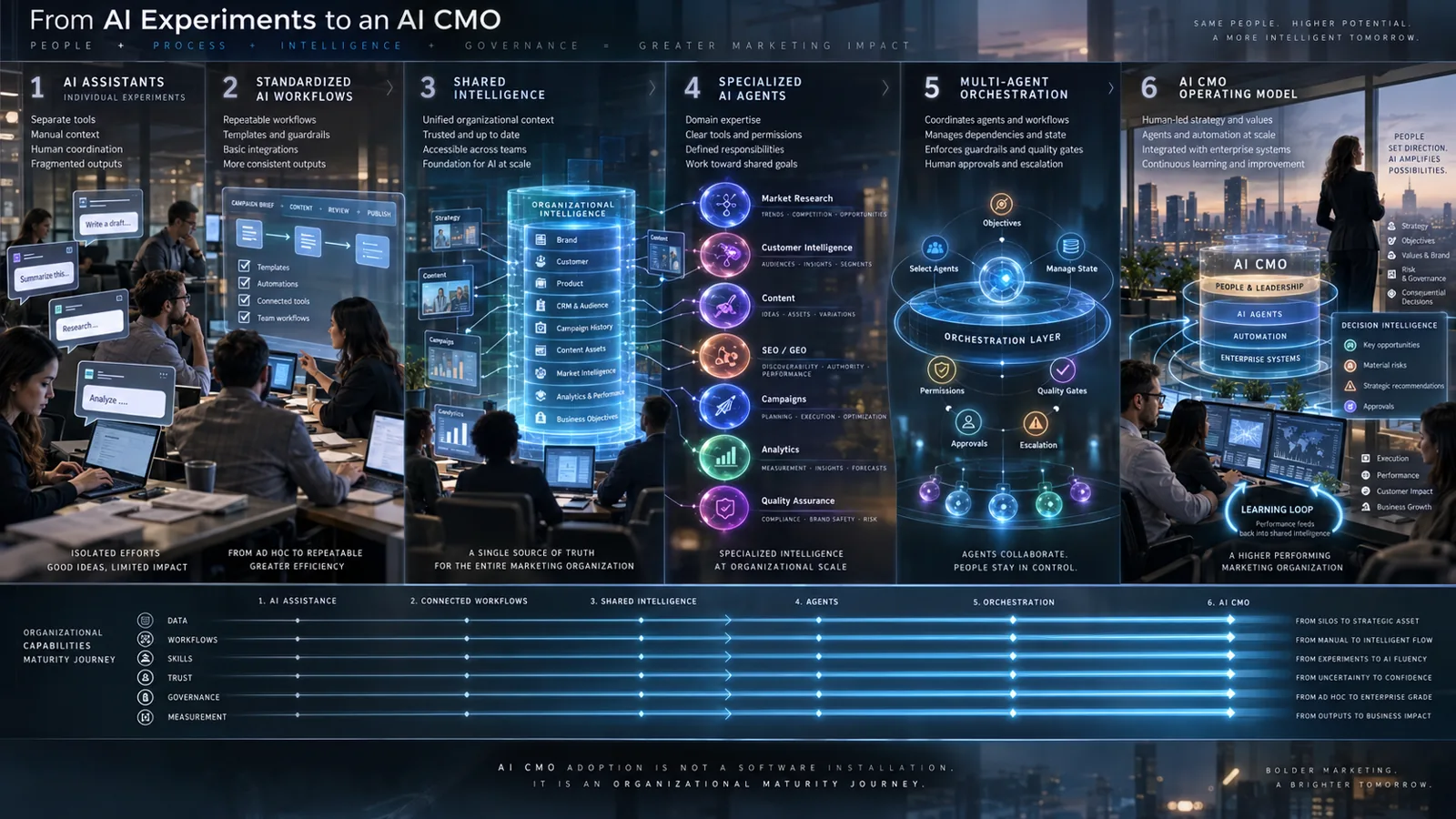
A practical AI CMO maturity model can help teams avoid trying to jump immediately into autonomous marketing.
Stage 1 — Individual AI Assistance
Employees use AI independently for:
writing;
research;
summaries;
analysis;
ideation.
Primary challenge: skills.
Stage 2 — Standardized AI Workflows
Teams create repeatable workflows for common activities.
Organizational context begins to become reusable.
Primary challenge: process design.
Stage 3 — Connected Intelligence
AI gains governed access to shared:
customer;
brand;
product;
campaign;
and business context.
Primary challenge: data and architecture.
Stage 4 — Specialized Agents
Persistent agents support:
research;
content;
campaigns;
analytics;
monitoring;
and QA.
Primary challenge: reliability and governance.
Stage 5 — Multi-Agent Orchestration
Agents coordinate around larger objectives.
Workflow state persists.
Human approvals are risk-based.
Primary challenge: orchestration and operating-model change.
Stage 6 — Adaptive AI CMO
Marketing continuously:
observes;
prioritizes;
executes;
measures;
learns;
and adapts
within human-defined strategy and governance.
Primary challenge: institutional trust and continuous optimization.
Most organizations do not need to jump from Stage 1 to Stage 6.
They need to build the foundations in order.
How to Make AI CMO Adoption Work
Instead of beginning with enterprise-wide transformation, start with one meaningful workflow.
Not:
“Use AI more.”
Choose something specific.
For example:
product launch;
content marketing;
campaign optimization;
lead nurturing;
competitive intelligence;
marketing reporting.
Then redesign that workflow end to end.
Step 1: Define the Business Outcome
What measurable problem are you solving?
Not:
“Implement an agent.”
But:
“Reduce campaign launch time by 30%.”
or:
“Reduce manual reporting time while improving anomaly detection.”
Step 2: Map the Existing Workflow
Document:
people;
steps;
systems;
data;
handoffs;
approvals;
waiting time;
and repeated context.
Do not automate anything yet.
Understand the current system.
Step 3: Remove Unnecessary Work
Ask:
What can disappear?
What report is unused?
What approval adds no value?
What repeated meeting exists only because systems are disconnected?
Do not spend AI budget automating waste.
Step 4: Establish Shared Context
Determine what the AI needs to know reliably.
Brand?
Customer?
Product?
Campaign history?
Analytics?
Previous decisions?
Build the intelligence foundation.
Step 5: Separate Automation From Agents
Use automation for predictable actions.
Use agents where interpretation or reasoning is required.
Do not introduce agents where a simple rule will be more reliable.
Step 6: Define Human Decision Rights
For every consequential action specify:
AI executes?
AI acts within a threshold?
AI recommends?
Human approves?
Human owns directly?
Step 7: Create Evaluation Before Autonomy
Define quality before deployment.
Accuracy.
Brand adherence.
Reliability.
Escalation rate.
Error tolerance.
Business outcome.
An agent should demonstrate performance before receiving broader permissions.
Step 8: Train Around Real Work
Do not teach employees generic AI theory and assume behavior changes.
Train people on:
their workflows;
their customers;
their decisions;
their agents;
and their responsibilities.
The relevant skill is not simply prompting.
It is working effectively inside a human-AI operating model.
Step 9: Measure the Workflow
Track:
cycle time;
rework;
coordination;
human effort;
decision speed;
quality;
and business outcomes.
Step 10: Expand Only After the Workflow Works
One trusted workflow creates organizational confidence.
Then build another.
Over time, shared intelligence, governance and agent capabilities can become reusable.
This is much more durable than launching 50 AI pilots simultaneously.
The CMO Has to Lead the Transition
There is a temptation to treat AI CMO implementation as a technology project.
That would be a mistake.
The technology matters.
But the hardest decisions are managerial.
Which work should disappear?
Which jobs change?
Which decisions become agent-assisted?
Which actions can be autonomous?
Which customer interactions should remain human?
What does quality mean?
What is the organization's risk tolerance?
Where should investment move?
Who owns the outcome when the AI makes a mistake?
Those are leadership decisions.
Gartner's 2026 survey found a striking gap between CMOs expecting their role to change and those recognizing the skill changes required to lead that transformation. Its guidance is explicit: AI cannot simply be something the marketing team uses while leadership watches from the sidelines.
The CMO does not need to become the technical builder.
But the CMO must become the architect of the marketing operating model.
Adoption Is More Cultural Than It Looks
There is also an emotional component to AI adoption that technology discussions often ignore.
An employee may wonder:
Is this system here to help me?
Or replace me?
Will using AI make me more valuable?
Or make my role easier to eliminate?
If I automate this task, will leadership simply give me more work?
If the AI makes a mistake, am I accountable?
If I disagree with its recommendation, can I override it?
If the system monitors everything, am I being evaluated against it?
These are not irrational questions.
Organizations that ignore them create passive resistance.
The answer is not generic reassurance.
It is clarity.
Explain:
why AI is being introduced;
what success means;
how roles will change;
which decisions remain human;
how employees are evaluated;
what happens when AI fails;
and where humans maintain authority.
Trust in AI often begins with trust in leadership.
AI CMO Adoption Is Really Organizational Redesign
This is the most important point.
At first, AI CMO adoption looks like a technology challenge.
Then you go deeper.
You discover that the company needs better data.
Then better workflows.
Then clearer decision rights.
Then different skills.
Then stronger governance.
Then better measurement.
Then new team structures.
Eventually you realize:
You are not implementing an AI tool.
You are redesigning how marketing works.
That is why adoption is difficult.
But it is also why the upside is so significant.
The company that successfully builds an AI CMO operating model does not merely get:
faster content;
better prompts;
or cheaper reports.
It can create:
faster decision cycles;
greater organizational memory;
lower coordination overhead;
higher marketing capacity;
continuous customer intelligence;
more experimentation;
and tighter links between strategy and execution.
That is a much larger transformation.
Frequently asked questions
Why do marketing teams struggle to adopt AI?
Marketing teams often struggle with AI because the underlying organizational foundations are not ready. Common barriers include fragmented data, unclear workflows, lack of shared context, limited AI literacy, low trust, weak governance, unclear ownership and poor measurement of business outcomes.
Why do AI marketing pilots fail to scale?
Pilots often operate with narrow use cases, clean data and highly involved teams. At scale, organizations face real-world data quality, integration, governance, permissions, edge cases, cost and change-management challenges.
What does a company need before implementing an AI CMO?
Companies need clear marketing objectives, mapped workflows, reliable organizational context, connected systems, AI literacy, governance, decision rights, evaluation criteria and defined business outcomes.
Does an AI CMO require perfect data?
No organization has perfect data. However, AI agents need sufficiently reliable, governed and accessible information for the decisions they are expected to support. The higher the consequence of a decision, the stronger the underlying data and validation requirements should be.
How do you build trust in AI marketing agents?
Trust should be built gradually through grounded context, clear quality standards, systematic evaluation, transparent limitations, auditability and bounded autonomy. Agents should earn broader permissions through demonstrated reliability.
Who should own AI adoption in marketing?
The CMO or relevant marketing leader should own business outcomes and operating-model decisions, while technology, data, governance and specialist teams support infrastructure and risk management. Ownership should be explicit rather than distributed ambiguously.
How should AI marketing adoption be measured?
Measure changes in workflow performance and business outcomes, including campaign cycle time, manual handoffs, rework, coordination hours, decision speed, customer outcomes, revenue impact and marketing efficiency—not just AI usage.
Should companies mandate AI adoption?
Mandates can increase usage, but mandates alone do not create value. Gartner's August 2026 research says CMOs are increasingly considering adoption mandates to accelerate AI-enabled performance, but sustained success still requires the conditions for effective use—clear workflows, capabilities, leadership and measurement.