How to Connect a Fragmented Marketing Stack: From Martech Sprawl to an AI-Orchestrated Operating System
The organization has more technology than ever, yet humans are still frequently the integration layer.

Most marketing technology stacks were never really designed.
They accumulated.
A CRM was added.
Then marketing automation.
Then analytics.
Then social media management.
Then project management.
Then SEO.
Then a customer data platform.
Then another analytics product.
Then content tools.
Then personalization.
Then AI writing.
AI research.
AI meeting notes.
AI analytics.
AI agents.
Eventually the company has dozens of capable systems.
But the marketer still spends half the day moving information between them.
That is the paradox of the modern marketing stack.
The organization has more technology than ever, yet humans are still frequently the integration layer.
This is what a fragmented marketing stack looks like: marketing data, customer context, workflows and execution capabilities are distributed across disconnected systems that cannot reliably coordinate without manual human intervention.
The answer is not necessarily replacing everything with one giant platform.
It is building enough connective tissue that the existing stack begins operating like one system.
And agentic AI is making that transition increasingly important.
Martech Has Become Enormous
The scale of the marketing technology ecosystem helps explain how we arrived here.
Chiefmartec's 2026 Marketing Technology Landscape contains 15,505 commercial marketing technology products.
That number barely increased from 2025, suggesting the industry may finally be approaching a plateau after more than a decade of explosive expansion.
But underneath that headline, the market remains highly dynamic.
More than 1,400 new products entered the landscape in a single year while more than 1,300 disappeared.
Categories such as integration, governance and analytics continue expanding as AI changes how systems interact.
The problem for CMOs is not a lack of choice.
It is architecture.
Gartner says utilization of existing martech capabilities has fallen to approximately 49%.
Organizations are simultaneously buying AI capabilities while struggling to extract full value from technology they already own.
That should tell us something.
The next breakthrough in marketing technology may not come from another tool.
It may come from making the existing tools work together.
What Is a Fragmented Marketing Stack?
A fragmented marketing stack is a collection of marketing technologies in which customer data, organizational knowledge, workflows and execution systems remain disconnected enough that humans must repeatedly transfer information or coordinate actions between them.
Fragmentation can occur at several levels.
Data Fragmentation
Customer information is distributed across:
CRM;
analytics;
advertising platforms;
email;
customer support;
commerce;
product analytics;
and offline systems.
No system has the complete customer picture.
Context Fragmentation
Brand knowledge lives in documents.
Campaign history lives somewhere else.
Customer insights are in presentation decks.
Product information is in another platform.
Previous decisions may exist only in Slack, email or people's heads.
Workflow Fragmentation
The campaign brief is created in one tool.
Production happens in another.
Approval happens through email.
The asset is uploaded elsewhere.
Performance is analyzed in yet another application.
Humans move the work between each stage.
Decision Fragmentation
SEO sees one signal.
Paid media sees another.
Sales sees something else.
Analytics sees the whole funnel differently.
Nobody has one decision layer determining what matters across the marketing system.
These forms of fragmentation reinforce one another.
Connecting the marketing stack therefore means much more than creating a few integrations.
Integration Is Not the Same as Orchestration
This distinction is increasingly important.
Integration asks:
Can System A exchange information with System B?
For example:
Can the CRM send customer data into the email platform?
Can advertising data flow into the analytics warehouse?
Can the CMS retrieve product information?
Orchestration asks:
Given everything happening across these systems, what should happen next?
Imagine a high-value customer begins showing signs of churn.
Integration can make the signal available.
Orchestration might determine that:
the customer should leave a standard nurture campaign;
a retention workflow should begin;
customer success should receive context;
certain messages should be suppressed;
an AI agent should summarize recent interactions;
and a human account owner should be alerted.
Integration moves information.
Orchestration coordinates outcomes.
An AI-native marketing stack needs both.
Why Buying One Giant Platform Doesn't Completely Solve the Problem
Whenever martech becomes too complicated, consolidation sounds attractive.
Replace everything.
Move to one vendor.
Create one system.
There are legitimate benefits to platform consolidation.
Fewer vendors can mean:
simpler procurement;
fewer integrations;
more consistent data;
lower administrative overhead;
and potentially easier governance.
But marketing rarely becomes a one-platform discipline.
Companies will continue using specialized tools for different capabilities.
A global enterprise may require sophisticated:
CRM;
commerce;
advertising;
product analytics;
creative technology;
customer support;
data infrastructure;
SEO;
experimentation;
and content management.
No single system will necessarily be best at all of them.
And new specialist applications will continue appearing.
This is why composable martech is becoming an important architectural idea.
Instead of betting everything on one monolithic platform, companies create a modular stack in which systems can be replaced or extended without rebuilding the entire marketing architecture.
Gartner's 2026 guidance specifically recommends customizable, modular and API-friendly architectures to improve interoperability and prepare organizations for AI-driven marketing.
The objective is therefore not:
one application.
It is:
one coherent architecture.
The Five Layers Required to Connect the Marketing Stack
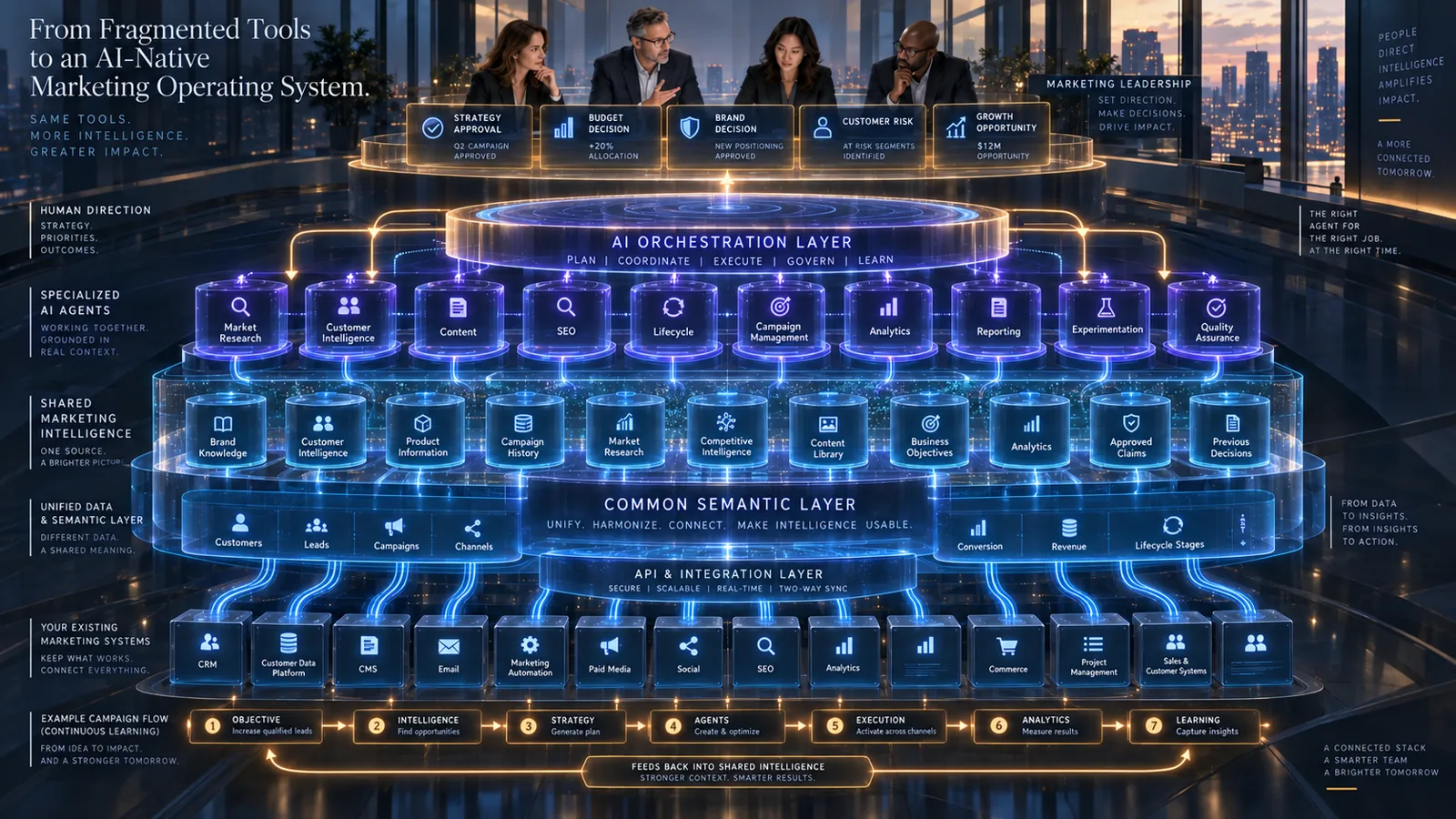
I think an integrated AI-era marketing stack increasingly needs five layers.
Layer 1: Data Connectivity
Before AI agents can operate intelligently, marketing needs access to reliable data.
That can include:
customer profiles;
CRM;
transaction history;
website behavior;
campaign data;
sales activity;
content engagement;
product usage;
service interactions;
and marketing performance.
The goal does not necessarily need to be physically moving every piece of data into one gigantic database.
But authorized systems need a reliable way to retrieve the data required for a particular decision.
This may involve:
APIs;
data warehouses;
customer data platforms;
iPaaS;
reverse ETL;
event streams;
or direct integrations.
Salesforce's 2026 connectivity research illustrates why this is critical.
Across surveyed enterprises, the average number of applications rose to 957 while only 27% were integrated.
The same study found 96% of IT leaders believed AI-agent success depended on integration across systems.
Agents cannot coordinate an enterprise they cannot access.
Layer 2: Shared Marketing Context
Data alone is not enough.
An AI system may know that conversion decreased 12%.
It also needs to understand:
the campaign objective;
the target audience;
the brand;
the product;
the previous strategy;
budget constraints;
the customer journey;
what leadership previously decided;
and what happened in similar campaigns.
That is context.
An effective shared intelligence layer might contain:
brand guidelines;
customer intelligence;
CRM information;
product information;
content libraries;
campaign history;
market research;
competitive intelligence;
business objectives;
performance analytics;
approved claims;
and previous decisions.
This is particularly important for agentic AI.
Without persistent organizational context, every agent becomes another disconnected AI assistant waiting for a prompt.
With shared context, different agents can begin operating from a common understanding of the business.
Layer 3: A Common Semantic Layer
There is another problem that integration alone does not solve.
Two systems may use the same word to mean different things.
What is a lead?
What counts as revenue?
What is an active customer?
What qualifies as marketing-sourced pipeline?
What exactly is a conversion?
Which customer identifier should systems use?
Marketing needs shared definitions.
A semantic layer establishes common meaning across systems.
That includes:
business metrics;
customer lifecycle stages;
channel definitions;
campaign taxonomy;
product taxonomy;
conversion definitions;
customer identities;
and business terminology.
This sounds technical.
It is actually strategic.
Because without shared meaning, you can integrate ten systems and still have ten versions of reality.
Layer 4: Workflow and Agent Orchestration
Now the architecture becomes much more interesting.
Suppose a campaign is launching.
A Market Research Agent collects relevant external signals.
A Customer Intelligence Agent identifies important audience insights.
A Content Agent develops assets.
A Brand Agent validates the output.
A Campaign Agent coordinates execution.
An Analytics Agent monitors performance.
Each agent may use multiple existing platforms.
One might query CRM.
Another accesses analytics.
Another operates the CMS.
Another activates marketing automation.
Something must coordinate all of them.
That orchestration layer can manage:
workflow state;
dependencies;
agent selection;
priorities;
permissions;
quality gates;
human approvals;
retry logic;
and escalation.
The marketing stack stops looking like:
Human → App → Human → App → Human → App
and begins looking like:
Objective → Context → Orchestration → Agents + Automation + Apps → Outcome
That architectural change is much more significant than adding an AI chatbot to the martech stack.
Layer 5: Governance and Human Control
Connecting more systems also increases risk.
An AI agent that can only draft copy has limited operational power.
An agent capable of accessing customer data, modifying CRM records, publishing content and adjusting campaigns is different.
The architecture therefore needs governance.
That includes:
identity;
permissions;
access controls;
approval gates;
data policies;
audit trails;
budget limits;
action limits;
and escalation rules.
Not every agent should access every system.
Not every workflow should be autonomous.
Not every marketing action should happen without human approval.
The more connected the stack becomes, the more intentional governance must become.
Salesforce's connectivity research already identifies an emerging orchestration and governance problem: half of agents in surveyed organizations were operating as isolated agents rather than coordinated multi-agent systems.
Connecting agents without governing them would simply replace application fragmentation with agent fragmentation.
AI Can Make the Fragmentation Problem Worse
This is worth emphasizing.
The arrival of AI does not automatically simplify the marketing stack.
It can make it considerably worse.
Every existing platform is adding AI.
Teams are buying specialist AI products.
Departments are building custom agents.
Employees are creating personal workflows.
Organizations are experimenting with multiple models.
The risk is a new layer of shadow AI sitting on top of existing SaaS sprawl.
Salesforce reports enterprises already use an average of 12 agents in its surveyed population, with deployment expected to increase materially. Yet half currently operate in isolated silos.
So the future fragmentation problem may not be:
“We have too many apps.”
It may become:
“We have too many apps, too many agents and no shared architecture connecting them.”
That is why orchestration needs to arrive alongside agent adoption.
What a Connected Marketing Campaign Could Look Like
Consider a company launching a new product.
Fragmented Model
Product marketing creates a brief.
Research happens manually.
Customer information is pulled from CRM.
The content team gets a document.
SEO receives another version.
Paid media adapts the messaging.
Lifecycle creates separate emails.
Design receives feedback through project-management software.
Campaign operations configures platforms.
The analyst builds a reporting dashboard.
Each team operates within its own systems.
Humans maintain continuity.
Connected Model
The approved product objective enters the marketing orchestration layer.
Authorized agents retrieve:
product data;
customer intelligence;
historical campaign performance;
market research;
competitive context;
and brand knowledge.
Research agents operate simultaneously.
The strategy team reviews synthesized intelligence.
Once humans approve the campaign direction, downstream agents receive the same approved context.
Content is produced.
Brand and quality agents validate it.
Execution workflows route approved assets into:
CMS;
email;
CRM;
advertising;
social;
and lifecycle platforms.
Analytics agents monitor performance across systems.
If a material anomaly appears, the analytics agent investigates.
A recommendation is routed to the human responsible for the decision.
Once approved, execution occurs automatically.
The underlying marketing platforms have not necessarily disappeared.
The human coordination layer has.
Do Not Start With the Technology Diagram
One of the biggest mistakes companies make when redesigning martech is beginning with vendors.
Start with capabilities and workflows instead.
Ask:
What customer journeys do we need to support?
What decisions do marketers need to make?
Which workflows need to operate across systems?
What information does each workflow require?
Where does that information currently live?
Which steps are deterministic?
Which require reasoning?
Which require human judgment?
Only then should you determine the architecture.
This prevents the classic problem where companies buy powerful technology and then search for something useful to do with it.
Gartner's martech guidance recommends evaluating technology through specific business use cases and shared capabilities rather than treating individual platforms as isolated investments.
A Practical Framework for Connecting the Stack
Companies do not need to rebuild everything at once.
Start with one important cross-platform workflow.
For example:
Lead → Qualification → Nurture → Sales → Customer
or:
Campaign Strategy → Content → Approval → Distribution → Measurement
Then document:
Systems
Which applications participate?
Data
What information needs to move?
Context
What organizational knowledge is required?
Decisions
Where must someone determine what happens next?
Handoffs
Where does a human currently transfer information?
Integrations
Which connections already exist?
Automation
Which steps are deterministic?
Agent Opportunities
Which steps require interpretation or continuous monitoring?
Governance
What actions require approval?
This creates the blueprint for an integrated workflow.
Solve several high-value workflows like this and the architecture begins emerging naturally.
Don't Integrate Everything
There is an important counterpoint.
A completely interconnected stack is not automatically a better stack.
Integrations create:
maintenance;
technical debt;
security dependencies;
data movement;
and failure points.
Connect systems because a valuable workflow requires the connection.
Not because integration is theoretically possible.
The goal is not maximum connectivity.
It is minimum friction between capabilities that need to work together.
That distinction prevents architecture from becoming complexity for complexity's sake.
Measure the Connected Stack by Outcomes
The success of martech integration should not be:
“We connected 37 systems.”
Better measures include:
Time to Launch
Did campaigns reach market faster?
Manual Handoffs
Did people stop copying data between applications?
Context Reuse
Are teams and agents using shared organizational knowledge?
Data Consistency
Do important systems agree on core metrics?
Workflow Completion Time
How quickly does work move from trigger to outcome?
Martech Utilization
Are existing capabilities being used more effectively?
Decision Velocity
Can marketing understand and respond to changing conditions faster?
Human Coordination Time
Are employees spending less time managing the stack?
The ultimate goal of integration is not technical elegance.
It is better marketing.
What Happens to the Martech Stack in the Agentic Era?
I do not think the marketing technology stack disappears.
CRM still matters.
Analytics matters.
CMS matters.
Advertising infrastructure matters.
Email delivery matters.
Customer data matters.
Commerce matters.
What changes is the interface marketers have with those systems.
Today a marketer might manually open:
CRM;
analytics;
SEO;
email;
paid media;
project management;
and content management.
Tomorrow, much of that interaction may happen through an intelligence and orchestration layer.
The marketer states an objective.
Agents gather information from appropriate systems.
Workflows execute through appropriate platforms.
Performance is monitored.
Exceptions are surfaced.
Human decisions are requested when necessary.
The existing applications become infrastructure.
The intelligence layer becomes the interface.
That may be one of the biggest shifts coming to martech.
The CMO's Job Is Becoming Architectural
This gives marketing leadership a new responsibility.
CMOs increasingly need to understand not simply:
which channels to invest in;
which campaigns to run;
and which tools to buy,
but how the marketing system itself should operate.
What should be centralized?
What should remain specialized?
Where should customer data live?
What context should AI agents access?
How should workflows cross systems?
Which actions can agents execute?
Where should humans approve?
What needs to be standardized?
Which tools should disappear?
Gartner's 2026 research increasingly reflects this shift, arguing that martech architecture itself determines whether agentic AI can scale effectively.
The CMO does not need to become the enterprise architect.
But marketing architecture is becoming a strategic marketing issue.
Frequently asked questions
What is a fragmented marketing stack?
A fragmented marketing stack is a collection of marketing technologies where data, context and workflows remain disconnected enough that employees must repeatedly transfer information or coordinate processes manually across systems.
Why do marketing technology stacks become fragmented?
Martech stacks usually grow incrementally. Different teams adopt specialized technologies at different times for different use cases. Without an overall architecture, this creates overlapping capabilities, data silos and disconnected workflows.
How do you connect a fragmented marketing stack?
Start by identifying high-value cross-system workflows. Connect the necessary data using APIs, integration platforms or shared data infrastructure, establish common business definitions, centralize reusable organizational context and introduce workflow orchestration across tools.
What is composable martech?
Composable martech is an architectural approach where modular, interoperable marketing technologies are assembled around business capabilities instead of depending entirely on one monolithic suite. Components can be replaced or extended as requirements change.
What is the difference between martech integration and orchestration?
Integration enables systems to exchange data or actions. Orchestration coordinates multiple systems, workflows, automation and AI agents toward a larger business outcome and determines what should happen next.
Can AI agents connect existing marketing tools?
Yes. When appropriate APIs, permissions and integrations exist, AI agents can retrieve information and perform permitted actions across existing tools. They still require reliable data, governance and orchestration to operate safely and consistently.
Does an integrated marketing stack require replacing existing software?
No. Companies can retain specialized CRM, analytics, content, advertising and automation platforms while adding shared data, context, integration and orchestration layers around them.