Marketing Decision Intelligence: How AI Is Turning Marketing Data Into Better Decisions
Marketing Decision Intelligence: How AI Is Turning Marketing Data Into Better Decisions

Suggested / Improved Title
Marketing Decision Intelligence: How AI Is Turning Marketing Data Into Better Decisions
This is stronger than the original because “marketing decision intelligence” is still an emerging search term. The expanded title explains the value proposition immediately: the shift from collecting and reporting marketing data to using AI, analytics, context, and decision frameworks to determine what actually matters and what should happen next.
SEO Title
Marketing Decision Intelligence: From Data to Better Decisions
Meta Description
Learn how marketing decision intelligence uses AI, analytics and business context to turn dashboards into prioritized insights, actions and better decisions.
URL Slug
/marketing-decision-intelligence/
Focus Keyword
marketing decision intelligence
Secondary Keywords
AI marketing analytics, decision intelligence, marketing decision support, AI decision making, marketing analytics AI, marketing intelligence, decision intelligence platforms, AI CMO analytics, marketing performance intelligence, decision automation
Long-Tail Keywords
- what is marketing decision intelligence
- how AI improves marketing decision making
- marketing analytics vs decision intelligence
- AI decision intelligence for marketing
- how to turn marketing data into decisions
- AI marketing decision support
- decision intelligence for CMOs
- future of marketing dashboards
- AI-powered marketing analytics
- marketing decision intelligence examples
Search Intent
Primary: Informational / educationalSecondary: Strategic / implementation
The reader is likely a CMO, marketing leader, analyst, or marketing-operations professional trying to understand how AI changes the role of analytics—from reporting what happened to helping determine what deserves attention, why it happened, what action should follow, and whether that action should be automated or escalated.
GEO Keywords
marketing decision intelligence, decision intelligence, AI decision support, marketing analytics, decision-centric analytics, decision modeling, decision automation, agentic analytics, decision velocity, marketing intelligence, AI CMO, business context, decision governance, marketing optimization
Relevant Entities
Gartner, Microsoft, Microsoft Foundry, Dynamics 365 Customer Insights, AI agents, decision intelligence platforms, business intelligence, marketing analytics, CRM, customer data platforms, large language models
Suggested Category
Marketing Analytics & Decision Intelligence
Estimated Reading Time
12–14 minutes
Hero Subtitle
Marketing does not have a data shortage. It has a decision bottleneck. Decision intelligence uses AI, analytics, business context, and governance to move marketing from reporting what happened toward understanding what matters and deciding what should happen next.
Marketing has spent more than a decade building dashboards.
Traffic dashboards.
Campaign dashboards.
Revenue dashboards.
SEO dashboards.
Paid-media dashboards.
CRM dashboards.
Attribution dashboards.
Customer dashboards.
Almost every part of modern marketing can now be measured.
Yet having more information has not necessarily made marketing decisions easier.
A CMO can open ten dashboards and still struggle to answer:
What actually changed?
Why did it change?
Does it matter?
What should we do about it?
What happens if we do nothing?
That gap between information and action is becoming one of the most important problems artificial intelligence can address.
It is also the idea behind marketing decision intelligence.
Marketing decision intelligence is not simply another analytics dashboard.
It represents a different philosophy:
Start with the decision—not the report.
That distinction matters.
Gartner now defines decision intelligence platforms as systems that combine data, analytics, knowledge, and AI to support, augment, and automate decision-making. Its August 2026 market overview explicitly frames the category around improving organizational decision-making rather than simply providing business intelligence.
For marketing leaders, the implication is substantial.
The future analytics system may not ask executives to interpret more information.
It may increasingly interpret that information before it reaches them.
What Is Marketing Decision Intelligence?
Marketing decision intelligence is the use of data, analytics, business context, AI, and structured decision processes to improve, augment, or automate marketing decisions.
The simplest way to understand it is through four levels.
Reporting
What happened?
Revenue decreased 8%.
Analytics
Why might it have happened?
Qualified traffic declined while conversion remained stable.
Decision Intelligence
What does it mean, and what should we do?
The decline is concentrated in enterprise organic acquisition. Three important pages lost search visibility. Refreshing those pages is likely a higher-priority intervention than changing conversion flows.
Decision Execution
Can the system act?
Prepare the recommended content updates and route them for approval.
This progression is critical.
Marketing analytics traditionally focuses on understanding performance.
Decision intelligence focuses on what decision the organization should make because of that performance.
Why Marketing Has a Decision Problem
Marketers are not short of metrics.
The challenge is that modern marketing creates enormous amounts of fragmented information.
Customer behavior lives in CRM.
Website performance lives in analytics.
Campaign data lives in advertising platforms.
Customer sentiment lives in support systems.
Search performance lives somewhere else.
Sales feedback may exist in calls and notes.
Business objectives may sit in presentations.
The executive still has to combine all of that mentally.
Microsoft described this broader problem in April 2026: executives are increasingly overwhelmed by fragmented data, and the gap between insight and execution has become a constraint on growth. The company describes “decision velocity” as the ability to turn information into action quickly and accurately.
This is especially relevant to marketing because marketing decisions happen continuously.
Should we increase spend?
Should we change positioning?
Why is conversion down?
Which customer segment deserves more investment?
Should this campaign continue?
What content should we create?
Which market signal matters?
These are not dashboard questions.
They are decision questions.
Marketing Analytics vs Decision Intelligence
The terms are closely related, but they are not identical.
Analytics remains essential.
Decision intelligence sits above analytics.
It asks:
Given everything we know, what decision should this information influence?
That distinction becomes particularly important as AI agents begin analyzing data.
Gartner's May 2026 research argues that “agentic analytics” without context and decision intelligence is insufficient because analytics creates value only when decisions are defined, governed, and operationalized.
In other words:
Insights are not the endpoint.
Decisions are.
The Five Questions Every Marketing Intelligence System Should Answer
A useful decision-intelligence layer should answer five questions.
1. What Changed?
Identify a meaningful deviation.
For example:
Enterprise demo requests declined 14%.
2. Why Did It Change?
Investigate likely causes.
Perhaps:
- paid traffic remained stable
- organic enterprise traffic declined
- conversion remained stable
- three high-value pages lost visibility
3. Why Does It Matter?
Connect the change to the business.
For example:
If the pattern continues, enterprise pipeline contribution may decline next quarter.
4. What Should We Do?
Generate possible interventions.
For example:
- refresh declining pages
- increase internal links
- create comparison content
- expand paid coverage temporarily
5. What Requires a Human Decision?
Determine authority.
For example:
Content updates can be prepared automatically.
A major paid-budget increase requires approval.
That is decision intelligence.
It transforms an anomaly into a structured decision.
Why Dashboards Alone Are Becoming Insufficient
Dashboards were built for a world where humans were the interpretation layer.
Software collected information.
Humans analyzed it.
But this creates an obvious scaling problem.
If marketing uses:
- ten channels
- hundreds of campaigns
- thousands of customer interactions
- dozens of audience segments
then leadership cannot manually inspect everything continuously.
The dashboard becomes a compression mechanism.
But even dashboards have limits.
The executive still needs to know where to look.
AI changes that relationship.
Instead of saying:
Here are 100 metrics.
the system can say:
Three things changed enough to deserve your attention.
That is a fundamentally better executive interface.
From Metrics to Decision Cards
Imagine replacing a traditional campaign dashboard with a decision card.
Signal
Enterprise conversion from paid search increased 11%.
Likely Cause
Performance improved primarily in two high-intent audience groups after messaging changes.
Business Impact
Estimated qualified pipeline contribution is increasing.
Recommended Action
Expand the winning creative to adjacent enterprise segments.
Confidence
High.
Decision Required
Approve expansion.
This is much closer to the information a marketing leader actually needs.
Data still exists underneath.
But AI increasingly translates the data into decision-ready intelligence.
Decision Intelligence Requires Business Context
AI cannot determine whether a metric matters without understanding what the business is trying to achieve.
Suppose website traffic increases 30%.
Is that good?
Maybe.
But perhaps the company's priority is enterprise revenue, and the new traffic consists almost entirely of low-intent consumer visitors.
Then the traffic increase may be largely irrelevant.
Decision intelligence therefore requires context such as:
- business objectives
- customer priorities
- product priorities
- budgets
- brand strategy
- historical performance
- risk tolerance
- campaign goals
Microsoft's 2026 Dynamics 365 Customer Insights roadmap reflects this direction: it positions unified customer data as grounding knowledge that AI agents can use to reason, act, and make more accurate decisions across marketing, sales, and service.
The key word is grounding.
AI cannot make useful decisions from metrics alone.
It needs to understand the organization around those metrics.
Customer Intelligence Becomes Decision Intelligence
Consider customer research.
Companies may have:
- 100,000 customer comments
- thousands of sales conversations
- surveys
- support tickets
- CRM history
That information has enormous value.
But humans cannot review it continuously.
Microsoft offers a useful real-world example.
Its Azure AI marketing organization built an AI Messaging Assistant grounded in more than 100,000 proprietary customer voices. Microsoft says the system allows customer intelligence to influence many more day-to-day marketing decisions and reports approximately $10 million in value associated with the initiative.
The important idea is not the specific tool.
It is the operating model:
customer data → structured intelligence → daily marketing decisions
instead of:
customer research → presentation → occasional strategy meeting
That is the decision-intelligence shift.
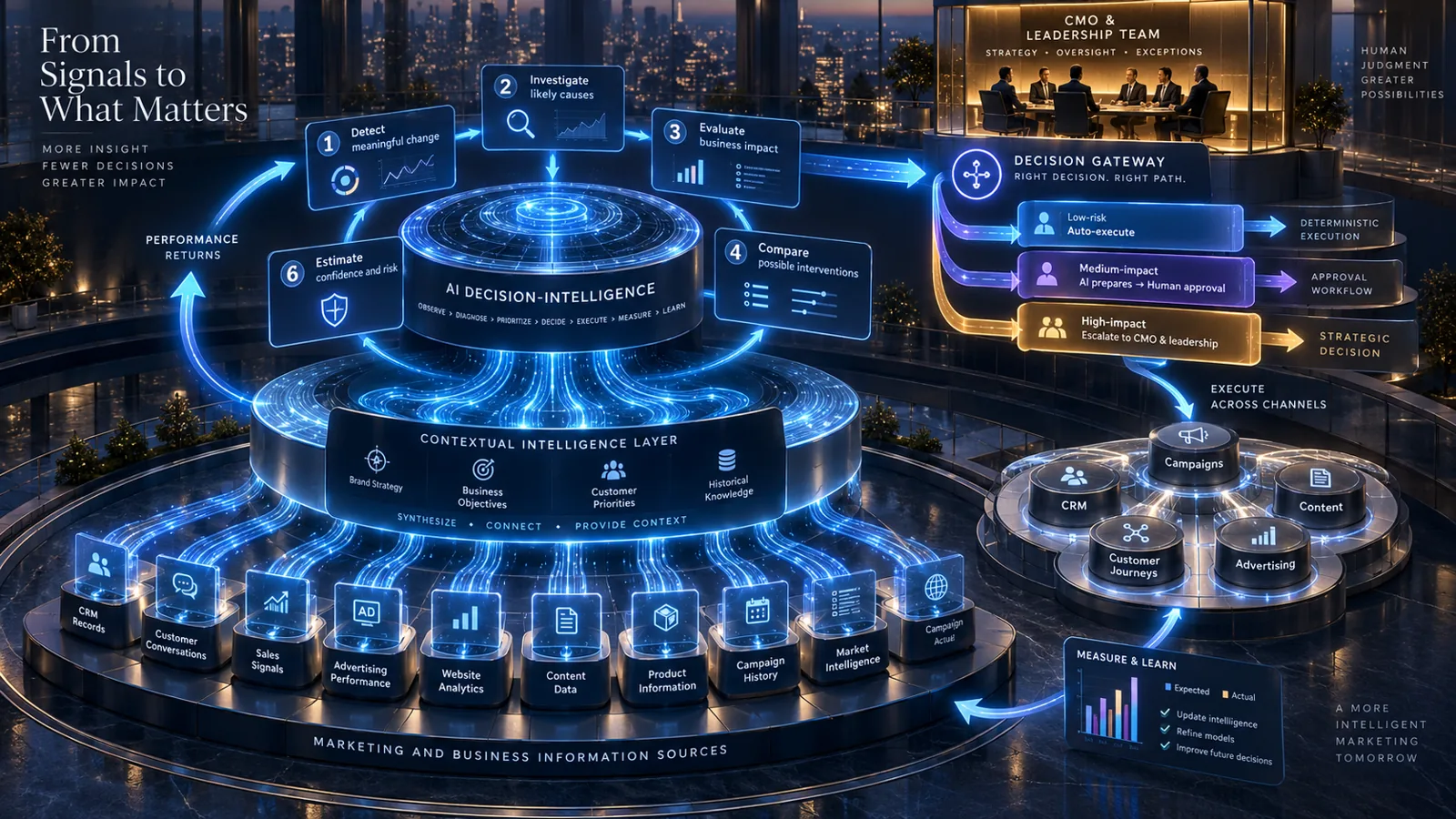
The Decision Intelligence Loop
A mature marketing decision-intelligence system operates continuously.
Observe
Monitor customers, campaigns, markets, and performance.
↓
Detect
Identify meaningful changes.
↓
Diagnose
Investigate why they occurred.
↓
Prioritize
Determine what matters most.
↓
Recommend
Identify possible responses.
↓
Decide
Human or machine chooses an action.
↓
Execute
Agent or automation performs the approved action.
↓
Measure
Evaluate the result.
↓
Learn
Update the intelligence system.
The last stage matters.
A decision system should remember:
- what decision was made
- why it was made
- what happened afterward
- whether the recommendation was correct
This creates an organizational learning loop.
Three Levels of Marketing Decisions
Not every marketing decision should be treated equally.
A useful operating model separates decisions into three levels.
Level 1: Operational Decisions
High-frequency and relatively low-risk.
Examples:
- scheduling
- CRM routing
- minor campaign optimizations
- content classification
Many of these decisions can be automated.
Level 2: Tactical Decisions
Require more judgment.
Examples:
- reallocating campaign spend
- changing audience prioritization
- modifying lifecycle journeys
- selecting an experiment
AI can recommend or sometimes act within defined limits.
Level 3: Strategic Decisions
High-impact and infrequent.
Examples:
- brand positioning
- market entry
- major budget allocation
- customer-segment strategy
- significant product messaging
These should remain strongly human-led.
Decision intelligence supports all three.
The difference is how much authority AI receives.
AI Decision Support vs AI Decision Automation
This distinction is critical.
Decision Support
AI provides:
- analysis
- evidence
- scenarios
- recommendations
A human decides.
Decision Augmentation
AI narrows the options and helps a human make the decision faster.
Decision Automation
AI makes and executes the decision within predefined boundaries.
Gartner's 2026 decision-intelligence definition explicitly includes systems that can support, augment, or automate decision-making.
The goal is not to automate every decision.
The goal is to choose the correct decision mode.
Where AI Agents Change Decision Intelligence
AI agents make decision intelligence significantly more interesting because they can potentially connect the decision to execution.
A traditional analytics tool may tell you:
Campaign performance declined.
A decision-intelligence agent might:
- 1detect the decline
- 2investigate causes
- 3consult campaign history
- 4compare audience performance
- 5generate possible interventions
- 6estimate potential impact
- 7prepare the chosen action
- 8execute it if permitted
- 9monitor what happens next
This compresses the distance between:
signal
and:
response.
That is where decision intelligence becomes part of an AI CMO operating model rather than merely an analytics feature.
Decision Intelligence Inside the AI CMO
The AI CMO can be understood as having two directions of flow.
Downward Flow
Human strategy
↓
objectives
↓
agents
↓
automation
↓
execution
Upward Flow
performance data
↓
analytics
↓
decision intelligence
↓
prioritized recommendations
↓
human leadership
Decision intelligence is therefore the upward interface of the AI CMO.
It determines what information deserves leadership attention.
This may eventually reduce the executive dependence on dashboards dramatically.
The CMO's Interface Could Become Exception-Based
Imagine a CMO starting Monday morning.
Instead of reviewing:
- paid search dashboard
- SEO dashboard
- social dashboard
- email dashboard
- CRM dashboard
the system provides:
Decision 1
Enterprise pipeline from organic search is at risk.
Recommended action: Approve three content interventions.
Decision 2
Campaign B significantly outperforms expected customer value.
Recommended action: Increase budget within defined limit.
Decision 3
Customer conversations show a rapidly increasing implementation objection.
Recommended action: Review messaging strategy.
Everything else is operating normally.
This is management by exception.
The executive focuses on deviations and choices rather than monitoring the entire system manually.
Decision Intelligence Can Improve Marketing Speed
Gartner's July 2026 marketing research argues that many marketing leaders still evaluate AI primarily through time and cost savings. Gartner says 81% of marketing leaders assess AI-driven automation based on time savings and 68% based on cost efficiency, potentially trapping organizations in incremental productivity improvements instead of using AI to improve strategic decision-making.
That is an important distinction.
The value of AI may not simply be:
create the report faster.
It may be:
make the decision sooner—and make a better one.
Decision quality and decision speed become strategic metrics.
What Makes Good Marketing Decision Intelligence?
A good system needs several foundations.
1. Reliable Data
Poor inputs still produce poor recommendations.
2. Shared Context
AI needs brand, customer, product, and business knowledge.
3. Explicit Objectives
The system must know what marketing is optimizing for.
4. Clear Decision Rights
Who can decide?
Human?
Agent?
Automation?
5. Evidence
Recommendations should be grounded in traceable information.
6. Confidence
The system should distinguish between strong and uncertain conclusions.
7. Feedback
Results should update future decisions.
Without these elements, AI may produce impressive explanations without becoming genuinely useful decision intelligence.
A Practical Decision Intelligence Framework for Marketing Teams
Marketing leaders can begin without replacing their entire analytics stack.
Step 1: Identify High-Value Decisions
Examples:
- budget allocation
- campaign optimization
- content prioritization
- audience targeting
- customer retention intervention
Step 2: Identify Required Inputs
What data is required for each decision?
Step 3: Define Decision Criteria
What makes one option better than another?
Step 4: Define Authority
Should AI:
- analyze
- recommend
- prepare
- execute?
Step 5: Create Decision Outputs
Do not simply generate dashboards.
Create decision-ready outputs containing:
- signal
- cause
- impact
- options
- recommendation
- confidence
- approval requirement
Step 6: Track Outcomes
Did the decision produce the intended result?
Step 7: Feed Learning Back
Use the result to improve future recommendations.
Why This Changes Marketing Analytics Roles
Marketing analysts will not become less important because AI can analyze data.
Their role may become more valuable if it moves upward.
Less time:
- assembling recurring reports
- copying metrics
- building static dashboards
More time:
- defining meaningful decisions
- validating causality
- improving data quality
- designing metrics
- challenging AI conclusions
- evaluating business impact
The future analyst may increasingly become a decision architect.
That is a much more strategic role.
The Future of Marketing Dashboards
Dashboards will not disappear.
They remain useful for:
- exploration
- operational monitoring
- auditability
- detailed analysis
But their prominence may decline.
The future hierarchy could become:
Decision intelligence first
↓
explanation and evidence second
↓
dashboard and raw data when needed
Today, executives frequently begin with dashboards and work upward toward decisions.
AI can reverse the order.
Begin with the decision.
Allow leaders to drill down when necessary.
That is a better interface for an increasingly complex marketing environment.
Marketing Needs Fewer Metrics and Better Decisions
One of the ironies of digital marketing is that measurement became easier while decision-making became harder.
Every platform created metrics.
Every team created dashboards.
Every campaign produced data.
But businesses do not win because they measured more things.
They win because they made better choices.
Marketing decision intelligence brings the function back to that basic reality.
The objective is not:
perfect visibility into everything.
The objective is:
better judgment about what deserves action.
Conclusion
Marketing analytics tells us what happened.
Decision intelligence asks what should happen next.
That difference becomes increasingly important as AI moves from:
reporting
to:
interpretation
to:
recommendation
to:
execution.
A mature marketing decision-intelligence system should help answer:
What changed?
Why did it change?
Why does it matter?
What should we do?
Who should decide?
What happened after we acted?
That is a much more valuable loop than simply generating another dashboard.
As AI agents, customer intelligence systems, and enterprise data become more connected, marketing organizations can begin moving from information-rich but decision-heavy environments toward systems where the complexity is interpreted before it reaches leadership.
The dashboard does not disappear.
It moves into the background.
The decision moves to the foreground.
And that may be one of the most important ways AI changes marketing leadership:
not by giving CMOs more information, but by helping them know what deserves a decision.
FAQs
1. What is marketing decision intelligence?
Marketing decision intelligence combines marketing data, analytics, business context, AI, and structured decision processes to help organizations make better marketing decisions and, in appropriate cases, automate those decisions.
2. How is marketing decision intelligence different from marketing analytics?
Marketing analytics focuses primarily on understanding data and performance. Decision intelligence goes further by connecting insights to decisions, actions, consequences, and outcomes.
3. What are examples of marketing decision intelligence?
Examples include identifying why campaign performance changed, recommending budget reallocations, prioritizing content opportunities, detecting customer risks, and determining which marketing actions require executive attention.
4. Can AI automate marketing decisions?
Yes, some decisions can be automated within defined constraints. High-frequency, low-risk operational decisions are better candidates, while strategic or consequential decisions should generally retain stronger human oversight.
5. Will decision intelligence replace marketing dashboards?
Not entirely. Dashboards remain useful for exploration and detailed analysis, but AI can increasingly interpret them first and surface prioritized decisions, anomalies, and recommendations to leaders.
6. What is the role of AI agents in decision intelligence?
AI agents can monitor data, investigate anomalies, use multiple tools, generate recommendations, prepare actions, and in some cases execute approved decisions within predefined permissions.
7. Why does decision intelligence need business context?
Metrics have different meanings depending on objectives, customers, budgets, strategy, and constraints. Business context allows AI to distinguish an important change from a statistically interesting but strategically irrelevant one.
8. How should a marketing team start implementing decision intelligence?
Start with a few high-value recurring decisions, define the required data and decision criteria, establish human and machine authority, produce decision-ready outputs, and track outcomes so future recommendations can improve.