Marketing Team Transformation: How AI Is Redesigning the Modern Marketing Organization
Instead of simply creating another marketing function, AI can operate across many existing ones.
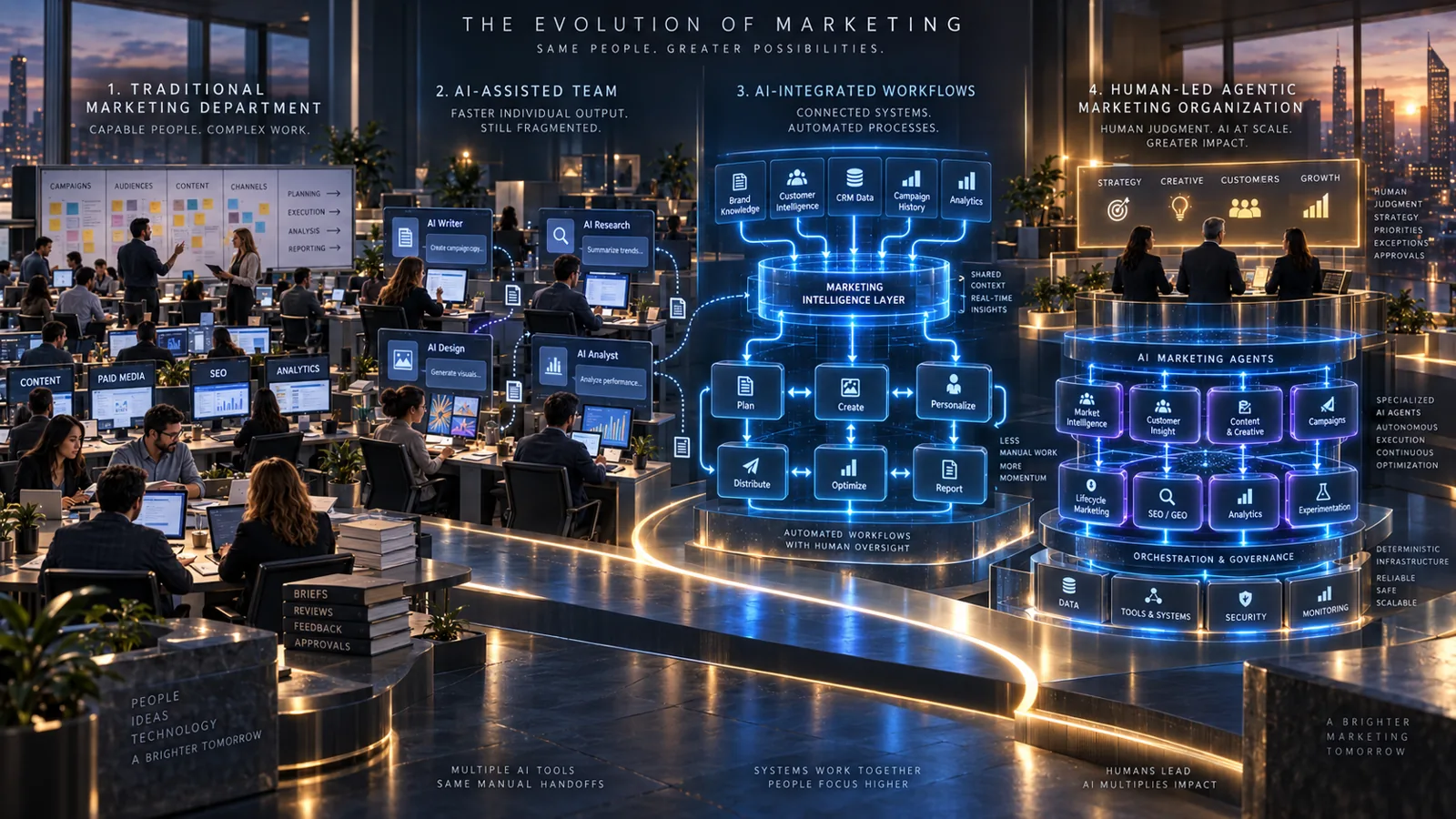
Marketing teams have been transforming for decades.
Digital created new channels.
Social created new roles.
Marketing automation created new operations teams.
Data created analytics functions.
SaaS created enormous MarTech stacks.
Each technological wave added capability.
It also usually added complexity.
More channels.
More specialists.
More software.
More handoffs.
More coordination.
Artificial intelligence introduces a different type of transformation.
Instead of simply creating another marketing function, AI can operate across many existing ones.
It can research.
Analyze.
Create.
Monitor.
Coordinate.
Recommend.
And increasingly, AI agents can perform multi-step work across connected systems.
That means marketing leaders face a more fundamental question than:
“Where should we add AI?”
The real question is:
“If AI can perform increasing amounts of marketing work, how should the marketing organization itself change?”
That is the marketing team transformation now underway.
Microsoft's 2026 Work Trend Index frames the challenge similarly: the issue is no longer simply individual access to AI. Organizations need to rearchitect work, because employees may develop AI capability faster than the systems, processes and management practices around them.
For marketing, that means the transformation cannot stop at copilots.
Roles, workflows, management structures and decision rights have to evolve too.
What Is Marketing Team Transformation?
Marketing team transformation is the redesign of a marketing organization's structure, roles, workflows, technology and decision-making model in response to changing business conditions and new capabilities such as artificial intelligence.
Historically, transformation often meant reorganizing people.
Today, it increasingly means redesigning the relationship between:
- humans
- AI agents
- automation
- data
- software
- workflows
The objective is not to make the existing organization slightly faster.
It is to create a better operating system for marketing.
The Traditional Marketing Team Was Built Around Human Execution
Most marketing departments still reflect an operating assumption that made perfect sense historically:
Humans perform the work.
Software supports them.
This creates functional structures such as:
- content team
- SEO team
- paid media team
- lifecycle team
- social team
- design team
- analytics team
- marketing operations team
The model works.
But every additional specialization introduces coordination.
For a single campaign, work may move through:
strategy → research → content → design → brand → media → CRM → analytics.
The more sophisticated the marketing organization becomes, the more people are required not only to perform work but also to coordinate work between specialists.
AI attacks that coordination problem differently.
It can increasingly operate between the functions.
The First Stage of Transformation: AI-Assisted Teams
Most organizations begin here.
Employees adopt tools such as AI assistants to improve individual productivity.
A writer drafts faster.
An analyst summarizes data.
A strategist researches competitors.
A designer creates concepts.
This can generate real value.
But the team structure remains mostly unchanged.
The workflow still looks like:
human → AI → human → human → system → another human.
Microsoft's 2026 research identifies a similar mismatch: many employees are already using AI in sophisticated ways, but organizational systems and practices often lag behind. Only 19% of surveyed AI users fell into Microsoft's highest “Frontier” category, where individual capability and organizational readiness reinforce each other.
That suggests a crucial point:
Individual AI adoption is not the same thing as organizational transformation.
The Four Stages of Marketing Team Transformation
A useful way to understand the transition is through four stages.
Stage 1: Traditional Marketing Team
Humans perform most work.
Software provides tools.
Workflows are largely manual.
Marketing capacity grows primarily through additional headcount.
Stage 2: AI-Assisted Marketing Team
Individuals use AI to accelerate tasks.
AI helps with:
- writing
- research
- summaries
- ideation
- analysis
But the human remains the main workflow coordinator.
Stage 3: AI-Integrated Marketing Team
AI becomes embedded into workflows.
Marketing teams begin connecting:
- AI
- CRM
- analytics
- CMS
- customer data
- automation
The organization starts reducing manual transfers between systems.
Stage 4: Agentic Marketing Team
AI agents take ownership of bounded responsibilities.
Agents can:
- monitor
- investigate
- prepare
- execute
- coordinate
- escalate
Humans increasingly focus on:
- objectives
- judgment
- creative direction
- governance
- strategy
The transition from Stage 2 to Stage 4 is where the real organizational transformation happens.
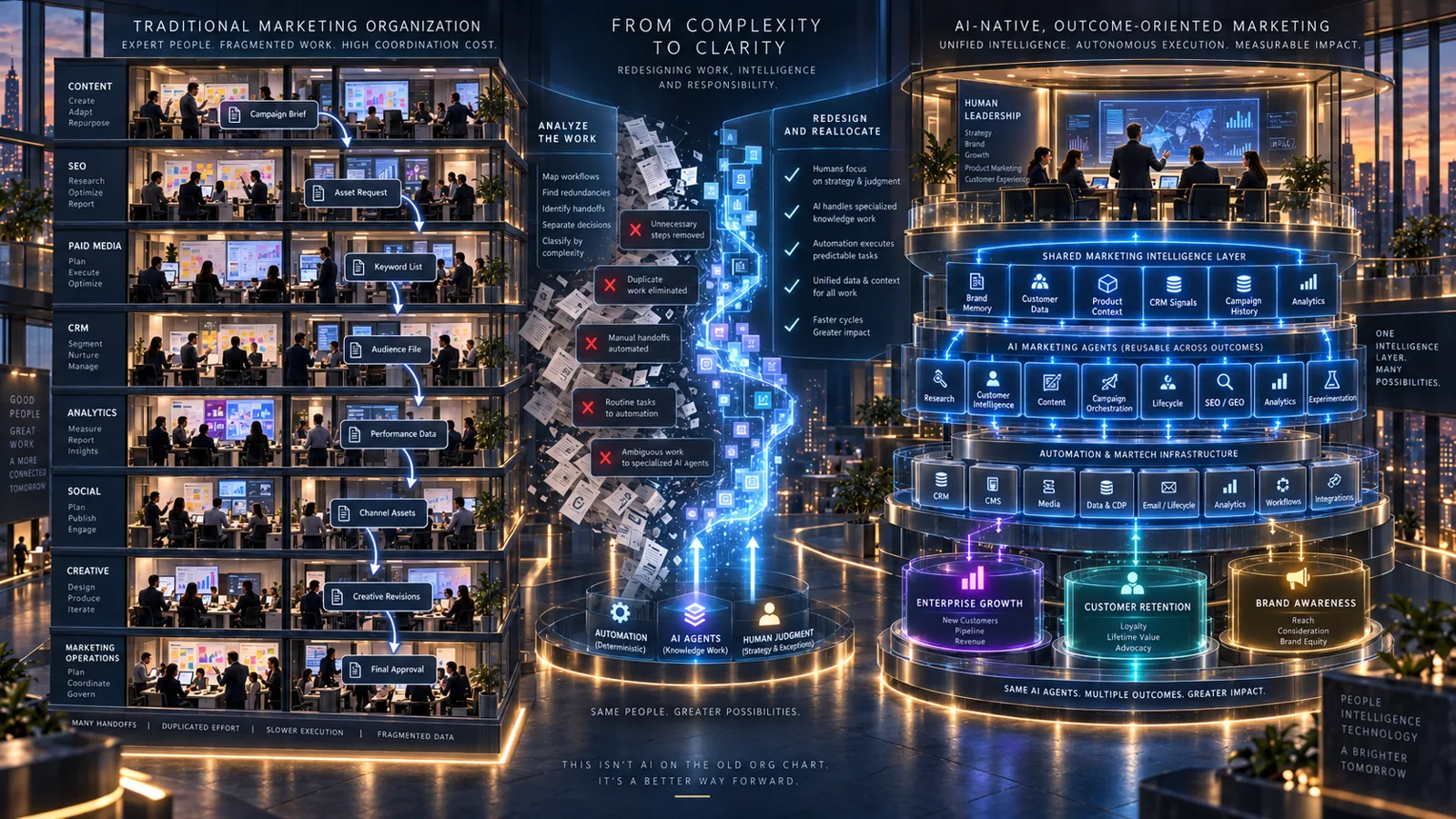
Transformation Starts With Work, Not Org Charts
A common mistake is to start by asking:
Which jobs can AI replace?
That is usually the wrong first question.
Jobs are bundles of activities.
Consider a lifecycle marketer.
Their role might contain:
- audience analysis
- campaign planning
- copywriting
- segmentation
- CRM configuration
- reporting
- stakeholder coordination
- experimentation
AI will not affect each activity equally.
A better transformation method is to map the work itself.
Every activity can be classified into four categories.
1. Eliminate
Does this work need to happen at all?
Examples:
- redundant status reports
- duplicate data entry
- unnecessary handoffs
2. Automate
Is the work predictable?
Examples:
- CRM updates
- scheduling
- data synchronization
- recurring notifications
3. Agentize
Does the work require reasoning or adaptation?
Examples:
- campaign analysis
- market research
- customer intelligence
- opportunity identification
4. Keep Human
Does it require judgment, accountability or creative leadership?
Examples:
- positioning
- major budget choices
- strategic messaging
- crisis communication
This method transforms the workflow before transforming the org chart.
Roles Will Become Broader, Not Just Smaller
Marketing has spent years increasing specialization.
AI may partially reverse that trend.
A marketer supported by intelligent systems can operate across a wider range of responsibilities.
For example, a future content leader may not need separate people manually responsible for:
- topic research
- basic SEO analysis
- first drafts
- repurposing
- performance summaries
Agents can support each capability underneath the role.
The human can focus on:
- editorial direction
- point of view
- quality
- audience understanding
- strategic distribution
This creates what might be called AI-enabled role compression.
Several execution responsibilities become capabilities available underneath one human role.
That does not mean expertise disappears.
It means specialists may spend more time applying expert judgment and less time performing every mechanical step.
The Marketing Manager Becomes an Orchestrator
Management also changes.
Traditional marketing managers coordinate:
- people
- deadlines
- campaigns
- approvals
- agencies
- meetings
Agentic systems introduce another management layer.
Future managers may also define:
- agent objectives
- permissions
- context
- escalation rules
- quality thresholds
- workflows
Microsoft's 2026 research argues that as agents take on execution, human agency can expand toward directing work and owning outcomes. It also found that stronger AI-performing organizations are more likely to document agent workflows, human handoffs and quality standards.
That implies a new managerial skill:
orchestration.
The manager does not merely assign tasks.
They design how humans and machines cooperate.
The CMO Role Changes Too
The CMO historically sits at the intersection of:
- brand
- growth
- customer
- technology
- revenue
AI increases the complexity of that intersection.
The modern CMO increasingly needs to understand:
- data architecture
- AI capabilities
- agent governance
- workflow design
- automation
- organizational redesign
McKinsey describes the emerging CMO as increasingly responsible for orchestrating data, technology and AI-enabled execution as marketing moves toward a more continuous growth model.
The CMO therefore becomes less of a manager of marketing departments and more of an architect of the marketing operating system.
Marketing Teams Will Become More Outcome-Oriented
Traditional organizational structures often follow channels.
Content.
Email.
SEO.
Social.
Paid media.
But customer problems rarely map neatly onto those boundaries.
AI makes it easier to organize around outcomes instead.
For example:
Outcome: Increase Enterprise Pipeline
Human lead:
Growth leader.
Supporting capabilities:
- research agent
- customer intelligence agent
- content agent
- campaign agent
- analytics agent
Outcome: Improve Customer Retention
Human lead:
Lifecycle leader.
Supporting capabilities:
- customer intelligence
- lifecycle agent
- content agent
- analytics agent
The team becomes more fluid.
Agent capabilities can be reused across outcomes.
This reduces the need for every objective to have its own permanent specialist infrastructure.
Shared Intelligence Becomes Organizational Infrastructure
One major weakness of traditional marketing teams is fragmented knowledge.
Brand context exists with one team.
Customer insight exists somewhere else.
Campaign history exists in analytics.
Competitor knowledge sits in presentations.
Product information sits with product marketing.
An AI-ready marketing organization needs a shared intelligence layer.
That layer can contain:
- brand knowledge
- customer insights
- campaign history
- product information
- performance data
- business priorities
- approved messaging
- experiments and lessons
This matters because agents are only as useful as the context they receive.
Ten agents with ten separate versions of the company create fragmentation.
Ten agents operating from shared organizational memory create leverage.
The Team Becomes a Human-Agent System
A mature marketing team may eventually operate across three layers.
Human Leadership
Responsible for:
- strategy
- judgment
- creative direction
- relationships
- accountability
Agentic Intelligence
Responsible for:
- research
- monitoring
- analysis
- dynamic decision support
- multi-step knowledge work
Deterministic Execution
Responsible for:
- CRM actions
- scheduling
- publishing
- synchronization
- repeatable workflows
This is more useful than asking whether AI will replace marketing.
The better question is:
Which operating layer should own each type of work?
What Happens to Marketing Headcount?
There is no universal answer.
Some organizations may reduce headcount.
Others may keep similar team sizes while dramatically increasing output.
Others may redeploy people toward new capabilities.
What matters more is the relationship between capacity and headcount.
In the traditional model:
more work often requires more people.
In an agentic model:
some additional work can be absorbed through:
- agent capacity
- automation
- workflow redesign
- better orchestration
Microsoft reports that the number of active agents in the Microsoft 365 ecosystem grew 15 times year over year through March 2026, indicating that agent adoption is increasingly moving beyond isolated experimentation.
The likely consequence is not simply smaller teams.
It is teams whose effective capacity becomes less tightly tied to human headcount.
The Biggest Risk Is Layering AI on Top of Old Work
The easiest transformation strategy is also the weakest:
keep every existing workflow, then add AI.
This creates:
- more tools
- more interfaces
- more prompts
- more notifications
- more agent outputs
without reducing organizational complexity.
That is not transformation.
It is augmentation.
Microsoft explicitly characterizes the current challenge as a systems problem: leaders need to redesign the environment around AI, including workflows, culture, quality standards and management practices.
The lesson for marketing leaders is straightforward.
Do not digitize bureaucracy.
Remove it.
A Practical Marketing Team Transformation Framework
A useful transformation program can follow seven steps.
Step 1: Map Current Work
Document major marketing workflows.
Identify:
- roles
- tools
- decisions
- data
- handoffs
- delays
Step 2: Define Outcomes
Reorganize thinking around outcomes rather than activities.
Instead of:
“content production”
use:
“generate qualified organic demand.”
Step 3: Redesign Work
Categorize each activity:
- eliminate
- automate
- agentize
- keep human
Step 4: Build Shared Intelligence
Connect the brand, customer, product and campaign context required for AI.
Step 5: Introduce Bounded Agents
Start with narrow responsibilities.
For example:
Monitor competitor positioning and report strategically relevant changes.
Not:
Run marketing.
Step 6: Redesign Human Roles
Ask:
What should this person stop doing now that the system exists?
This step is often skipped.
Without it, AI simply adds more work.
Step 7: Measure Organizational Outcomes
Track:
- campaign cycle time
- number of handoffs
- decision speed
- human intervention rate
- quality
- business results
Do not measure transformation by number of AI licenses.
Governance Needs to Evolve With the Team
As agents gain more authority, the organization needs clearer controls.
Define:
- which systems agents may access
- what they can modify
- spending thresholds
- publishing permissions
- escalation rules
- human approvals
OpenAI's business guidance on agents emphasizes that organizations should deliberately delegate, supervise and optimize agent work while using guardrails to preserve safe, valuable use.
OpenAI's current workspace-agent architecture similarly highlights administrative permissions, approval checkpoints and monitoring as necessary when agents operate real workflows.
Governance therefore becomes part of team design.
Not merely IT policy.
Culture Is Part of Transformation
Technology alone does not transform teams.
People need to trust the new operating model.
They also need permission to redesign work.
Microsoft found that its highest-performing “Frontier” professionals were significantly more likely to report managers who:
- use AI themselves
- define quality standards
- create room for experimentation
- encourage work redesign
The top signals associated with AI impact were organizational rather than demographic or purely individual.
That matters because teams will not redesign work if employees believe the safest option is to preserve existing processes.
Leaders need to make transformation part of the job.
What a Transformed Marketing Team Could Look Like
Imagine a future Monday morning.
The team does not begin by opening ten dashboards.
The analytics agent has already monitored them.
The market intelligence agent has flagged three meaningful changes.
The customer intelligence agent has identified a rising objection in sales conversations.
The content system has proposed two priorities based on that signal.
The campaign agent has prepared recommended adjustments.
The human leadership meeting focuses on:
- whether the signal matters
- whether positioning should change
- which strategic action to take
The humans make the consequential decisions.
The machines perform increasing amounts of preparation and execution.
Marketing becomes less about manually coordinating tasks.
It becomes more about directing an intelligent system.
Transformation Does Not Mean Removing Humans
The end state is not a marketing department with no marketers.
The more realistic target is:
fewer low-value coordination demands on humans.
Humans remain uniquely valuable when marketing requires:
- empathy
- judgment
- taste
- narrative
- relationships
- leadership
- accountability
AI becomes valuable where work requires:
- speed
- scale
- monitoring
- synthesis
- repetition
- coordination
The strongest organization allocates each capability appropriately.
Conclusion
Marketing team transformation is not a technology rollout.
It is an operating-model redesign.
The journey moves from:
traditional human execution
to:
AI-assisted productivity
to:
integrated AI workflows
to:
human-led agentic marketing organizations.
The transformation affects:
- roles
- workflows
- management
- team structure
- technology
- decision rights
- culture
Some activities disappear.
Some become automated.
Some become agentic.
Some become more valuable precisely because they remain human.
The most important change is that humans stop being the manual integration layer between every part of marketing.
Software and agents increasingly coordinate the operational complexity underneath them.
That gives people more room to focus on:
strategy.
creativity.
judgment.
customers.
decisions.
The future marketing team will therefore not simply be today's team equipped with better AI tools.
It will be a fundamentally different system of work.
And the companies that recognize that distinction early will be better positioned to turn AI capability into actual organizational advantage.
FAQs
1. What is marketing team transformation?
Marketing team transformation is the redesign of team structure, roles, workflows, technology and decision-making to improve how marketing operates. AI is accelerating this transformation by enabling automation, agentic execution and new human-AI working models.
2. How is AI changing marketing teams?
AI is automating repetitive tasks, supporting research and analysis, enabling agentic workflows and shifting human roles toward strategy, judgment, orchestration and creative direction.
3. Will AI reduce marketing team headcount?
It may in some organizations, but the impact will vary. A more reliable prediction is that AI will change the relationship between marketing capacity and human headcount by allowing teams to manage more work through agents and automation.
4. What is an agentic marketing team?
An agentic marketing team combines human leadership with specialized AI agents that perform bounded research, analysis, execution and monitoring tasks inside coordinated workflows.
5. What happens to marketing roles as AI adoption grows?
Roles are likely to become more focused on judgment, direction, orchestration and integration, while execution-heavy responsibilities increasingly shift toward AI and automation.
6. How should a company start transforming its marketing team?
Begin by mapping workflows, defining business outcomes, removing unnecessary work, identifying activities suitable for automation or agents, building shared context and redesigning human roles around higher-value responsibilities.
7. Why isn't buying more AI tools enough?
Tools can improve individual tasks while leaving fragmented processes unchanged. Organizational value comes from redesigning workflows, management practices and the operating model around AI capabilities.
8. What should remain human in an AI-powered marketing organization?
Humans should remain strongly involved in strategy, brand decisions, creative judgment, relationships, major budget decisions, sensitive communications, governance and accountability.