The AI CMO Operating Model: From Strategy to Autonomous Execution
How should all of that capability actually operate inside a marketing organization?
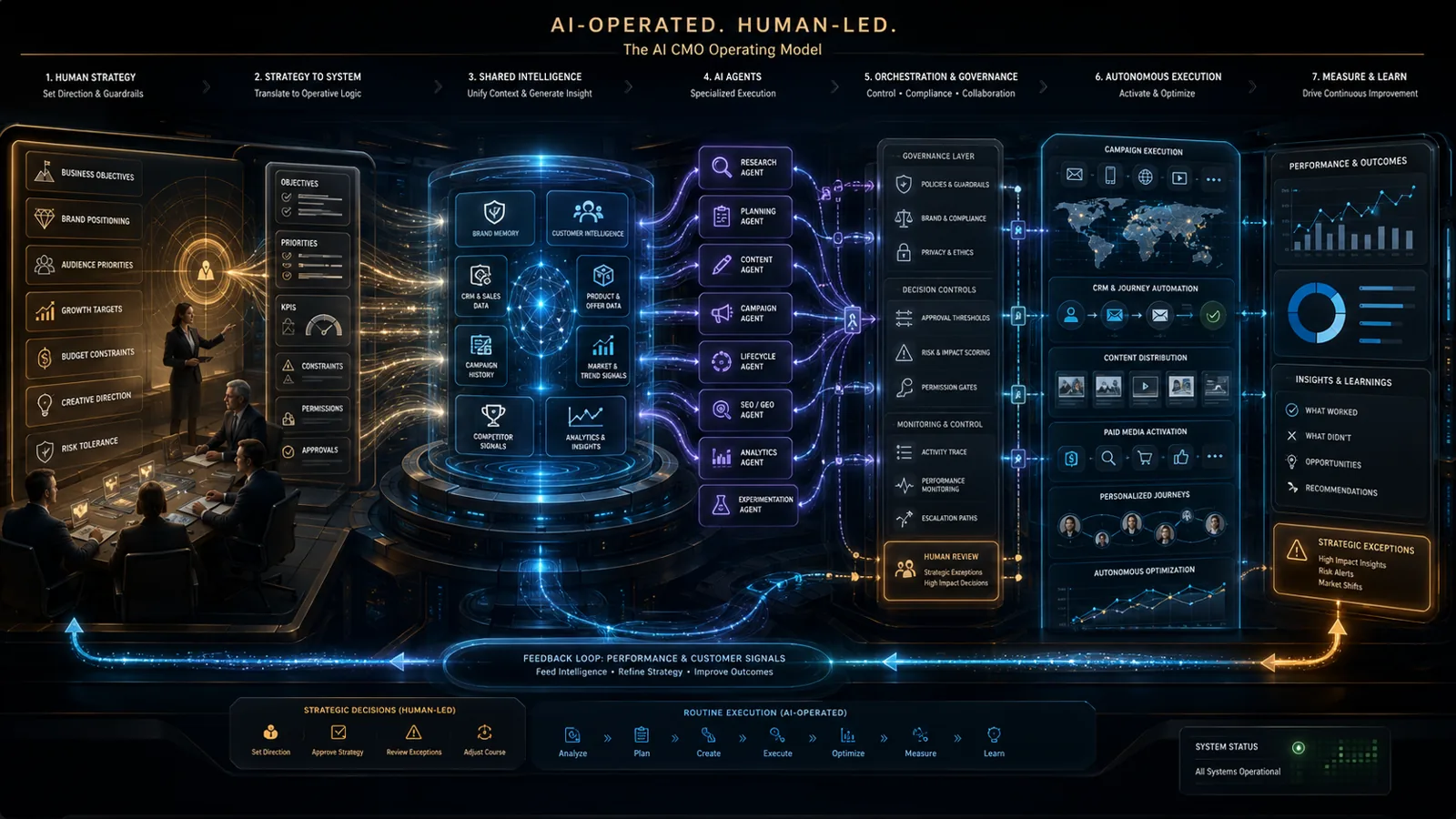
The most interesting question about AI marketing is no longer:
What can AI create?
We already know the answer is a lot.
AI can write.
Research.
Analyze.
Generate creative.
Summarize customer conversations.
Monitor campaigns.
Recommend experiments.
Operate software.
And increasingly, AI agents can perform multi-step work across multiple systems.
The harder question is:
How should all of that capability actually operate inside a marketing organization?
Who decides what matters?
Who turns strategy into execution?
Which decisions can AI make?
Which actions can agents perform automatically?
What still requires human approval?
And how does the organization prevent autonomous execution from becoming autonomous chaos?
This is the operating-model problem behind the AI CMO.
An AI CMO should not be understood as one artificial executive making every marketing decision.
A more useful model is:
human strategy → machine-readable objectives → shared intelligence → coordinated AI execution → human governance → continuous learning.
That is the AI CMO operating model.
It is the bridge between strategy and autonomous execution.
What Is the AI CMO Operating Model?
The AI CMO operating model is a human-led, AI-operated marketing framework in which leaders define strategy, objectives and permissions while AI systems, agents and automation coordinate increasing amounts of execution, monitoring and optimization.
This creates a division of responsibility.
Humans determine:
- where the business is going
- what the brand should stand for
- which customers matter
- what risks are acceptable
- what outcomes marketing should create
- where AI is permitted to act
AI systems then help translate those decisions into:
- research
- plans
- workflows
- content
- campaigns
- personalization
- analysis
- optimization
- recommendations
This is a fundamentally different model from simply giving every marketer an AI assistant.
Microsoft describes a similar organizational shift as agents move from assisting people to executing work. In an assistive model, humans still make and perform the decision. In an execution model, agents increasingly act across systems while humans oversee outcomes.
That shift changes the job of marketing leadership.
The CMO becomes less of a coordinator of tasks and more of an architect of the system.
Why the Operating Model Matters More Than the Model
Companies spend enormous attention choosing AI models.
GPT.
Claude.
Gemini.
Another enterprise model.
Model quality matters.
But the organizational advantage may increasingly come from everything surrounding the model.
The same underlying AI can perform very differently depending on:
- the context it receives
- the data it can access
- the tools it can use
- the workflows surrounding it
- its permissions
- its evaluation criteria
- its approval boundaries
This is why agentic AI increasingly forces companies to think about operating architecture rather than just technology.
McKinsey's 2026 work on agentic marketing argues that the larger opportunity lies in redesigning marketing workflows into a continuous growth engine connecting insights, content, commerce and performance rather than adding AI to isolated tasks.
That is precisely what an AI CMO operating model is supposed to accomplish.
The Six Stages of the AI CMO Operating Model
A useful AI CMO operating model can be understood as six connected stages:
- 1Human Strategy
- 2Objective Translation
- 3Intelligence & Planning
- 4Agentic Execution
- 5Governance & Escalation
- 6Measurement & Learning
These stages form a loop rather than a one-way pipeline.
Stage 1: Human Strategy
The system begins with humans.
This is important.
AI can analyze enormous amounts of information.
It can model potential outcomes.
It can recommend strategies.
But companies still need humans to answer questions that involve identity, judgment, ambition and accountability.
For example:
Who should we become?
Which market should we prioritize?
What customer problem do we want to own?
How aggressively should we grow?
What should the brand stand for?
What trade-offs are acceptable?
These are not merely optimization questions.
They are strategic choices.
What Human Strategy Should Define
The leadership layer should establish:
- business objectives
- brand positioning
- audience priorities
- growth targets
- marketing budget
- geographic priorities
- risk appetite
- creative direction
- customer promises
- strategic constraints
This becomes the north star for everything underneath.
Without clear strategy, autonomous execution simply allows AI to perform unclear work faster.
Stage 2: Translate Strategy Into Machine-Readable Objectives
This is where many AI initiatives fail.
Humans speak in strategic language.
A CEO might say:
“We need to become the category leader among mid-market companies.”
That is directionally useful.
It is not yet operational.
An AI CMO system needs to translate strategy into measurable objectives and constraints.
For example:
Strategic Direction
Become the most trusted solution for mid-market finance teams.
Marketing Objectives
Increase qualified pipeline from organizations with 200–2,000 employees.
Audience Priority
Finance leaders and operations leaders.
Messaging Priority
Reduce manual operational complexity.
Success Metrics
- qualified opportunities
- conversion rate
- pipeline value
- customer acquisition efficiency
Constraints
- maintain premium positioning
- no unsupported claims
- human approval required for new positioning
- advertising spend changes above threshold require approval
Strategy becomes executable when the system understands both:
what to optimize for
and:
what it is not allowed to sacrifice.
Stage 3: Intelligence and Planning
Once objectives exist, the AI CMO needs to understand the environment.
This layer continuously synthesizes:
- market intelligence
- customer signals
- competitor activity
- campaign history
- sales feedback
- search behavior
- content performance
- product information
- CRM activity
- brand context
From that information, the system can build or update plans.
This is where marketing starts moving away from fixed annual planning toward more continuous decision-making.
McKinsey's June 2026 view of AI-powered marketing identifies capabilities around insights, creativity, personalization, agentic commerce and orchestration as core pillars of the future marketing model.
The implication is significant.
Marketing planning becomes less episodic.
It becomes continuously informed.
Example
Suppose an AI CMO is monitoring an enterprise SaaS market.
It notices:
- competitor messaging shifting toward security
- increased customer questions around compliance
- sales-call objections changing
- search interest growing around a related topic
- content addressing that topic outperforming benchmarks
A traditional team may discover these patterns over several meetings.
An intelligence layer can identify them continuously.
The system might surface:
Emerging opportunity: compliance-led positioning is gaining relevance among enterprise buyers.
Humans can then determine whether that opportunity should affect strategy.
Stage 4: Agentic Execution
Once goals and plans are approved, execution begins.
This is where specialized agents become useful.
A research agent can gather information.
A content agent can create briefs.
A creative agent can generate variants.
A lifecycle agent can adapt customer communications.
A campaign agent can coordinate execution.
An analytics agent can monitor results.
An experimentation agent can design tests.
But the most important shift is not that AI performs individual tasks.
It is that these capabilities can increasingly work toward shared objectives.
OpenAI's production agent architecture reflects this broader operating pattern through tools, agent handoffs, guardrails, tracing and evaluation rather than treating each model interaction as a standalone prompt.
What Autonomous Execution Might Look Like
Suppose the approved objective is:
Increase qualified product-demo demand from financial-services companies.
An AI CMO could potentially coordinate:
Research AgentIdentifies high-intent audience problems.
↓
Customer Intelligence AgentAnalyzes relevant CRM and sales signals.
↓
Strategy AgentProposes campaign angles.
↓
Human LeaderApproves strategic direction.
↓
Content AgentCreates content and landing-page recommendations.
↓
Campaign AgentPrepares distribution.
↓
AutomationExecutes approved publishing and CRM workflows.
↓
Analytics AgentMonitors performance.
↓
Optimization AgentInvestigates anomalies and recommends changes.
This is not simply AI-assisted content production.
It is AI-operated execution.
Autonomous Does Not Mean Unsupervised
The word autonomous creates unnecessary confusion.
Organizations often imagine two extremes:
Humans manually approve everything.
or:
AI does whatever it wants.
Neither is a mature operating model.
Autonomy should exist on a spectrum.
Anthropic's 2026 research into real-world agent use found that experienced users often grant agents more autonomy but also intervene selectively when necessary. The research argues that effective agent deployment will require new oversight models that help humans and AI manage autonomy and risk together.
That suggests a better model:
govern by exception.
Four Levels of Marketing Autonomy
Level 1 — Recommend
AI analyzes information and recommends actions.
Humans execute everything.
Example:
“Organic pipeline appears at risk. Consider refreshing these three pages.”
Level 2 — Prepare
AI prepares the action but waits for approval.
Example:
“I have prepared revised content and campaign changes. Approve?”
Level 3 — Execute Within Limits
AI performs actions automatically within defined thresholds.
Example:
“Optimize campaign allocations within ±10% of approved budgets.”
Level 4 — Autonomous Workflow
AI manages an extended process and escalates only when conditions exceed predefined boundaries.
Example:
“Manage ongoing campaign optimization, but escalate material budget changes, new positioning, regulatory risks or performance anomalies.”
Different marketing workflows should operate at different levels.
Where Humans Should Remain in Control
AI should generally have less autonomy when the activity involves:
- major brand changes
- sensitive customer communication
- large budget changes
- public crisis response
- regulatory claims
- new market entry
- product positioning
- strategic partnerships
- high-reputation-risk content
AI can often have greater autonomy in:
- research
- monitoring
- reporting
- classification
- scheduling
- routine optimization
- internal summarization
- low-risk data synchronization
The principle is:
Autonomy should increase as consequence decreases and reliability increases.
Governance Is Part of the Operating Model
Governance cannot be bolted on later.
When AI systems act across tools, organizations need clear rules governing:
- data access
- system access
- publishing permissions
- budget authority
- customer communication
- escalation
- logging
- review
- reversibility
OpenAI's business guidance for agent deployment emphasizes guardrails precisely because agents can plan, adapt and act across multiple tools. These controls can include approved data sources, confirmation before consequential actions and clear restrictions on what agents may do.
Anthropic similarly argues that increased agent autonomy creates new governance risks because systems may misinterpret intent or take unintended actions.
This means autonomy cannot be treated as simply an AI capability.
It is a permission design problem.
The AI CMO Should Operate Through Decision Rights
Every autonomous marketing organization needs to define decision rights.
A useful framework separates decisions into three classes.
Machine-Owned Decisions
Low-risk, reversible, high-frequency actions.
Examples:
- classify customer feedback
- schedule approved content
- update CRM fields
- detect anomalies
- generate routine reports
Machine-Proposed, Human-Approved Decisions
Medium- or high-impact actions where AI provides analysis but humans approve.
Examples:
- campaign strategy
- new creative direction
- larger budget reallocation
- new audience positioning
- major website changes
Human-Owned Decisions
Strategic or highly consequential decisions.
Examples:
- brand positioning
- annual marketing strategy
- market entry
- crisis communications
- company-level messaging
- major capital allocation
This framework prevents one of the biggest risks in autonomous marketing:
AI slowly accumulating decision authority simply because the technology can technically perform more actions.
Capability does not automatically equal permission.
From Campaign Management to Continuous Marketing
Traditional marketing tends to operate episodically.
Plan.
Launch.
Measure.
Review.
Repeat.
An AI CMO operating model can increasingly operate continuously.
The loop becomes:
observe → interpret → prioritize → act → measure → learn → adjust
This matters because customer behavior does not wait for quarterly planning cycles.
Competitors change.
Markets shift.
Campaign performance deteriorates.
Customer questions evolve.
Search behavior changes.
An AI-powered operating model can detect those changes more quickly.
McKinsey describes future marketing as a continuous real-time growth engine rather than a collection of disconnected campaigns and channels.
The AI CMO is one possible architecture for making that continuous model operational.
The Human CMO's Job Changes
The CMO does not disappear.
The job changes.
Traditional CMO responsibilities include enormous amounts of coordination.
Meetings.
Approvals.
Reports.
Budget reviews.
Campaign reviews.
Agency coordination.
Performance interpretation.
AI can increasingly absorb parts of that coordination layer.
The CMO then spends more time on:
- strategic direction
- resource allocation
- creative judgment
- customer understanding
- market decisions
- organizational leadership
- defining AI permissions
- evaluating major recommendations
Microsoft's 2026 Work Trend Index argues that as agents take on more execution, people can gain greater agency to direct work and own outcomes—but only if organizations redesign how work is structured.
That is perhaps the clearest description of the AI CMO transition.
AI does more execution.
Humans gain more leverage over direction.
The AI CMO Becomes an Organizational Control Loop
Another useful way to understand the operating model is as a control system.
Humans define:
desired state
Where should marketing go?
↓
AI observes:
current state
What is actually happening?
↓
Intelligence determines:
gap
What is preventing us from reaching the objective?
↓
Agents recommend or execute:
intervention
What should happen next?
↓
Analytics measure:
result
Did the intervention work?
↓
Humans and AI update:
strategy and execution
What should change?
This loop can operate continuously.
That is much more powerful than treating AI as a collection of content-generation features.
What Companies Need to Build This Operating Model
Organizations do not need to automate an entire marketing department on day one.
They need several foundations.
1. Clear Objectives
Agents cannot reliably optimize vague ambitions.
2. Shared Context
Brand, customer, product and business information must be available.
3. Simplified Workflows
Broken processes should be redesigned before they are automated.
4. The Right Mix of Agents and Automation
Predictable work should remain deterministic.
Ambiguous work may benefit from agents.
5. Explicit Decision Rights
Every agent needs a defined authority boundary.
6. Observability
Organizations need to understand what agents did and why.
7. Evaluation
Outputs should be measured against quality and business objectives.
8. Human Leadership
AI should amplify strategic leadership, not create ambiguity about accountability.
What the Mature AI CMO Operating Model Looks Like
Imagine a marketing organization several years into this transition.
Monday morning does not begin with executives checking fifteen dashboards.
The AI CMO has already monitored them.
The leadership team receives:
Priority 1
Enterprise conversion has improved significantly after a messaging change.
Recommendation: Increase exposure.
Priority 2
Customer churn signals are increasing in one segment.
Recommendation: Launch investigation.
Priority 3
A competitor has introduced a major pricing change.
Recommendation: Review positioning.
Meanwhile:
Research agents continue monitoring the market.
Campaign agents coordinate approved programs.
Lifecycle agents manage customer journeys.
Analytics agents watch performance.
Automation executes predictable processes.
Humans intervene when:
- strategic direction changes
- uncertainty becomes significant
- risk increases
- major investments are required
- creative judgment matters
Marketing has not become humanless.
It has become less manually coordinated.
That distinction matters.
The Ultimate Goal Is Not Autonomy
It is tempting to measure AI maturity by how much work runs without humans.
That is the wrong metric.
The goal should be:
maximum useful leverage with appropriate human control.
A completely autonomous system producing mediocre marketing is not advanced.
A carefully designed human-AI organization producing better decisions, faster execution and stronger business outcomes is.
The strongest AI CMO operating model therefore does not ask:
“How much can we automate?”
It asks:
“Where does human judgment create the most value, and how can AI operate everything else responsibly around it?”
That is a fundamentally different philosophy.
Conclusion
The AI CMO operating model is not about replacing the Chief Marketing Officer with software.
It is about redesigning the relationship between strategy and execution.
Humans define:
- direction
- objectives
- values
- permissions
- trade-offs
AI systems increasingly handle:
- intelligence
- planning support
- coordination
- execution
- monitoring
- optimization
Governance connects the two.
And results continuously feed back into future decisions.
The operating loop becomes:
human strategy
↓
machine-readable objectives
↓
shared intelligence
↓
agentic execution
↓
governance
↓
measurement
↓
learning
↓
better strategy
That is the path from AI-assisted marketing to AI-operated marketing.
And ultimately, that may be the defining characteristic of the AI CMO:
not autonomous leadership, but autonomous execution under human leadership.
FAQs
1. What is the AI CMO operating model?
The AI CMO operating model is a human-led, AI-operated framework in which leaders define strategy, objectives and permissions while AI systems and agents increasingly coordinate execution, monitoring and optimization.
2. Does an AI CMO make marketing fully autonomous?
No. Different workflows should operate at different autonomy levels. Low-risk work may execute automatically, while strategic, sensitive or high-impact decisions should remain under human control.
3. What does autonomous marketing execution mean?
Autonomous marketing execution means AI agents or systems can perform defined multi-step marketing tasks and use connected tools without requiring humans to manually complete every intermediate action.
4. What remains the responsibility of the human CMO?
The human CMO should remain accountable for business strategy, brand direction, major resource allocation, creative judgment, risk decisions, organizational leadership and the boundaries within which AI operates.
5. How is an AI CMO different from marketing automation?
Traditional automation mainly executes predefined rules. An AI CMO adds shared context, agentic reasoning, orchestration, decision intelligence and adaptive execution above deterministic marketing automation.
6. How should companies determine how much autonomy to give AI agents?
Autonomy should depend on reliability, reversibility, risk and business consequence. Low-risk tasks can receive broader authority, while high-impact actions should require stronger human oversight.
7. What is human-in-the-loop marketing?
Human-in-the-loop marketing is an operating model in which AI performs or recommends work while humans remain involved at strategically or operationally important decision points.
8. How do companies start building an AI CMO operating model?
Begin with clear objectives, map one important workflow, establish shared context, determine what should be automated versus agentic, define decision rights and human approvals, and measure results before expanding autonomy.