What Is an AI CMO? The Complete Guide to AI-Powered Marketing Leadership in 2026
Marketing has spent the last several years adding artificial intelligence to individual tasks.
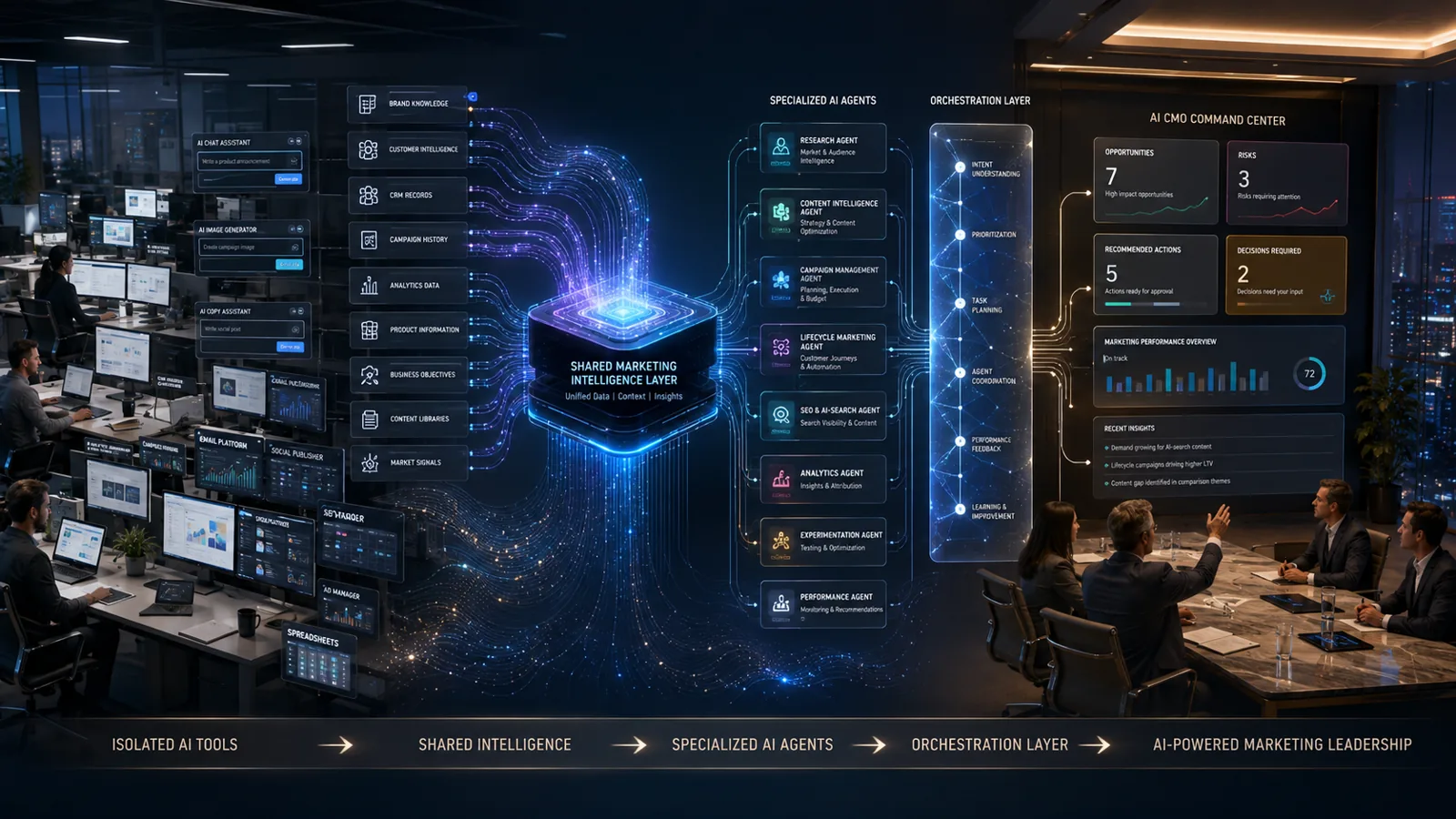
Marketing has spent the last several years adding artificial intelligence to individual tasks.
AI can write an email.
It can generate an advertisement.
It can summarize analytics.
It can research competitors, suggest campaign ideas, create social posts and analyze customer feedback.
But giving marketers dozens of AI tools does not automatically create an AI-powered marketing organization.
Someone—or something—still has to connect the customer data, understand the brand, coordinate campaigns, prioritize opportunities, allocate resources, monitor performance and determine what should happen next.
That is where the idea of the AI CMO becomes important.
An AI CMO is best understood not as an artificial replacement for a Chief Marketing Officer, but as an AI-powered marketing leadership and orchestration system that helps organizations analyze, plan, execute and continuously optimize marketing through connected intelligence, automation and specialized AI agents.
The distinction matters.
The future of marketing is unlikely to be defined simply by marketers becoming better at prompting individual AI applications. Increasingly, the larger opportunity is to redesign how marketing itself operates.
Microsoft, for example, said in April 2026 that its Azure AI marketing organization had been developing agent-based tools to transform marketers' work and amplify human impact. McKinsey similarly argues that the opportunity extends beyond automating existing workflows toward creating a continuous AI-powered growth engine spanning insights, creation, personalization and orchestration.
The AI CMO represents that next layer.
It connects intelligence with execution.
And it could fundamentally change what marketing leadership looks like.
What Is an AI CMO?
An AI CMO is an AI-powered marketing system that supports marketing leadership by combining business context, customer intelligence, brand knowledge, analytics, automation and specialized AI agents to help plan, execute, monitor and optimize marketing activities.
Unlike a basic AI assistant, an AI CMO is designed to operate across marketing functions rather than completing isolated tasks.
It may coordinate activities such as:
- market research
- customer intelligence
- content strategy
- campaign planning
- content production
- lifecycle marketing
- CRM workflows
- personalization
- SEO and AI-search visibility
- performance monitoring
- experimentation
- reporting
- budget recommendations
- marketing decision support
The most important word is coordinate.
AI-generated content alone is not marketing leadership.
Neither is an analytics chatbot.
Neither is an automated email sequence.
An AI CMO becomes valuable when these capabilities begin operating as parts of the same system.
Why Is the AI CMO Emerging Now?
Several technological shifts are happening simultaneously.
Large language models can reason across significantly more information than early AI marketing tools.
AI agents can increasingly perform sequences of tasks instead of answering only one prompt.
Enterprise AI platforms are connecting models with internal data, applications and permissions.
Marketing organizations are also accumulating enormous quantities of customer, campaign, content and performance information that humans cannot continuously analyze manually.
Microsoft describes current AI marketing applications across customer insights, campaign execution, content, personalization and CRM-connected workflows. Its enterprise materials increasingly emphasize agents capable of executing business processes rather than simply generating recommendations.
At the same time, customer discovery itself is changing.
Traditional search engines are increasingly being joined by AI assistants, answer engines and purchasing agents. Microsoft Advertising notes that AI-powered search and generative answers are changing both how consumers ask questions and how brands are surfaced within responses.
Marketing therefore has to operate across more channels, more customer contexts and more machine-mediated interactions.
A human marketing organization cannot simply respond by creating more dashboards.
It needs better intelligence.
AI CMO vs AI Assistant: What Is the Difference?
This is one of the most important distinctions.
An AI assistant responds to requests.
An AI CMO coordinates marketing toward objectives.
Consider the difference.
Imagine asking an AI assistant:link
“Write five LinkedIn posts promoting our new product.”
It completes the task.
An AI CMO would ideally understand:
- what the product is
- who the ideal customer is
- how the brand communicates
- what campaigns are currently running
- what content has already been published
- which messages performed well
- what the current business objectives are
- what competitors are discussing
- what customers are asking
- which channels matter
- what content requires human approval
It might then determine that five LinkedIn posts are not actually the highest-priority action.
That is the difference between generation and marketing intelligence.
How Does an AI CMO Work?
There is no single universal AI CMO architecture yet, but a useful model contains several interconnected layers.
1. Business Context
The system needs to understand what the organization is trying to achieve.
That can include:
- revenue goals
- growth priorities
- products
- target markets
- positioning
- strategic initiatives
- campaigns
- budgets
- constraints
Without business context, AI optimizes tasks rather than outcomes.
2. Brand Memory
Generative AI without persistent context often produces generic output.
An AI CMO therefore needs access to an evolving brand knowledge layer containing information such as:
- brand positioning
- voice
- messaging
- product knowledge
- approved claims
- audience personas
- customer pain points
- previous campaigns
- content history
- creative guidelines
This is essentially the organizational memory required for consistent marketing decisions.
3. Customer Intelligence
The system may connect information from:
- CRM
- customer support
- website behavior
- sales conversations
- marketing automation
- surveys
- product usage
- transaction history
This gives AI a richer understanding of what customers actually need rather than relying exclusively on prompts written by marketers.
4. Specialized AI Agents
Instead of one enormous AI system attempting everything, an AI CMO can coordinate specialized agents.
For example:
Research AgentTracks markets, customers and competitors.
Content Intelligence AgentIdentifies content opportunities and audience questions.
Creative AgentDevelops campaign concepts and creative variations.
SEO/GEO AgentOptimizes discoverability across traditional and AI-powered search.
Lifecycle AgentCoordinates CRM and customer communications.
Campaign AgentLaunches and monitors campaigns.
Analytics AgentEvaluates performance and identifies anomalies.
Experimentation AgentDesigns and evaluates tests.
These agents do not need to resemble humans.
They are better understood as specialized software capabilities assigned responsibility for specific marketing processes.
McKinsey argues that significant agentic value comes not from adding agents to isolated tasks but from redesigning complete workflows and combining human-AI teams, shared data and governance.
5. Orchestration Layer
This is where the system becomes more than a collection of tools.
The orchestration layer determines:
- which agent should act
- what information it needs
- which actions can happen automatically
- which actions require approval
- what happens after an action is completed
- how results affect future decisions
It acts like the coordination infrastructure of the marketing organization.
6. Decision Intelligence
Traditional marketing dashboards show information.
An AI CMO should increasingly interpret it.
Instead of presenting a CMO with fifteen dashboards, the system could surface:
What changed?
Organic product-page traffic dropped 18%.
Why?
Several high-ranking pages lost visibility while competitor content increased.
Business impact?
Pipeline contribution from organic search may decline if the trend continues.
Recommended action?
Refresh three pages, strengthen product-comparison content and investigate AI-search visibility.
Human decision required?
Approve the proposed content and resource allocation.
This moves analytics from reporting toward decision intelligence.
What Can an AI CMO Actually Do?
The capabilities will vary by organization, but an advanced AI CMO could support much of the marketing lifecycle.
Market Intelligence
Continuously analyze:
- competitor activity
- industry developments
- customer conversations
- search trends
- product feedback
- market signals
Marketing Strategy Support
Use those signals to identify:
- emerging opportunities
- customer segments
- messaging priorities
- campaign themes
- channel strategies
- experimentation opportunities
The human leader should still establish business direction.
AI helps translate that direction into continuously updated marketing intelligence.
Content Operations
The system could coordinate:
research → strategy → briefs → creation → review → distribution → measurement → learning.
That is dramatically different from asking ChatGPT to generate a blog post.
Campaign Management
AI agents could help:
- 1identify an opportunity
- 2create a campaign plan
- 3develop channel assets
- 4configure targeting
- 5launch approved activities
- 6monitor performance
- 7identify anomalies
- 8recommend changes
- 9generate new creative
- 10report outcomes
Personalization
AI can combine audience information with contextual signals to personalize customer experiences more dynamically.
Personalization is already one of the major areas where organizations are integrating AI into end-to-end marketing workflows rather than isolated experiments.
Marketing Analytics
Instead of asking executives to interpret endless charts, AI can continuously monitor those charts underneath the system.
The human receives exceptions, opportunities and decisions.
Does an AI CMO Replace the Human CMO?
No.
At least, that is not the most useful way to think about it.
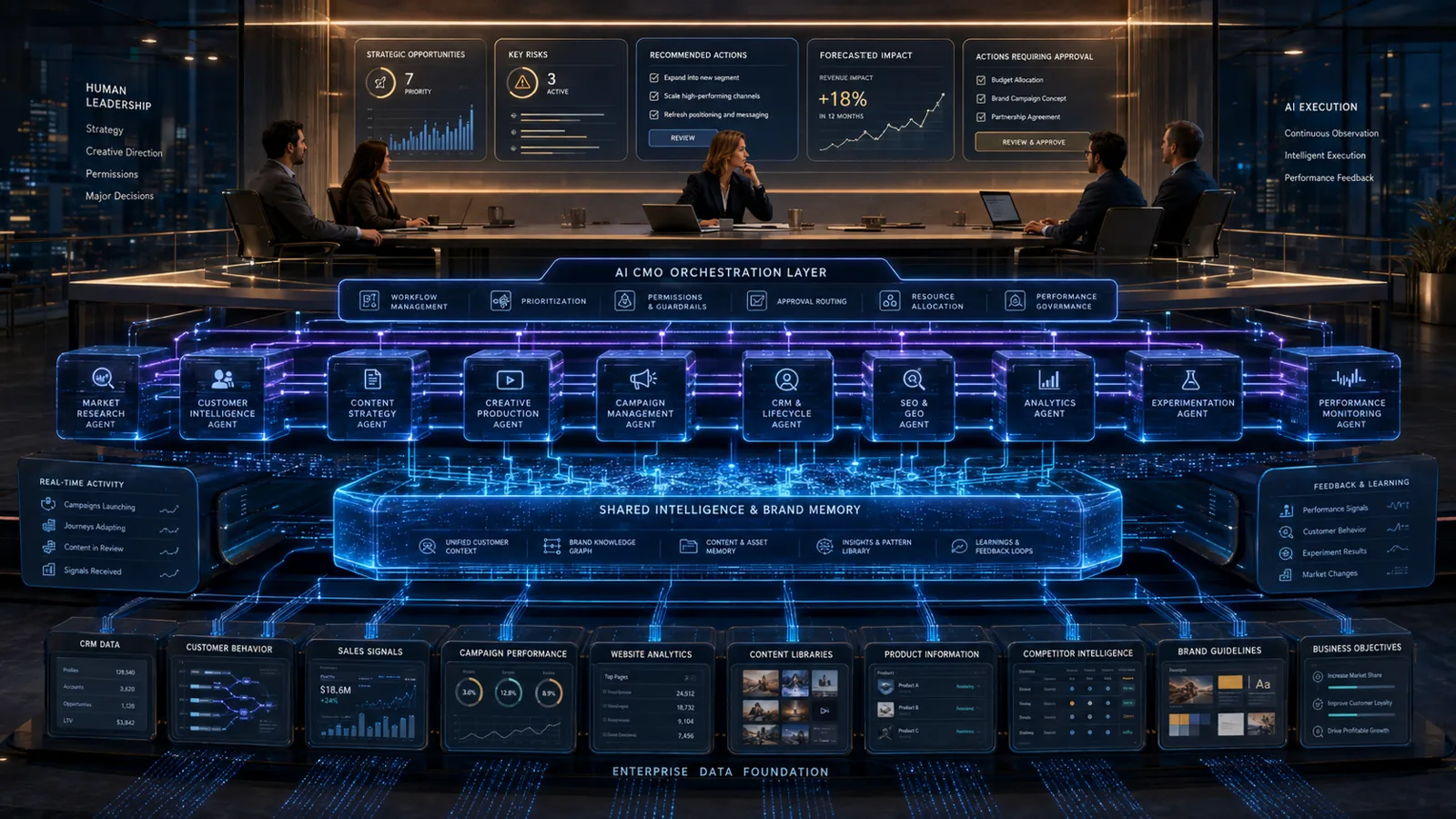
The stronger model is human-led, AI-operated marketing.
AI is extremely useful when work requires:
- monitoring enormous datasets
- generating variations
- detecting patterns
- coordinating repetitive workflows
- summarizing information
- executing clearly bounded actions
Humans remain critical when work requires:
- judgment
- accountability
- taste
- empathy
- organizational leadership
- brand direction
- ethical decisions
- major budget decisions
- strategic trade-offs
- understanding ambiguous business environments
The human CMO therefore moves upward in the decision hierarchy.
Instead of spending substantial time asking:
“What happened to campaign performance?”
the CMO can spend more time asking:
“Should we enter this market?”
“Are we positioning this product correctly?”
“What customer problem should we own?”
“What should the brand stand for?”
The AI CMO does not eliminate marketing leadership.
It can make marketing leadership more strategic.
AI CMO vs Traditional Marketing Automation
Marketing automation has existed for decades.
So what is different?
Traditional automation usually operates through predetermined logic.
IF customer downloads guideTHEN send email.
IF lead reaches scoreTHEN notify sales.
Agentic AI introduces more flexible reasoning.
The system may evaluate context, select from several actions and adapt the workflow dynamically.
Traditional automation remains extremely useful.
AI does not make workflows, CRM rules or deterministic automation obsolete.
Instead, intelligence increasingly sits above them, determining when and how different systems should operate.
What Are the Benefits of an AI CMO?
1. Faster Marketing Execution
Research, analysis, content and operational processes can happen dramatically faster.
2. Better Use of Marketing Data
Customer, campaign and market information becomes continuously interpreted rather than waiting for periodic reports.
3. Greater Personalization
AI can evaluate more audience signals and generate more relevant experiences at scale.
4. Consistent Brand Intelligence
Persistent brand memory can reduce the inconsistency created when every employee independently prompts different AI tools.
5. Continuous Optimization
Campaigns can be monitored continuously instead of waiting for weekly performance reviews.
6. More Strategic Human Roles
Marketers can spend less time coordinating mechanical tasks and more time on judgment, creativity, relationships and business decisions.
The economic motivation is substantial. McKinsey estimated earlier in the generative-AI adoption cycle that generative AI alone could create productivity value equivalent to roughly 5–15% of total marketing spending. Its more recent research argues that companies redesigning marketing around AI can potentially achieve much larger improvements in productivity and execution efficiency, although results depend heavily on implementation quality.
What Are the Limitations of an AI CMO?
AI-powered marketing is not automatically good marketing.
Several major limitations remain.
Bad Context Produces Bad Decisions
If product data, customer information or brand knowledge is wrong, the AI can confidently optimize in the wrong direction.
Generated Content Can Become Generic
When every organization uses similar models without proprietary context, outputs converge.
Brand memory, customer insight and human creative judgment therefore become more valuable—not less.
Hallucinations Remain a Risk
AI systems can produce incorrect information.
High-risk outputs require verification.
Governance Becomes Critical
Organizations must determine:
- what AI may access
- what AI may publish
- what requires approval
- which systems agents may modify
- how actions are logged
- who is accountable
Strategy Cannot Be Reduced to Automation
AI can evaluate information and recommend actions.
But deciding what a company should become, what markets it should pursue and what brand it wants to build remains fundamentally connected to human leadership.
The AI CMO Is Really a Marketing Operating System
Perhaps the best way to understand the concept is to stop thinking about the word CMO as a job title.
Think about the CMO as a function.
That function connects:
Business Strategy
↓
Market Intelligence
↓
Customer Intelligence
↓
Brand Strategy
↓
Marketing Strategy
↓
Execution
↓
Measurement
↓
Learning
An AI CMO creates an intelligence layer across that entire system.
This is why the long-term opportunity is much larger than AI content generation.
Content generation is one component.
Campaign automation is another.
Analytics is another.
Customer intelligence is another.
The AI CMO connects them.
What Does the Future Marketing Team Look Like?
The marketing organization may gradually evolve from:
large teams manually coordinating software
toward:
smaller human leadership teams coordinating AI-powered systems and specialized agents.
A future marketing organization might include:
Human Leadership
- CMO
- brand leader
- creative director
- product marketing leader
- growth leader
AI Agent Layer
- research agent
- audience intelligence agent
- content agent
- campaign agent
- SEO/GEO agent
- lifecycle agent
- analytics agent
- experimentation agent
Shared Intelligence Layer
- CRM
- customer data
- brand memory
- campaign history
- analytics
- product information
- market intelligence
- business objectives
Humans define direction.
Agents manage increasing amounts of execution.
The intelligence layer preserves context.
Governance determines authority.
That is a fundamentally different operating model from today's collection of disconnected marketing applications.
How Should Companies Start Implementing an AI CMO?
Organizations should resist the temptation to automate everything immediately.
Start with one meaningful workflow.
Step 1: Define the Business Objective
Do not begin with:
“We need AI.”
Begin with:
“We need to increase qualified pipeline.”
or:
“We need to reduce campaign production time.”
Step 2: Map the Current Workflow
Document:
- decisions
- systems
- people
- data
- handoffs
- bottlenecks
Step 3: Build the Context Layer
Identify the information AI actually needs.
This might include brand guidelines, customer data, approved content, analytics or CRM information.
Step 4: Introduce Specialized Agents
Give agents narrow responsibilities before granting broad autonomy.
Step 5: Define Human Approval Points
Decide where humans must remain in control.
Step 6: Measure Outcomes
Measure business outcomes—not merely AI usage.
The question is not:
“How many prompts did our team send?”
The question is:
“Did marketing become more effective?”
Step 7: Expand Gradually
Successful workflows can then connect into a wider AI marketing operating system.
The Bigger Shift: From AI Tools to AI-Native Marketing
The first phase of AI marketing was largely about tools.
Copy generators.
Image generators.
Chatbots.
Analytics assistants.
The next phase is increasingly about systems.
Persistent context.
Specialized agents.
Shared memory.
Connected data.
Workflow orchestration.
Continuous optimization.
Governance.
Decision intelligence.
This shift is already visible in how major technology providers describe AI at work. Microsoft increasingly positions agents as systems capable of performing business processes, while McKinsey's research emphasizes workflow redesign and human-agent operating models rather than isolated AI productivity tools.
For marketing leaders, that creates a different question.
The question is no longer simply:
“How can my team use AI?”
It becomes:
“How should marketing operate when intelligence and execution can increasingly be coordinated by AI?”
That is the question the AI CMO attempts to answer.
Conclusion
An AI CMO is not simply ChatGPT with a marketing prompt.
It represents an emerging architecture for AI-powered marketing leadership.
The model combines:
- business objectives
- brand memory
- customer intelligence
- marketing data
- specialized AI agents
- workflow orchestration
- automation
- analytics
- decision intelligence
- human governance
Its purpose is not to eliminate the human CMO.
Its purpose is to transform marketing from a collection of disconnected tasks and applications into a more intelligent, coordinated and continuously learning system.
The most important change may therefore not be that AI produces more marketing.
We already know AI can produce more.
The bigger transformation is that AI can increasingly help decide what should happen, coordinate how it happens, evaluate what happened and inform what happens next.
That is the evolution from AI-assisted marketing to AI-powered marketing leadership.
And that is the foundation of the AI CMO.
FAQs
1. What is an AI CMO?
An AI CMO is an AI-powered marketing leadership and orchestration system that combines business context, brand knowledge, customer intelligence, analytics, automation and AI agents to help plan, execute and optimize marketing.
2. Is an AI CMO the same as an AI marketing assistant?
No. An AI assistant generally completes individual tasks or responds to prompts. An AI CMO is designed to coordinate multiple marketing activities, systems and specialized agents around broader business objectives.
3. Will AI CMOs replace human Chief Marketing Officers?
The more practical model is human-led marketing supported by AI systems. AI can automate execution and analysis, while humans remain responsible for strategy, judgment, creativity, governance and accountability.
4. What can an AI CMO automate?
Potential workflows include market research, content operations, campaign execution, lifecycle marketing, personalization, SEO/GEO analysis, customer intelligence, reporting, experimentation and performance monitoring.
5. How is an AI CMO different from marketing automation?
Traditional marketing automation primarily executes predefined rules. An AI CMO can add reasoning and context, allowing agents to interpret conditions, recommend actions and coordinate adaptive workflows within defined permissions.
6. What technologies are required for an AI CMO?
Typical components may include large language models, AI agents, CRM integrations, marketing automation systems, customer data, analytics platforms, knowledge bases, workflow orchestration and governance controls.
7. What is agentic marketing?
Agentic marketing describes marketing systems in which AI agents can perform multi-step tasks, coordinate workflows and take bounded actions toward defined objectives instead of only generating responses to individual prompts.
8. How should a company start building an AI CMO?
Start with one high-value marketing workflow, define the desired business outcome, map the required data and decisions, introduce narrowly scoped AI agents, establish human approval rules and measure results before expanding autonomy.