The Marketing Team of the Future: How Humans and AI Agents Will Work Together
Work moves between them through briefs, meetings, project-management systems, messages, approvals and dashboards.
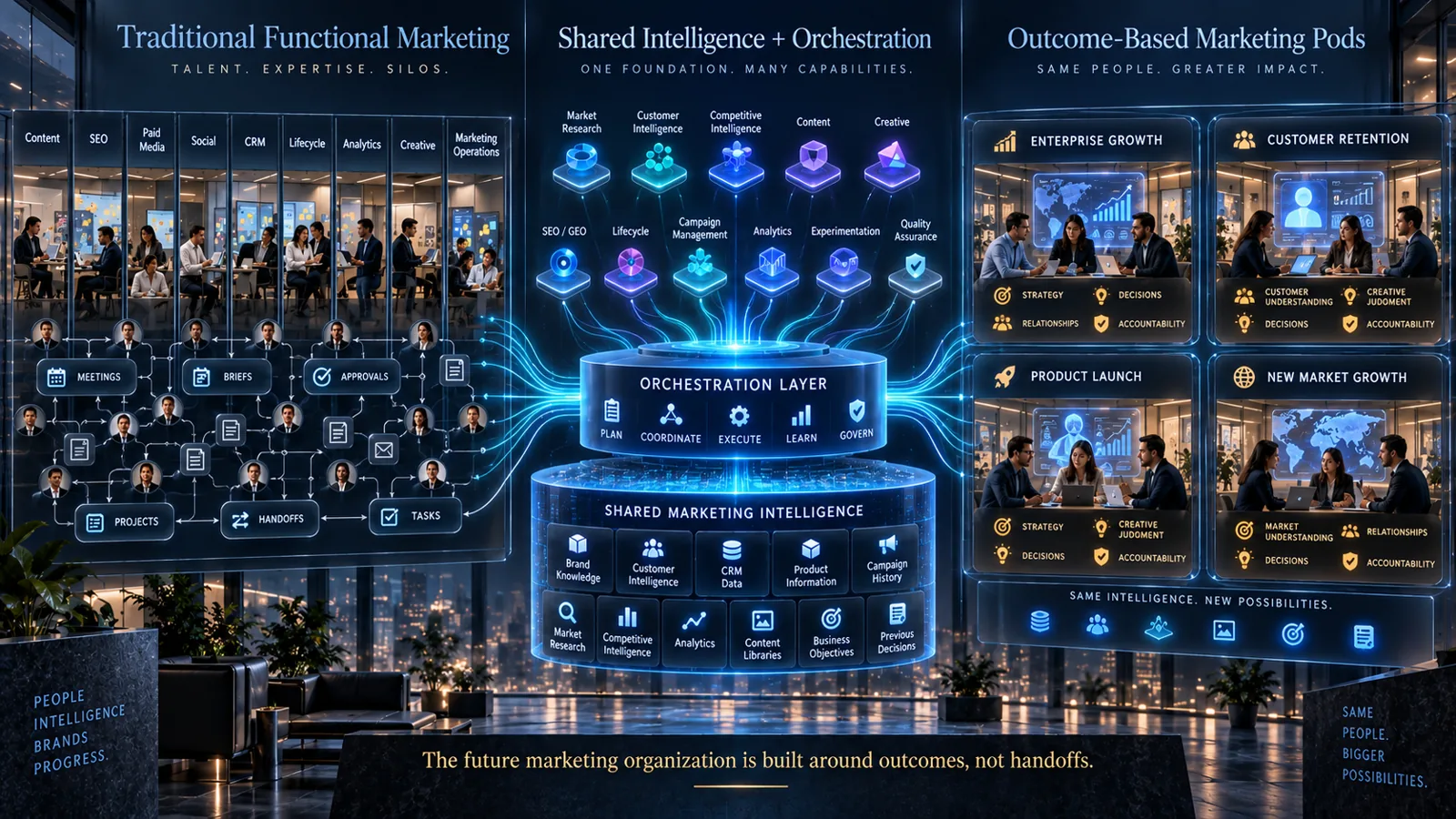
Open almost any marketing org chart today and you will see a familiar structure.
Content.
Social.
Paid media.
SEO.
CRM.
Lifecycle.
Analytics.
Product marketing.
Creative.
Marketing operations.
Each function has specialists.
Each specialist has tools.
Work moves between them through briefs, meetings, project-management systems, messages, approvals and dashboards.
This structure made sense when human capacity was the primary constraint.
If you wanted more content, you hired content marketers.
If you wanted more campaigns, you hired campaign managers.
If you wanted deeper analysis, you hired more analysts.
If you entered another channel, you created another specialization.
AI is beginning to challenge that architecture.
Not because marketing expertise suddenly stops mattering.
But because more of the execution surrounding that expertise can increasingly be performed by software.
Research can happen in parallel.
Content can be generated and adapted rapidly.
Campaigns can be monitored continuously.
Analytics can investigate anomalies.
Agents can coordinate workflows.
Automation can execute predictable steps.
And one marketer can increasingly direct capabilities that previously required several separate people.
The marketing team of the future will therefore not simply be today's team with an AI assistant beside every employee.
It will be a different operating model.
A hybrid organization in which humans define intent, strategy, standards and important decisions while AI agents, automation and enterprise systems perform increasingly large portions of research, production, coordination, execution and monitoring.
The org chart itself may need to change.
The Future Marketing Team Is Not Just a Smaller Team
It is tempting to reduce this discussion to headcount.
Will AI allow ten people to do the work of fifty?
Will marketing departments shrink?
Which jobs disappear?
Those questions matter, but they miss the larger transformation.
The important change is not simply team size.
It is team architecture.
A twenty-person organization built around manual handoffs may be less capable than a twelve-person organization operating with:
shared organizational intelligence;
specialized AI agents;
reusable automated workflows;
strong orchestration;
and clear human decision rights.
Likewise, a large enterprise marketing organization may remain large while dramatically changing what its people actually do.
The question is therefore not:
How many marketers will the future team have?
It is:
What should humans, agents, automation and software each be responsible for?
Microsoft's 2026 Work Trend Index describes this broader shift as a new agency equation: as agents absorb more execution, humans gain more room to direct work, make decisions and own outcomes. Its research also found organizational factors account for roughly twice the reported impact of AI compared with individual effort alone.
That suggests the biggest AI advantage may not come from the best individual AI user.
It may come from the best-designed organization.
Today's Marketing Organization Is Built Around Functions
Most marketing teams are organized by expertise.
That creates valuable specialization.
The SEO specialist understands search.
The lifecycle marketer understands customer journeys.
The performance marketer understands media.
The content strategist understands editorial development.
The analyst understands measurement.
But this structure also creates boundaries.
A customer does not experience:
SEO.
Then content.
Then paid media.
Then CRM.
They experience one brand.
A business outcome does not care which department produced it.
A product launch needs:
research;
positioning;
content;
creative;
media;
lifecycle;
sales enablement;
analytics;
and optimization
to work together.
Yet traditional structures frequently require the campaign to travel through each function sequentially.
The customer journey is horizontal.
The org chart is vertical.
Humans become responsible for connecting the two.
The Future Team Will Increasingly Organize Around Outcomes
AI agents make another structure more practical.
Instead of organizing every activity primarily around channels, teams can increasingly organize around:
a customer segment;
a product;
a market;
a growth objective;
a customer journey;
or a strategic business outcome.
BCG's 2026 CMO research found that organizations furthest ahead in agentic transformation are beginning to use smaller AI-enabled teams with broader responsibilities, organized around business objectives or customer segments rather than individual marketing channels.
Imagine an Enterprise Growth Pod.
It might contain only a handful of humans:
a growth leader;
product marketer;
creative strategist;
customer expert;
and marketing technologist.
But that team could have access to specialized agents for:
market research;
customer intelligence;
competitive analysis;
content;
SEO/GEO;
media;
lifecycle;
analytics;
experimentation;
and quality assurance.
The team owns an outcome.
The agents expand its execution capacity.
That is structurally different from building ten departments and asking project managers to coordinate them.
Shared Intelligence Becomes Part of the Team
Today's marketing team has another hidden dependency.
Knowledge lives inside people.
One employee understands the customer.
Another remembers the previous campaign.
Someone knows why leadership rejected a positioning direction six months ago.
A product marketer knows which claims are approved.
An analyst knows which dashboard contains the reliable number.
This makes experienced employees extremely valuable.
It also creates organizational fragility.
The marketing team of the future needs a persistent shared intelligence layer containing authorized access to:
brand knowledge;
customer intelligence;
CRM context;
product information;
campaign history;
market research;
competitive intelligence;
content libraries;
performance analytics;
business objectives;
approved claims;
and previous decisions.
That intelligence becomes part of the team's infrastructure.
Humans use it.
Agents use it.
Workflows use it.
When someone joins the team, the organization does not have to transfer every important fact manually.
When an agent begins a workflow, it does not start from a blank prompt.
The organization begins to remember.
AI Agents Become Digital Team Members — But Not Employees
The language around AI agents can become misleading.
Calling them "employees" suggests they should be treated exactly like humans.
They should not.
Agents do not have:
human accountability;
social judgment;
organizational citizenship;
personal relationships;
or legal responsibility.
But operationally, agents can increasingly perform persistent roles within marketing workflows.
A future marketing organization might maintain agents responsible for:
Market Intelligence
Continuously monitoring market developments and relevant external signals.
Customer Intelligence
Synthesizing customer conversations, CRM activity, support data, research and behavioral signals.
Competitive Intelligence
Monitoring competitors, category positioning and market movement.
Content Strategy
Identifying content gaps, topics, audience questions and campaign opportunities.
Content Production
Developing and adapting approved content.
SEO/GEO
Optimizing for conventional search and AI-mediated discovery.
Lifecycle Marketing
Supporting journey design, segmentation and relevant communications.
Campaign Operations
Coordinating campaign workflows and execution.
Analytics
Monitoring performance and investigating meaningful changes.
Experimentation
Proposing, managing and evaluating tests.
These agents should not operate as ten isolated chat windows.
They need shared context and orchestration.
Otherwise organizations will simply replace SaaS sprawl with agent sprawl.
Orchestration Becomes a Core Marketing Capability
Once a team contains humans, agents, automation and many enterprise systems, coordination becomes more important.
Something must understand:
the objective;
workflow state;
current priorities;
dependencies;
approved decisions;
available agents;
permissions;
quality standards;
risk thresholds;
and required human approvals.
That is the orchestration layer.
Today this coordination is often performed manually by:
marketing managers;
project managers;
marketing operations;
account managers;
and individual contributors.
Tomorrow, more routine coordination can become computational.
The system can determine:
which agent should act next;
what context it needs;
whether a dependency is complete;
whether the output passed QA;
whether another automated step can begin;
or whether the issue should escalate to a person.
This does not eliminate management.
It changes management.
Future Marketing Managers Will Manage Systems, Not Just People
The traditional manager allocates work across employees.
A future marketing manager may allocate capability across:
employees;
AI agents;
automation;
external partners;
and software systems.
They may spend less time asking:
"Did you finish the report?"
and more time asking:
"Why does this workflow require manual intervention?"
Their responsibilities may increasingly include:
defining objectives;
designing workflows;
setting quality standards;
setting agent permissions;
determining approval thresholds;
monitoring exceptions;
evaluating agent performance;
and deciding where human judgment belongs.
This is why systems thinking may become one of the most valuable marketing leadership skills.
Gartner's 2026 guidance explicitly recommends shifting toward hybrid human-AI structures in which human talent focuses more heavily on decision-making and oversight as AI scales execution.
Some Marketing Roles Will Move Up the Value Chain
AI is unlikely to affect every role in exactly the same way.
But one pattern will appear repeatedly:
less manual execution, more ownership of outcomes.
A content marketer may spend less time producing first drafts and more time on:
editorial strategy;
proprietary insight;
quality;
distribution;
and differentiation.
An analyst may spend less time assembling reports and more time on:
measurement design;
experimentation;
causal reasoning;
and strategic interpretation.
A marketing operations specialist may spend less time configuring repetitive workflows and more time designing:
agent systems;
data architecture;
governance;
orchestration;
and automation.
A creative director may produce fewer individual assets and spend more time deciding:
what deserves to exist;
what represents the brand;
and which creative direction is genuinely distinctive.
AI does not necessarily eliminate expertise.
It often raises the level at which expertise is applied.
New Roles Will Appear Between Marketing, AI and Operations
Future teams will also need responsibilities that barely existed in traditional marketing organizations.
The exact job titles will vary, but several capability areas are likely to become important.
One is AI marketing operations: designing and maintaining the workflows through which humans and agents collaborate.
Another is marketing intelligence architecture: making customer, brand, product and campaign knowledge accessible to authorized AI systems.
Another is agent governance: defining permissions, evaluation, escalation and risk boundaries.
Another is AI quality leadership: establishing what acceptable machine-generated work actually means.
Another is workflow design: continuously redesigning how marketing outcomes are produced rather than simply optimizing individual tasks.
BCG's 2026 research says the CMOs furthest ahead are already creating new roles, expanding marketing-science and AI-engineering capabilities and investing heavily in AI-specific upskilling. Around 80% of surveyed CMOs reported significant investment in AI-specific upskilling programs.
The future marketing organization therefore will not simply eliminate roles.
It will create different concentrations of expertise.
Human Ownership Becomes More Explicit
As agents perform more work, organizations need clearer answers about what humans still own.
Humans should remain deliberately responsible for areas such as:
strategic intent;
positioning;
major trade-offs;
creative taste;
customer relationships;
brand stewardship;
significant budget decisions;
ethical boundaries;
high-risk communication;
and ultimate accountability.
This produces a useful distinction.
AI execution can increase while human ownership remains strong.
An agent might analyze 10,000 customer conversations.
A human decides whether the resulting insight should change positioning.
An agent may create 100 creative concepts.
A creative leader decides which territory represents the brand.
An analytics agent may recommend reallocating budget.
A CMO approves a consequential investment shift.
The goal is not human approval of every AI action.
That would destroy scalability.
The goal is to put humans at the points where judgment changes the outcome.
The Future Team Needs Risk-Based Autonomy
Not every marketing action deserves the same governance.
An approved image resized for another channel is relatively low risk.
A new positioning claim is not.
An agent updating metadata is low risk.
An agent changing a multimillion-dollar media allocation is not.
Future organizations therefore need different autonomy levels.
Low-risk, reversible actions can increasingly execute automatically.
Moderate-risk actions can operate within predefined thresholds.
High-risk, novel or difficult-to-reverse decisions should move upward toward humans.
This creates an operating spectrum:
AI Executes
→ AI Executes Within Guardrails
→ AI Recommends / Human Approves
→ Human Decides With AI Support
→ Human Owns Directly
Marketing teams that design these boundaries clearly will scale more safely than teams operating with either extreme:
AI does nothing without approval.
Or AI can do everything.
The Channel Specialist Does Not Necessarily Disappear
One mistake would be assuming outcome-oriented teams mean expertise no longer matters.
It matters enormously.
Search remains technically complex.
Media requires expertise.
Brand requires judgment.
Lifecycle remains its own discipline.
Analytics requires measurement knowledge.
But experts may increasingly contribute to reusable systems, not only individual tasks.
An SEO expert may define the standards, frameworks and agent instructions used across many campaigns.
A brand leader may encode terminology, visual constraints and approval rules into the shared intelligence system.
An analytics expert may create measurement logic that dozens of agents can reference.
Expertise becomes more scalable.
Instead of:
Expert performs task 100 times
the model can increasingly become:
Expert designs system → system supports 100 workflows → expert handles exceptions and improvements.
That is a major shift in professional leverage.
Agencies Will Also Change
The marketing team of the future does not exist only inside companies.
The relationship with agencies will change too.
Traditionally, agencies provide capacity and specialized expertise.
Both remain valuable.
But if AI makes generic production cheaper, agencies will face increasing pressure to differentiate through:
strategy;
category expertise;
original creative thinking;
proprietary intelligence;
technology;
systems integration;
and measurable outcomes.
The client may no longer want to pay an agency primarily because it can produce 100 social posts.
AI can make 100 social posts.
The agency will need to answer a harder question:
Why should these 100 posts exist, what should they say, how do they connect to the customer's strategy, and what business outcome will they create?
AI shifts value upward across both internal teams and external partners.
The Future Team Will Be Smaller in Some Places and Larger in Others
Predictions that every marketing team will become tiny are probably too simplistic.
Different organizations will experience different effects.
Some teams may shrink because large amounts of repetitive execution become automated.
Some may stay similar in size while increasing output dramatically.
Others may grow because AI creates opportunities the business previously could not pursue.
For example:
more personalization;
more markets;
more experimentation;
more customer intelligence;
more product lines;
more sophisticated lifecycle marketing.
The useful question is not:
Will marketing headcount go up or down?
It is:
Will headcount remain the primary constraint on marketing capability?
Increasingly, probably not.
The combination of human expertise and machine capacity weakens the historical relationship between team size and output.
Marketing Will Become More Cross-Functional
As agents make coordination across channels easier, marketing can become less siloed.
But another boundary may simultaneously become more important:
the boundary between marketing and the rest of the company.
Customer experience crosses:
product;
sales;
marketing;
support;
commerce;
and service.
AI agents will increasingly operate across those boundaries too.
BCG argues that agentic AI creates richer customer intelligence that can influence not just campaigns, but products, partnerships and business models.
That makes the future marketing organization potentially more strategically important.
Marketing becomes one of the functions where:
market intelligence;
customer intelligence;
brand;
growth;
and AI-enabled decision-making
converge.
The CMO Becomes the Designer of a Marketing System
The future CMO's responsibilities therefore expand.
The CMO still owns:
growth;
brand;
customers;
strategy;
budget;
and performance.
But they increasingly also need to design the system through which those outcomes are created.
Questions include:
Which work belongs to humans?
Which belongs to agents?
Which belongs to automation?
What should be centralized?
What should remain embedded in pods?
Which intelligence should be shared?
Where should specialists sit?
What autonomy can agents have?
Where are human approvals necessary?
How should agencies participate?
How do we train people to manage AI?
How do we evaluate the combined system?
Gartner's 2026 CMO research argues that AI-driven changes to marketing are not only technological but structural and cultural, requiring leaders to rethink team composition and hybrid human-agent work.
This makes organizational design a marketing capability.
The Org Chart of the Future May Have Three Dimensions
Today's org chart mostly shows people.
Tomorrow's marketing operating model may need to show three separate dimensions.
Human Organization
Who owns:
strategy;
customers;
products;
markets;
creative direction;
and decisions?
Agent Organization
Which persistent AI capabilities exist for:
research;
content;
analytics;
campaigns;
lifecycle;
and monitoring?
Workflow Organization
How do people, agents, automation and systems combine around:
product launches;
customer acquisition;
retention;
content;
brand;
or other outcomes?
A simple hierarchy cannot describe all three.
The operating model may look more like a network.
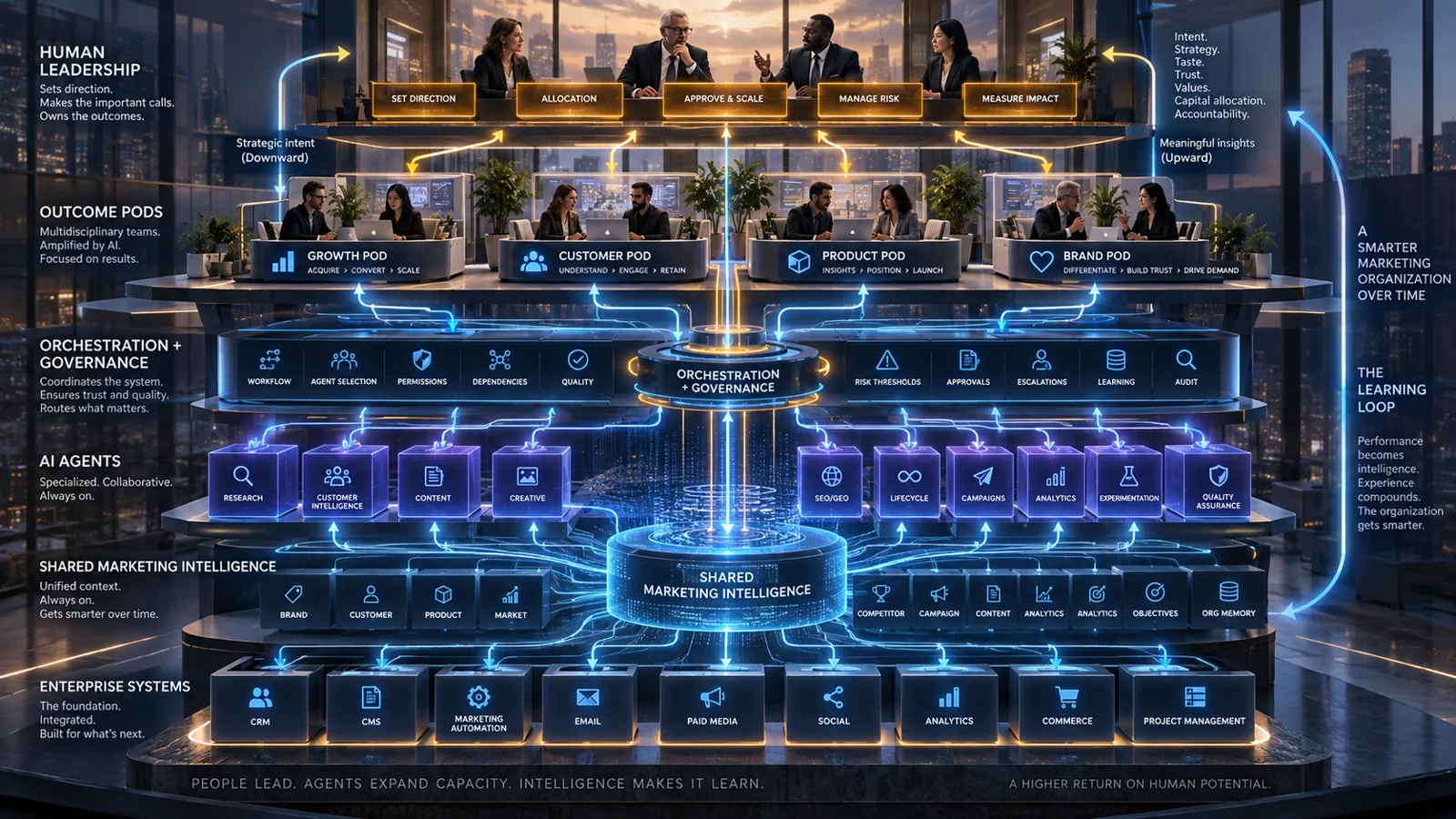
A Future Marketing Pod Could Look Like This
Imagine one team responsible for enterprise customer growth.
The humans include:
a growth leader;
a product marketer;
a creative strategist;
a customer expert;
and an AI/marketing operations lead.
They have persistent access to:
customer intelligence;
brand memory;
product context;
campaign history;
and business performance.
Around them operate agents for:
market research;
competitive intelligence;
content;
SEO/GEO;
paid media;
lifecycle;
analytics;
experimentation;
and quality assurance.
The humans define the objective.
Agents perform research in parallel.
Humans approve strategy.
Production agents execute.
Quality agents validate.
Automation activates.
Analytics agents monitor.
Routine optimizations happen within approved limits.
Important changes return to the team.
That group behaves like something much larger than five people.
Not because each employee is overloaded.
Because each employee is directing much more capability.
Measure Teams by Outcomes, Not Busyness
The future operating model also requires different metrics.
A team should not be considered productive because:
everyone's calendar is full;
employees produce lots of assets;
or every person appears busy.
Better questions include:
How quickly does the team move from opportunity to market?
How much time is spent on coordination?
How many manual handoffs exist?
How much human capacity goes toward strategy?
How frequently does completed work require rework?
How quickly does the organization identify performance changes?
How fast do those insights become action?
How effectively are previous learnings reused?
How much business impact does the system produce?
This shifts management from utilization toward leverage.
Upskilling Matters More Than Hiring an Entirely New Team
Another common assumption is that companies must replace their existing marketers with "AI people."
That is unlikely to be the best strategy.
Existing marketers hold:
customer knowledge;
category expertise;
brand context;
organizational relationships;
and professional judgment.
Those are precisely the things AI systems need.
The better opportunity is often to teach existing specialists how to turn their expertise into scalable systems.
BCG found roughly 80% of CMOs in its 2026 survey are making significant investments in AI-specific upskilling. The leaders furthest ahead view the required AI capability as talent they often need to build, rather than simply hire externally.
The marketer who understands both the business and how to direct AI systems may become far more valuable than either skill alone.
The Marketing Team Becomes a Learning System
There is one final difference between today's team and tomorrow's.
Most organizations lose enormous amounts of knowledge.
A campaign happens.
People learn.
Some of those people leave.
The next team starts again.
An AI-native organization can increasingly capture:
campaign decisions;
customer insights;
experiments;
successful approaches;
failed approaches;
creative learnings;
performance patterns;
and the outcomes of human decisions.
The organization begins to learn from its own work.
Microsoft calls this one of the defining characteristics of emerging Frontier Firms: organizations evolve into learning systems where insights from work feed back into how future work happens.
That may ultimately matter more than any individual agent.
Competitors can access similar AI models.
They cannot instantly replicate years of structured organizational learning.
Frequently asked questions
What will the marketing team of the future look like?
The future marketing team will increasingly combine a focused human organization with shared marketing intelligence, specialized AI agents, workflow orchestration, automation and enterprise software. Humans will concentrate more heavily on strategy, judgment, relationships, creativity and accountability while AI expands execution capacity.
Will AI replace marketing teams?
AI is likely to automate parts of many marketing roles rather than simply eliminate the marketing function. Team structures, responsibilities and required skills will change, with humans increasingly owning higher-level decisions and AI handling more research, production, monitoring and coordination.
Will future marketing teams be smaller?
Some will be. Others may remain similar in size while dramatically increasing their scope and output. The larger change is that marketing capacity will become less directly dependent on human headcount.
What roles will exist in future marketing teams?
Traditional marketing expertise will remain important, while new responsibilities will emerge around AI marketing operations, agent orchestration, shared intelligence, AI governance, workflow design and AI quality.
How will AI agents work with marketers?
AI agents can support persistent roles such as market research, customer intelligence, content, SEO/GEO, lifecycle marketing, campaign management, analytics and experimentation. Humans establish objectives, standards, permissions and consequential decisions.
What should humans still own in an AI-powered marketing team?
Humans should retain meaningful ownership of strategic intent, positioning, creative judgment, customer relationships, significant budget decisions, values, high-risk actions and accountability.
How should CMOs prepare their teams for agentic AI?
CMOs should map workflows, identify human versus machine responsibilities, build shared organizational intelligence, establish AI governance, create reusable agent capabilities, redesign team structures around outcomes and invest heavily in AI-specific upskilling.