10 Predictions for Marketing in 2030: AI Agents, Machine Customers and the End of Campaign-Led Growth
Predicting the future of marketing is difficult because the visible technology often changes faster than the underlying business problems.

Predicting the future of marketing is difficult because the visible technology often changes faster than the underlying business problems.
Platforms rise and fall.
Interfaces change.
New content formats appear.
Yet the fundamental purpose of marketing remains relatively stable:
- Understand customers
- Create meaningful differentiation
- Build demand
- Help people make decisions
- Develop profitable customer relationships
What will change by 2030 is how these responsibilities are performed.
Artificial intelligence is moving from a tool used inside individual tasks towards an operating layer coordinating complete workflows.
Search is becoming more conversational.
Commerce is beginning to involve agents that compare, recommend and potentially transact for users.
Content production is becoming inexpensive, making trust, originality and distribution more valuable.
Marketing organisations are also beginning to redesign work around combinations of human employees and AI agents.
McKinsey currently describes the future of marketing through five connected AI capabilities: insights, creativity, personalisation, agentic commerce and continuous optimisation.
These signals suggest that marketing in 2030 will not simply be a faster version of marketing today.
The operating model itself will change.
The following predictions are not certainties. They are evidence-based scenarios built from developments already visible in 2026.
Prediction 1: Marketing Teams Will Include More AI Agents Than Human Employees
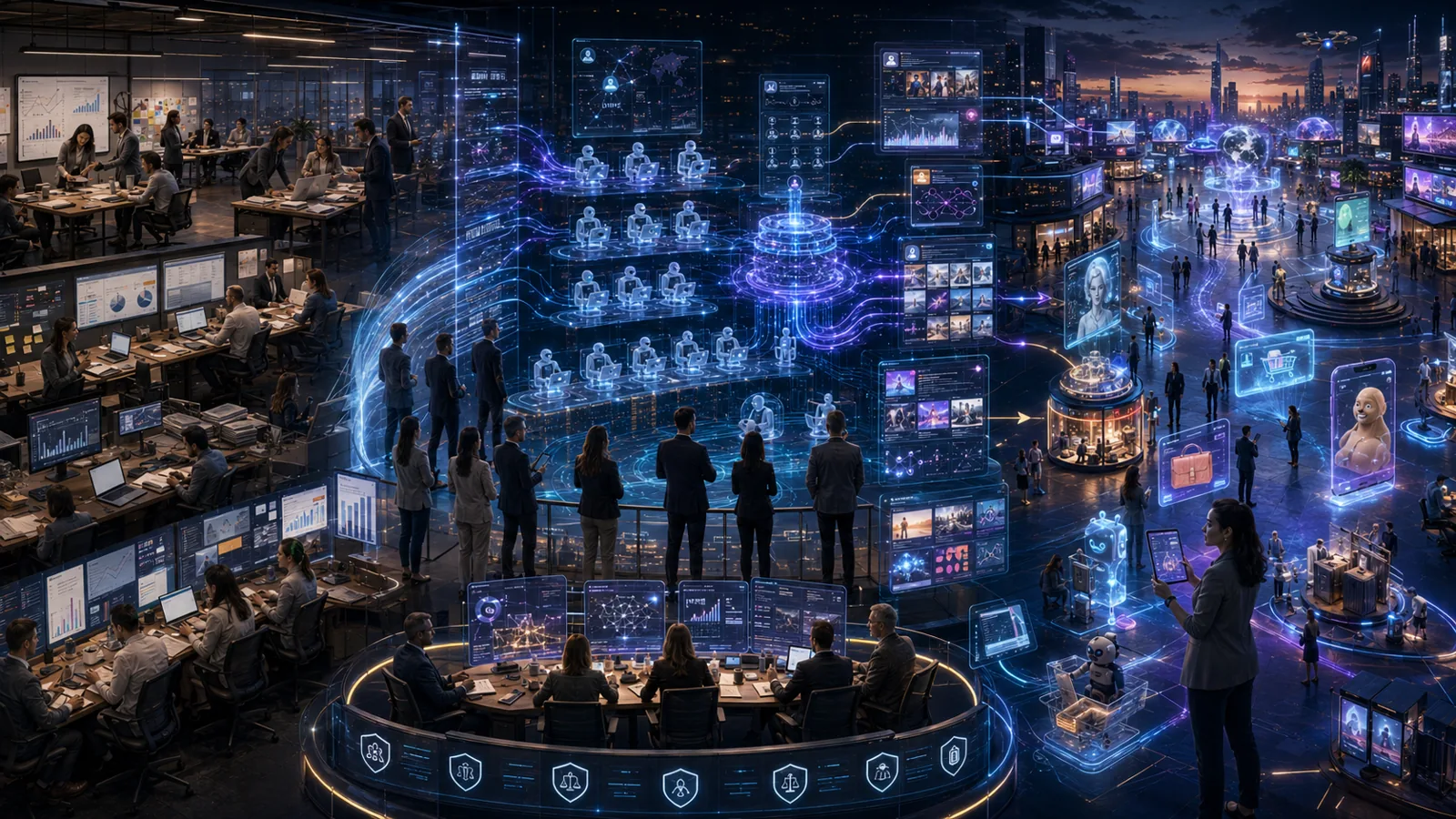
By 2030, many marketing departments will operate with a relatively small human team directing a larger portfolio of specialised AI agents.
A B2B marketing organisation may have human leaders responsible for:
- Strategy
- Brand
- Customer research
- Creative direction
- Product marketing
- Growth
- Partnerships
Supporting them may be agents dedicated to:
- Market monitoring
- Customer-conversation analysis
- Account research
- Content operations
- Campaign coordination
- Lifecycle marketing
- Performance investigation
- Marketing administration
These agents will not necessarily appear as independent digital personalities.
They may operate as specialised capabilities inside one marketing operating system.
Microsoft’s 2026 research describes a movement towards organisations in which agents take on more execution while people direct the work, redesign workflows and retain ownership of consequential outcomes.
What This Means
Marketing leadership will increasingly involve managing two types of capacity:
- 1Human talent
- 2Agent capacity
The best marketer may not be the person who personally completes the greatest number of tasks.
It may be the person who can:
- Define the objective
- Assign work correctly
- Evaluate AI output
- Handle exceptions
- Improve the system
- Preserve human accountability
The management of AI agents will become a mainstream marketing skill rather than a technical specialisation.
Prediction 2: Campaigns Will Give Way to Continuous Growth Systems
Traditional marketing is organised around campaigns.
A team:
- 1Conducts research.
- 2Develops a concept.
- 3Produces assets.
- 4Launches activity.
- 5Measures results.
- 6Plans the next campaign.
By 2030, more marketing will operate continuously.
AI systems will monitor:
- Customer behaviour
- Product usage
- Search demand
- Competitor activity
- Campaign performance
- Sales conversations
- Support issues
When a meaningful change occurs, the system will activate the appropriate workflow.
For example, it may:
- Identify a new customer objection.
- Retrieve relevant company expertise.
- Recommend a content response.
- Prepare channel adaptations.
- Route them for approval.
- Monitor the effect.
McKinsey’s current marketing outlook explicitly describes a shift from conventional campaigns towards continuous growth systems combining insight, creativity, personalisation, commerce and optimisation.
What This Means
The annual content calendar will not disappear.
It will become one layer inside a more adaptive operating canvas.
Marketing teams will combine:
- Planned brand activity
- Continuous customer journeys
- Real-time market responses
- Persistent experimentation
- Agent-generated recommendations
The organisation will need clearer rules for what may change automatically and what must remain stable.
Prediction 3: AI Agents Will Become a Major Marketing Audience
For most of marketing history, the audience was human.
By 2030, companies will increasingly market to systems acting on behalf of humans.
A customer may ask an agent to:
- Find the best software for a particular workflow
- Compare product specifications
- Evaluate pricing
- Review customer feedback
- Negotiate terms
- Place an order
McKinsey estimates that AI agents could mediate between $3 trillion and $5 trillion in global consumer commerce by 2030 under moderate scenarios.
This creates a new audience:
The machine evaluator.
A human may respond to:
- Emotion
- Storytelling
- Identity
- Creative distinction
An AI agent may prioritise:
- Structured product information
- Verifiable evidence
- Transparent pricing
- Compatibility
- Availability
- Reviews
- Policies
- Trusted citations
What This Means
Brands will need to become legible to both people and machines.
Marketing assets may require two complementary layers:
Human Layer
- Narrative
- Emotion
- Design
- Community
- Brand identity
Machine Layer
- Structured data
- Clear claims
- Reliable documentation
- Product feeds
- APIs
- Evidence
- Current policies
The most successful brands will not choose between emotional storytelling and machine readability.
They will design for both.
Prediction 4: AI Search Will Become a Primary Discovery Environment
Search will remain important, but the experience will continue shifting from lists of links towards generated answers, recommendations and actions.
Google’s 2026 marketing guidance describes AI as accelerating the journey from discovery to decision and highlights the emerging relationship between search, advertising and agentic commerce.
By 2030, a customer may not search for:
Best project-management software for agencies.
They may ask:
Compare the strongest project-management platforms for a 50-person creative agency, including pricing, resource planning, client approvals and migration difficulty.
The answer may synthesise information from:
- Product pages
- Reviews
- Documentation
- Research
- Customer communities
- Videos
- Trusted publications
What This Means
Search optimisation will expand beyond ranking pages.
Brands will compete to become:
- Trusted sources
- Cited entities
- Structured knowledge providers
- Recognised experts
- Recommended solutions
Content performance may increasingly be measured through:
- Citation visibility
- Inclusion in generated answers
- Brand recommendation frequency
- Qualified downstream traffic
- Agent-mediated consideration
The objective will not simply be to attract a click.
It will be to influence the answer.
Prediction 5: Content Production Will Become Abundant—and Original Insight Will Become More Expensive
By 2030, almost every company will be able to generate competent:
- Articles
- Videos
- Advertisements
- Images
- Presentations
- Social content
Production quality will no longer be a reliable differentiator.
The internet will contain far more polished content than people can consume.
This will increase the value of scarce inputs such as:
- Original research
- First-hand experience
- Recognised expertise
- Proprietary data
- Strong opinions
- Trusted personalities
- Customer communities
Google’s current guidance already focuses on helpful, reliable, original and people-first content rather than content created primarily to manipulate rankings.
What This Means
The content team of 2030 may spend less time manually writing every sentence and more time:
- Interviewing experts
- Conducting research
- Capturing customer evidence
- Developing original frameworks
- Directing AI production
- Building distribution
- Maintaining editorial standards
The marketing advantage will not come from access to generation.
Generation will be widely available.
The advantage will come from supplying the AI system with knowledge that competitors cannot reproduce.
Prediction 6: Personalisation Will Move From Segments to Individual Decision Context
Most personalisation today is based on relatively broad categories:
- Industry
- Geography
- Previous purchase
- Funnel stage
- Website behaviour
By 2030, personalisation systems may consider a much richer decision context.
A customer experience could reflect:
- Current objective
- Product usage
- Previous conversations
- Buying-committee role
- Support history
- Preferred communication
- Immediate constraints
- Trust and consent settings
McKinsey currently describes AI-powered personalisation as moving from isolated use cases towards end-to-end marketing workflows, while also emphasising the need for responsible data use and customer relevance.
What This Means
Personalisation will become less about inserting a name and more about selecting the appropriate:
- Information
- Sequence
- Channel
- Timing
- Level of detail
- Next action
However, greater personalisation will also create greater risk.
Customers may reject experiences that feel:
- Intrusive
- Manipulative
- Unfair
- Excessively persistent
- Based on information they did not knowingly share
The best personalisation systems will optimise not only conversion but also:
- Trust
- Customer control
- Communication frequency
- Long-term relationship quality
Prediction 7: Marketing Dashboards Will Become Background Infrastructure
By 2030, senior leaders will spend less time searching through walls of dashboards.
AI decision systems will continuously:
- Validate metrics
- Detect anomalies
- Connect customer and campaign context
- Develop possible explanations
- Recommend investigations
- Surface required approvals
The executive interface may resemble a decision inbox containing:
- Three risks
- Two opportunities
- One budget decision
- Supporting evidence
- Recommended next steps
Traditional dashboards will remain available for:
- Inspection
- Auditing
- Exploration
- Deeper analysis
But they will no longer be the primary interface.
What This Means
Marketing analytics will move:
- From reporting to decision preparation
- From channel metrics to customer outcomes
- From manual investigation to continuous intelligence
- From retrospective explanation to recommended action
The analyst’s role will also change.
Analysts will spend less time preparing weekly charts and more time:
- Designing metric systems
- Testing causal hypotheses
- Validating AI explanations
- Building experiments
- Auditing decision agents
Prediction 8: Brand Memory Will Become Core Marketing Infrastructure
AI systems cannot remain consistent if each interaction begins with a new prompt.
By 2030, serious marketing organisations will maintain governed brand and organisational memory containing:
- Positioning
- Product truth
- Customer definitions
- Approved claims
- Strategic decisions
- Campaign history
- Editorial examples
- Legal restrictions
- Performance learning
This memory will support:
- Human employees
- AI assistants
- Specialised agents
- Agencies
- Customer-facing systems
What This Means
The brand guideline document will evolve into a living knowledge system.
Important information will need:
- A source
- An owner
- A version
- An authority level
- A review date
This will create a new operational discipline.
Marketing teams will need to decide:
- What the organisation should remember
- What should expire
- Which feedback becomes a permanent rule
- Which agent may access which knowledge
- How conflicting information is resolved
Brand memory will become as important to AI marketing as customer data is to modern CRM.
Prediction 9: Marketing Operations Will Become the Architecture of Growth
Marketing operations has historically focused on:
- Technology administration
- Lead routing
- Campaign configuration
- Reporting
- Process consistency
By 2030, it may become one of the most strategic functions in marketing.
Marketing operations teams will design:
- Human-agent workflows
- Agent permissions
- Organisational memory
- Evaluation systems
- Approval paths
- Data access
- Tool orchestration
- Decision logs
- AI economics
McKinsey argues that meaningful agentic value requires redesigning complete workflows rather than attaching agents to fragmented legacy processes.
Microsoft makes a similar argument: organisations need to redesign how work happens rather than simply distribute more AI tools.
What This Means
The future marketing-operations leader will sit at the intersection of:
- Marketing
- Data
- AI
- Process design
- Governance
- Finance
Their question will not be:
Which tool should we buy?
It will be:
How should intelligence, authority and work move through the marketing system?
Prediction 10: Marketing Performance Will Be Measured Through Incremental Business Outcomes
Marketing measurement has long struggled with attribution.
Every channel wants credit.
Every platform reports its own value.
By 2030, mature organisations will place greater emphasis on:
- Controlled experiments
- Incrementality
- Customer lifetime value
- Retention
- Product adoption
- Pricing power
- Qualified demand
- Business growth
AI will make it easier to model relationships across large datasets.
But it will not eliminate the need for sound measurement design.
A sophisticated system can still confidently optimise the wrong metric.
What This Means
Marketing leaders will need balanced scorecards covering:
Short-Term Performance
- Conversion
- Pipeline
- Revenue
- Acquisition efficiency
Customer Performance
- Satisfaction
- Adoption
- Retention
- Customer effort
Brand Performance
- Awareness
- Preference
- Pricing power
- Future demand
Operational Performance
- Workflow speed
- Human effort
- Agent reliability
- Cost per outcome
The question will shift from:
Which channel received credit?
To:
Which marketing investment caused a meaningful improvement in customer and business performance?
What Will Not Change by 2030
Technological forecasts often overstate discontinuity.
Several fundamentals will remain.
Customers Will Still Need Trust
People and purchasing agents will prefer brands that provide:
- Reliable information
- Clear evidence
- Consistent delivery
- Honest limitations
Distinction Will Still Matter
When production becomes easier, sameness increases.
Recognisable positioning and creative identity become more important.
Strategy Will Still Require Choice
AI can produce options and execute decisions.
Human leaders must still determine:
- Whom to serve
- How to compete
- What to reject
- Which risk to accept
Relationships Will Still Matter
Partnerships, communities, complex sales and sensitive customer situations will continue to require human trust.
Accountability Will Remain Human
An agent may recommend or execute an action.
A person or organisation must remain responsible for its consequences.
A Plausible Marketing Team in 2030
A future B2B marketing department might include the following human team.
Human Leadership
- Chief Marketing Officer
- Brand and creative director
- Growth leader
- Customer-insight leader
- Product-marketing leader
- Marketing-operations architect
- Community and partnerships lead
Supporting them might be dozens of agent capabilities.
Agent Portfolio
- Market-intelligence agent
- Customer-conversation agent
- Account-research agent
- Content-strategy agent
- Creative-production agent
- Distribution agent
- Campaign-orchestration agent
- Lifecycle agent
- Performance agent
- Governance agent
The human team defines:
- Direction
- Standards
- Priorities
- Trade-offs
- Exceptions
The agent portfolio provides:
- Scale
- Monitoring
- Coordination
- Analysis
- Production
- Adaptation
This is not a human-free marketing department.
It is a department where human attention is allocated more deliberately.
How CMOs Should Prepare Now
2030 is close enough that the foundations must be built today.
1. Clarify the Strategy
Agents multiply whatever direction they receive.
Weak priorities create automated fragmentation.
2. Build Organisational Memory
Create authoritative sources for:
- Brand
- Product
- Customers
- Campaign decisions
- Governance
3. Redesign One Workflow
Choose a recurring process such as:
- Customer intelligence
- Content operations
- Campaign reporting
- Market monitoring
Build it around human-agent collaboration.
4. Establish Agent Governance
Define:
- Permissions
- Human owners
- Escalation rules
- Evaluations
- Logs
5. Strengthen Proprietary Insight
Invest in:
- Customer research
- Expert knowledge
- Original data
- Community
- Brand perspective
6. Prepare for Machine Customers
Improve:
- Structured product data
- Documentation
- Pricing transparency
- APIs
- Verifiable claims
7. Move Measurement Towards Outcomes
Connect marketing activity with:
- Customer behaviour
- Product usage
- Revenue
- Retention
- Long-term brand value
Risks That Could Change These Predictions
The direction is visible, but several factors could slow or alter it.
Regulation
Privacy, copyright, competition and AI-safety rules may limit how agents use customer data or execute actions.
Customer Resistance
Consumers may reject excessive automation or delegate fewer decisions to AI than expected.
Agent Reliability
Tool errors, hallucinations and weak coordination may slow autonomous deployment.
Platform Concentration
A small number of AI and commerce platforms may control discovery, increasing dependency and cost.
Economics
Agent usage, data preparation and human review may remain expensive for some workflows.
Trust
Major failures could produce stronger demand for human review and transparent provenance.
These uncertainties reinforce the need for controlled adoption rather than unconditional automation.
Key Takeaways
- Marketing teams in 2030 will likely combine small human groups with larger portfolios of specialised AI agents.
- Marketing will move from periodic campaigns towards continuous growth systems.
- AI agents will become an important audience and intermediary in commerce.
- Search optimisation will expand into influence over AI-generated answers and recommendations.
- Content production will become abundant, increasing the value of original research and human expertise.
- Personalisation will move from broad segmentation towards individual decision context.
- Dashboards will become evidence layers behind proactive decision systems.
- Brand memory will become governed marketing infrastructure.
- Marketing operations will evolve into human-agent workflow architecture.
- Performance measurement will focus more heavily on incremental customer and business outcomes.
- Strategy, creativity, relationships and accountability will remain human responsibilities.
Conclusion: Marketing in 2030 Will Be a System, Not a Collection of Channels
The marketing organisation of 2030 will still create content, run campaigns and build brands.
But those activities will be coordinated differently.
Customer and market signals will flow continuously into shared intelligence systems.
AI agents will monitor, analyse, produce, distribute and optimise.
Human marketers will define strategy, direct creativity, build relationships and govern the complete system.
Customers will encounter brands through websites, creators, communities and physical experiences.
They will also encounter them through AI systems that compare options, synthesise evidence and sometimes act on their behalf.
This creates a new marketing environment.
Brands must persuade humans while remaining legible to machines.
They must personalise at scale while protecting trust.
They must automate execution without automating accountability.
They must produce more efficiently without becoming more generic.
The companies that win in 2030 will not necessarily have the most advanced models.
Most companies will have access to capable AI.
The advantage will come from what surrounds the model:
- Better customer knowledge
- Better organisational memory
- Better workflows
- Better proprietary insight
- Better governance
- Better human judgement
Marketing will become faster, more continuous and more autonomous.
But it will not become less human.
The more execution moves to machines, the more important human choices will become.
Actionable Next Steps
- 1Identify where agents could already support recurring marketing workflows.
- 2Create authoritative brand, customer and product knowledge sources.
- 3Audit whether your product information is understandable to AI systems.
- 4Shift content investment towards proprietary research and expert insight.
- 5Redesign one campaign process as a continuous workflow.
- 6Replace dashboard-heavy reviews with decision-focused operating reviews.
- 7Define which marketing decisions must always remain human-controlled.
- 8Strengthen experimentation and incrementality measurement.
- 9Train marketers to manage, evaluate and govern agent capacity.
- 10Build the marketing operating system gradually rather than adding disconnected AI tools.
Frequently asked questions
What will marketing look like in 2030?
Marketing will likely combine human strategy and creativity with AI agents that continuously perform research, production, personalisation, coordination and performance analysis.
Will AI replace marketers by 2030?
AI will replace or transform many repetitive tasks, but humans will remain essential for strategy, creative direction, relationships, ethical judgement and accountability.
What is agentic commerce?
Agentic commerce occurs when AI agents help customers discover, compare, select or purchase products and services, sometimes completing parts of the transaction on their behalf.
Will traditional search disappear?
Search is unlikely to disappear, but discovery will increasingly happen through conversational answers, recommendations and AI agents rather than only lists of links.
Will brands still need content?
Yes, but generic content will become less valuable. Brands will need original evidence, recognised expertise, strong perspectives and machine-readable product knowledge.
What is brand memory?
Brand memory is a governed system containing positioning, product truth, customer definitions, approved claims, editorial examples and previous strategic decisions for humans and AI agents to use.
What skills will marketers need in 2030?
Important skills will include strategy, customer research, creative judgement, workflow design, agent management, evaluation, data interpretation and AI governance.
How should companies prepare for marketing in 2030?
Companies should strengthen organisational knowledge, redesign repeatable workflows, establish AI governance, improve proprietary insight and connect marketing activity with customer and commercial outcomes.