End-to-End AI Marketing Workflow: From Market Signal to Revenue Learning
It is a connected marketing system in which AI agents, automation, enterprise software, shared organizational intelligence, and human judgment work together across the entire marketing lifecycle—from…
Most companies do not have an AI marketing workflow.
They have AI inside marketing workflows.
There is a difference.
Someone uses AI for research.
Another marketer uses it for copy.
Design uses generative AI.
SEO has another tool.
Sales uses an AI assistant.
Analytics summarizes reports with AI.
The company can legitimately say:
“We use AI throughout marketing.”
But look at what happens between those activities.
Humans still transfer the research into the brief.
Humans explain the brief to content.
Humans transfer content into creative.
Humans chase approvals.
Humans upload assets.
Humans monitor dashboards.
Humans decide that performance changed.
Humans investigate why.
Humans prepare another report.
AI is present.
The workflow itself is still largely manual.
An end-to-end AI marketing workflow is something different.
It is a connected marketing system in which AI agents, automation, enterprise software, shared organizational intelligence, and human judgment work together across the entire marketing lifecycle—from identifying an opportunity to executing work, measuring results, and feeding those learnings into the next decision.
The important word is not AI.
It is end-to-end.
Because the biggest opportunity in AI marketing is no longer making isolated tasks faster.
It is making the entire marketing system more intelligent.
What Is an End-to-End AI Marketing Workflow?
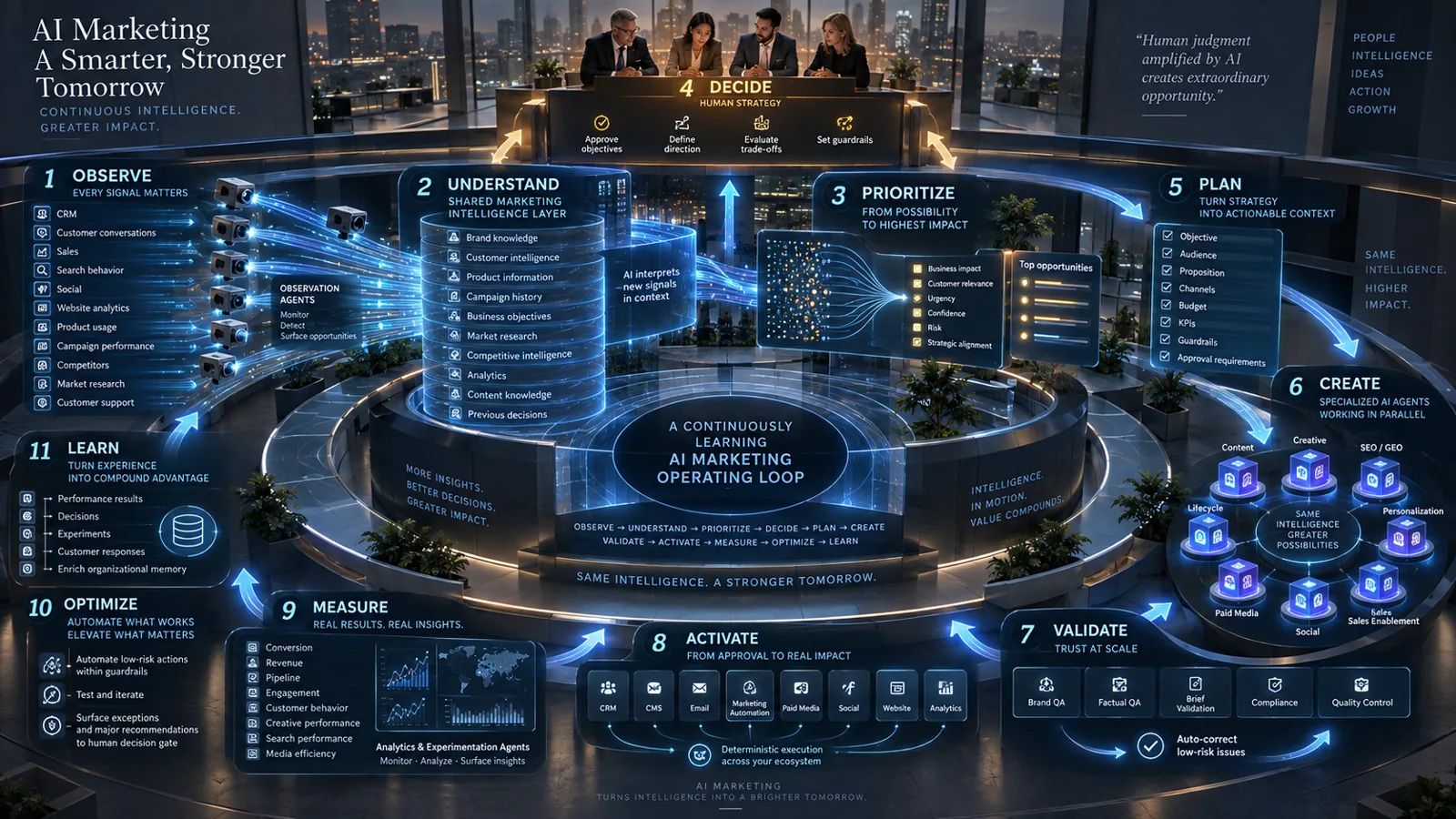
An end-to-end AI marketing workflow is a connected operating process that uses shared context, AI agents, automation, marketing technology, and human decision-making to move continuously from market signals to strategy, execution, measurement, optimization, and organizational learning.
A mature workflow might look like:
OBSERVE↓UNDERSTAND↓PRIORITIZE↓DECIDE↓CREATE↓VALIDATE↓ACTIVATE↓MEASURE↓OPTIMIZE↓LEARN↓OBSERVE AGAIN
Notice what this is not.
It is not:
Prompt → Output
It is not:
AI Writer → Human → AI Designer → Human
And it is not simply:
Automate every marketing task.
The workflow is an intelligent loop.
Each stage informs the next.
And every outcome makes the system smarter.
Why Most AI Marketing Is Still Fragmented
The first wave of marketing AI focused largely on tasks.
Write an article.
Generate ad copy.
Summarize a report.
Create an image.
Research a competitor.
Produce a presentation.
Those use cases were attractive because they were easy to understand and deploy.
But marketing does not create value through isolated tasks.
It creates value through connected workflows.
A customer insight affects positioning.
Positioning affects content.
Content affects creative.
Creative affects campaign performance.
Performance affects budget.
Budget affects customer acquisition.
Customer response creates new intelligence.
When AI is inserted into only one stage, humans still have to preserve those relationships manually.
That is why organizations can have dozens of AI tools and still feel operationally unchanged.
BCG's 2026 CMO research captures this gap clearly: while almost every CMO surveyed described AI as an end-to-end transformation, 42% were still primarily using generative AI to assist humans with discrete tasks. Only a minority had progressed into deeply agentic workflows.
The next stage of AI adoption is therefore not:
more AI features.
It is:
workflow redesign.
Stage 1: Observe — Continuously Detect Market Signals
Traditional marketing planning often starts with a meeting.
“What should we campaign about next month?”
“Which topics should we create?”
“What is happening in the market?”
An AI-native workflow should begin earlier.
It should continuously observe relevant signals.
These can include:
customer conversations;
CRM activity;
search demand;
website behavior;
social conversations;
sales calls;
customer support;
campaign performance;
competitor changes;
market news;
product usage;
content performance;
and broader category trends.
Different AI agents can monitor different environments.
A Customer Intelligence Agent watches customer signals.
A Competitive Intelligence Agent watches competitors.
A Search Intelligence Agent monitors search behavior and emerging questions.
A Performance Agent watches campaigns.
A Market Research Agent monitors broader market developments.
Most observations will not matter.
The system's job is not to produce more alerts.
It is to identify which changes may deserve attention.
That changes marketing from periodic research to continuous listening.
Stage 2: Understand — Turn Signals Into Context
Detection is not enough.
Suppose website conversion falls 12%.
What happened?
Maybe paid-media traffic quality changed.
Maybe pricing changed.
Maybe a competitor launched something.
Maybe the product page changed.
Maybe the audience mix shifted.
Maybe nothing strategically important happened at all.
AI needs context.
That is why an end-to-end workflow requires a shared marketing intelligence layer.
This layer can include authorized access to:
brand knowledge;
customer intelligence;
CRM data;
product information;
campaign history;
content libraries;
market research;
competitive intelligence;
analytics;
business objectives;
previous experiments;
and previous decisions.
Instead of analyzing every signal in isolation, AI can interpret it relative to what the organization already knows.
This is the difference between:
data
and:
organizational intelligence.
Stage 3: Prioritize — Decide What Deserves Attention
AI dramatically increases the number of opportunities an organization can identify.
That creates another problem.
Which ones matter?
A system might identify:
27 SEO opportunities;
six declining campaigns;
14 audience segments;
nine competitor changes;
43 content gaps;
and five customer trends.
Marketing cannot pursue everything.
So an end-to-end system needs prioritization.
Opportunities can be ranked according to:
business impact;
customer relevance;
strategic alignment;
urgency;
confidence;
cost;
available capacity;
risk;
and expected return.
This is one of the places where AI should simplify marketing rather than increase workload.
The ideal output is not:
“Here are 104 things you could do.”
It is:
“Here are the three things that deserve attention now, and why.”
Stage 4: Decide — Human Strategy Sets Direction
This is where the workflow should deliberately slow down.
AI can:
gather evidence;
identify patterns;
generate scenarios;
forecast possibilities;
and recommend actions.
But significant strategic decisions still require human ownership.
For example:
Should we reposition the product?
Should we target a new segment?
Should we increase investment in this market?
Should we respond publicly to a competitor?
Should this opportunity become a major campaign?
Which customer problem should we own?
The AI system should improve the quality of information reaching marketers.
Humans should make the consequential trade-offs.
This gives the workflow a clear principle:
AI expands the decision surface.Humans own the decisions that matter.
Stage 5: Plan — Turn the Decision Into an Executable Workflow
Once direction is approved, strategy needs to become work.
Today, this often happens manually.
Someone writes a brief.
Someone creates a project.
Someone lists deliverables.
Someone assigns people.
Someone creates timelines.
Someone explains what was already agreed.
In an AI-native workflow, the strategic decision can become structured campaign context.
For example:
Business ObjectiveGenerate $5M qualified enterprise pipeline.
AudienceCFOs at enterprises undergoing finance transformation.
Customer ProblemX.
Campaign PropositionY.
Approved ClaimsA, B, C.
Required ChannelsSearch, LinkedIn, email, website.
Success MetricsQualified pipeline, CAC, conversion.
BudgetDefined range.
Human Approval GatesPositioning, major creative, major budget changes.
Agent PermissionsDefined actions and thresholds.
The marketing brief becomes partially executable.
It is no longer only a document humans read.
It becomes context that downstream systems can use.
Stage 6: Create — Specialized Agents Execute in Parallel
Once the plan is approved, production can begin.
But the model should not be:
one giant chatbot creates everything.
Marketing involves different specialties.
An end-to-end workflow may use specialized agents for:
research;
content strategy;
long-form content;
creative;
SEO/GEO;
social;
paid media;
email;
lifecycle marketing;
personalization;
sales enablement;
and localization.
These agents should not independently reconstruct the strategy.
They inherit it.
Every downstream system receives the same:
audience;
positioning;
objective;
brand context;
approved claims;
customer intelligence;
and success criteria.
This creates something marketing organizations often struggle with today:
consistency without constant human briefing.
It also allows appropriate work to happen in parallel.
Content does not always have to finish before SEO begins.
Research agents do not always need to work sequentially.
Lifecycle architecture can begin while creative development is underway.
Orchestration manages dependencies.
Stage 7: Validate — AI Should Check Before Humans Review
Generative AI makes production abundant.
Without better validation, it can also create enormous review queues.
That is why quality needs its own workflow layer.
Before content reaches human reviewers, AI agents can check predictable criteria.
A Brand Agent checks:
voice;
terminology;
visual rules;
and approved messaging.
A Brief Agent checks:
audience relevance;
campaign objective;
required components;
and CTA consistency.
A Factual QA Agent checks:
product details;
approved internal sources;
statistics;
and consistency.
A Compliance Agent can evaluate predefined requirements where appropriate.
A Duplication Agent can identify whether similar material already exists.
The goal is not for AI to decide whether creative is brilliant.
It is to stop highly skilled humans spending their attention finding:
wrong product names;
missing disclaimers;
outdated messaging;
or obvious brief violations.
Adobe describes this type of modern content supply chain as an end-to-end process connecting planning, creation, management, delivery, and measurement, increasingly supported by shared context, AI, automation, and governance.
Stage 8: Approve — Human Attention Should Be Risk-Based
Human-in-the-loop should not mean:
human-in-everything.
Different decisions need different levels of supervision.
Consider three examples.
Low Risk
Resize an approved asset for another platform.
AI can probably execute if validation passes.
Moderate Risk
Create several variations of an already approved campaign.
AI may execute within established guidelines, perhaps with sampled review.
High Risk
Launch a completely new positioning claim across a multimillion-dollar campaign.
Human approval.
The level of oversight should increase with:
financial impact;
brand impact;
customer impact;
legal risk;
ambiguity;
novelty;
and irreversibility.
This creates a more scalable governance model.
Instead of senior marketers approving everything, the system knows what actually deserves senior attention.
Stage 9: Activate — Connect Intelligence to Execution Systems
Eventually marketing has to leave the AI environment and enter the real world.
Emails have to send.
Campaigns have to launch.
Pages have to publish.
CRM needs updating.
Ads need activating.
Content needs distributing.
This is where existing marketing technology remains critical.
The end-to-end AI workflow does not necessarily replace:
CRM;
CMS;
marketing automation;
email;
paid-media platforms;
social platforms;
analytics;
or project systems.
It coordinates them.
Agents may reason.
Traditional automation executes predictable actions.
Enterprise software remains the transaction layer.
This is an important architectural distinction.
AI should not replace deterministic software where deterministic software works better.
McKinsey explicitly makes this point in its 2026 agentic-workflow guidance: agents are only one part of the automation landscape, alongside scripting, RPA, machine learning, and existing systems.
The best workflow uses each technology where it fits.
Stage 10: Measure — Stop Waiting for the Weekly Report
Traditional measurement is periodic.
Launch campaign.
Wait.
Collect data.
Create report.
Hold meeting.
Interpret report.
Act.
An AI-native workflow can monitor continuously.
Analytics agents can track:
customer behavior;
campaign efficiency;
conversion;
pipeline;
revenue;
creative performance;
content performance;
search visibility;
email performance;
budget pacing;
and anomalies.
But good AI monitoring should not produce endless notifications.
Normal performance stays underneath.
Meaningful deviations rise.
For example:
Conversion declined 14%.
A basic dashboard alerts someone.
An intelligent workflow investigates.
Was the decline concentrated in one audience?
Did creative fatigue increase?
Did traffic quality change?
Did the landing page change?
Did the product price change?
Did a competitor launch something?
Then the system surfaces:
What changed
Probable cause
Business impact
Recommended action
Confidence
Decision required
That is decision intelligence.
Stage 11: Optimize — Move From Insight to Action
This is where the workflow becomes genuinely agentic.
Suppose an Analytics Agent identifies that:
Audience A is underperforming.
Creative B is fatigued.
Segment C converts dramatically better.
Email sequence D is producing stronger qualified responses.
Now something should happen.
Low-risk optimization can increasingly operate automatically within approved guardrails.
For example:
rotate approved creative;
change send timing;
pause a technically broken asset;
reallocate a small predefined budget percentage;
or activate a previously approved variation.
Larger interventions escalate.
Recommended: shift 35% of regional campaign budget toward Segment C.
Human approval required.
So autonomy exists on a spectrum:
OBSERVE
→ RECOMMEND
→ EXECUTE WITH APPROVAL
→ EXECUTE WITHIN GUARDRAILS
The goal is not maximum autonomy.
It is eliminating unnecessary delay between signal and appropriate action.
Stage 12: Learn — Make Every Workflow Improve the Next One
This is the stage that turns automation into an operating system.
Most marketing organizations create enormous amounts of information.
They do not necessarily create organizational memory.
A campaign finishes.
The report is presented.
Someone writes recommendations.
The presentation gets stored.
Six months later, another team performs similar research again.
That is not a learning system.
A mature AI workflow should capture:
which audience performed;
which proposition resonated;
which creative failed;
which customer objection appeared;
which channel combination worked;
which hypothesis was wrong;
which human decision improved performance;
which agent recommendation was rejected;
and what happened afterward.
These learnings feed back into the shared marketing intelligence layer.
Now the next workflow starts from a stronger baseline.
The loop becomes:
ACTION → RESULT → LEARNING → BETTER FUTURE ACTION
That is the difference between using AI and building organizational intelligence.
The Orchestration Layer Holds Everything Together
None of this works if every agent operates independently.
Someone—or something—must understand:
the marketing objective;
workflow stage;
current context;
approved decisions;
dependencies;
agent responsibilities;
permissions;
quality requirements;
required approvals;
exceptions;
and completion state.
That is orchestration.
Think of it as the control layer above the marketing workflow.
It determines:
which agent acts;
what information it receives;
which tool it may use;
what happens after completion;
whether quality criteria passed;
whether another agent should act;
or whether a human must intervene.
BCG identifies multi-agent orchestration as one of the critical infrastructure differences between companies experimenting with isolated AI tools and those beginning to scale end-to-end agentic marketing.
Without orchestration:
AI tool sprawl becomes AI agent sprawl.
The Architecture Behind an End-to-End Workflow
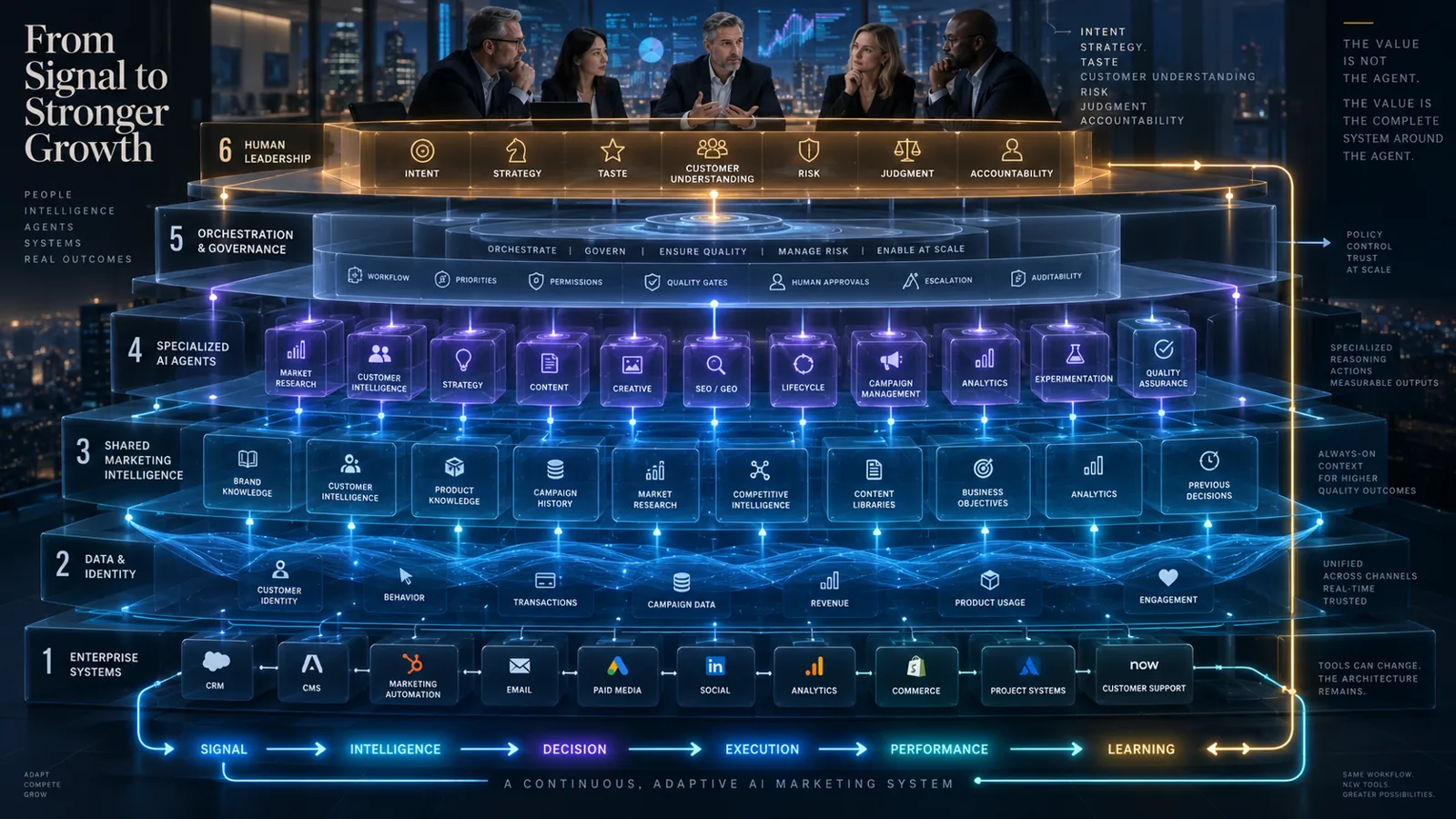
The workflow can be simplified into six architectural layers.
Layer 1 — Enterprise Systems
CRM.
CMS.
Analytics.
Advertising.
Marketing automation.
Email.
Commerce.
Project systems.
These systems execute and record business activity.
Layer 2 — Data and Identity
Customer data.
Behavior.
Campaign signals.
Transactions.
Identity resolution.
Business metrics.
Layer 3 — Shared Marketing Intelligence
Brand.
Customer.
Product.
Campaign history.
Competitive intelligence.
Business objectives.
Previous decisions.
Layer 4 — Specialized AI Agents
Research.
Strategy.
Content.
Creative.
Campaign.
Lifecycle.
Analytics.
Experimentation.
Quality assurance.
Layer 5 — Orchestration and Governance
Workflow state.
Permissions.
Agent routing.
Decision thresholds.
Quality gates.
Human approvals.
Escalation.
Layer 6 — Human Leadership
Intent.
Strategy.
Taste.
Relationships.
Judgment.
Risk.
Accountability.
The mistake is building only Layer 4.
That creates impressive agents sitting on weak infrastructure.
The value comes from connecting all six.
Agentic AI and Marketing Automation Are Not the Same Thing
End-to-end AI marketing does not eliminate automation.
It adds reasoning around it.
Traditional automation might say:
If lead score exceeds 80 → add to enterprise nurture.
An agentic workflow might ask:
What does this customer appear to be trying to accomplish?
What previous interactions matter?
Which offer is most relevant?
Should this lead enter automation at all?
Does sales need to intervene?
Which approved journey fits the current context?
Automation follows rules.
AI agents interpret context.
Orchestration determines which capability should act.
A mature workflow therefore combines:
AI for reasoning
automation for predictable execution
humans for consequential judgment
The Unit of AI Value Is Moving From Tasks to Workflows
This may be one of the most important changes for marketing leaders.
First-generation AI ROI often asked:
How much faster can we write?
How quickly can we create images?
How much time can AI save analysts?
Those questions remain useful.
But they are local optimizations.
Suppose AI reduces content creation time by 70%.
Great.
But the campaign still spends:
four days waiting for approval;
three days moving through systems;
two days reconciling feedback;
and a week before anyone notices underperformance.
The task became faster.
The workflow barely changed.
McKinsey argues that the biggest financial gains increasingly require redesigning high-value workflows rather than layering agents onto existing work.
So the better measures become:
time from signal to decision;
time from decision to market;
manual handoffs per workflow;
time waiting for approval;
human coordination hours;
time from anomaly to corrective action;
learning reuse across campaigns;
and ultimately:
business outcome per unit of human attention.
End-to-End Does Not Mean Fully Autonomous
This distinction is critical.
A complete AI workflow can still contain multiple human decisions.
End-to-end describes connectivity.
Autonomous describes who makes the decisions.
Those are different dimensions.
A workflow can be end-to-end while humans approve:
strategy;
creative direction;
large budgets;
high-risk claims;
sensitive customer interactions;
and major optimizations.
The system remains connected before and after each approval.
That is probably the more realistic near-term operating model for many organizations.
The Workflow Should Survive Changes in Tools
There is another important architectural principle.
AI models will change.
Agents will change.
Martech will change.
Today's best application may not be tomorrow's.
If the entire operating model depends on one specific tool, the organization becomes fragile.
The workflow should therefore be designed around:
objectives;
context;
roles;
interfaces;
permissions;
and outcomes.
Then components can evolve underneath it.
BCG's 2026 work similarly emphasizes open, composable ecosystems in which underlying agents and martech tools can evolve while marketers retain a more consistent operating experience.
That is why the workflow is more strategic than the tool.
From Campaigns to Continuous Marketing
There is one final evolution.
Most marketing workflows still begin with:
“We are launching a campaign.”
But agentic systems can continuously observe:
customer needs;
market changes;
behavior;
inventory;
performance;
search demand;
and business objectives.
That eventually creates something more dynamic.
Instead of waiting for the next campaign calendar, the system can continuously ask:
What is the best marketing action now?
BCG's July 2026 work describes a potential shift toward next-best-action marketing, where more customer interactions move from predefined campaign calendars toward real-time orchestration governed by business rules and human-defined strategy. Major launches and brand campaigns remain, but continuous decisioning grows around them.
That means the eventual evolution may look like:
Task-based AI↓AI-assisted workflows↓Agentic end-to-end workflows↓Continuously learning marketing systems
The fourth stage is where marketing truly begins to behave differently.
How to Start Building an End-to-End AI Marketing Workflow
Do not attempt to automate the entire marketing function in one project.
Choose one valuable workflow.
For example:
Product launch.
Lead nurture.
Content engine.
Customer expansion.
Paid campaign optimization.
Then map it from beginning to end.
Ask:
What triggers the workflow?
Customer signal?
Business objective?
Campaign request?
Performance anomaly?
What context is required?
Customer information?
Brand guidelines?
Campaign history?
Product data?
Where does reasoning happen?
Research?
Prioritization?
Diagnosis?
Recommendation?
Where does deterministic execution happen?
Routing?
Publishing?
Data updates?
Notifications?
Where are humans genuinely required?
Strategy?
Creative judgment?
Risk?
Budget?
Approval?
Where are the handoffs?
Which of them can disappear?
What should the system learn afterward?
Then rebuild the entire workflow around the outcome.
Not around today's org chart.
Not around today's tools.
And not around AI for AI's sake.
Frequently asked questions
What is an end-to-end AI marketing workflow?
An end-to-end AI marketing workflow is a connected process in which AI agents, automation, marketing technology, shared organizational intelligence, and humans collaborate across the complete marketing lifecycle—from detecting opportunities through strategy, creation, activation, measurement, optimization, and learning.
What are the stages of an AI marketing workflow?
A mature workflow can include observation, contextual analysis, prioritization, strategic decision-making, planning, content and campaign production, quality validation, human approvals, activation, measurement, optimization, and organizational learning.
What is the difference between an AI marketing workflow and an AI marketing tool?
An AI tool performs a specific capability. An AI workflow connects multiple capabilities, people, agents, systems, data sources, and decisions to produce a broader business outcome.
What is agentic marketing?
Agentic marketing uses AI agents capable of reasoning about objectives, retrieving context, using approved tools, executing multi-step tasks, observing results, and deciding or recommending what should happen next within defined boundaries.
What is marketing orchestration?
Marketing orchestration is the coordination of people, AI agents, automation, data, and enterprise systems so that the correct action happens at the correct stage with the necessary context, permissions, and governance.
Does end-to-end AI marketing mean fully autonomous marketing?
No. End-to-end refers to workflow connectivity, not necessarily full autonomy. Humans can remain responsible for strategy, creative direction, significant budget decisions, high-risk actions, and accountability while AI coordinates and executes other parts of the workflow.
How should companies measure AI marketing workflow performance?
Useful measures include workflow cycle time, manual handoffs, approval waiting time, coordination hours, time to insight, time to action, rework, agent reliability, learning reuse, and ultimately business impact.