Scaling Marketing Without Scaling Headcount: How AI Creates Marketing Operating Leverage
So when leadership asked marketing to do 50% more, the natural response was often:
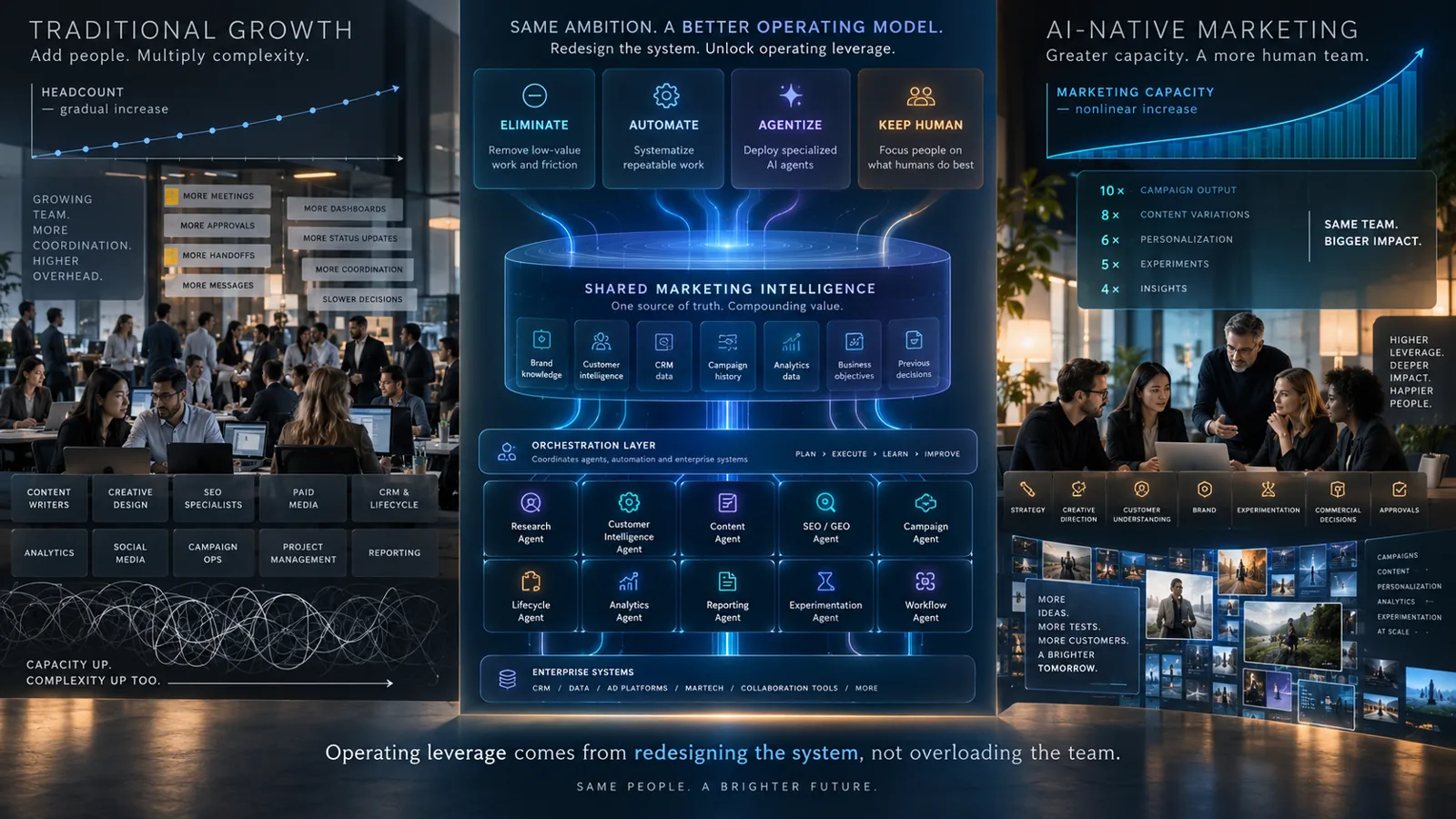
For most of modern marketing, scaling had a predictable consequence.
More campaigns required more campaign managers.
More content required more writers and designers.
More channels required more specialists.
More customers required more lifecycle marketers.
More data required more analysts.
More complexity required more marketing operations.
So when leadership asked marketing to do 50% more, the natural response was often:
We need more people.
AI is beginning to challenge that equation.
Not because companies suddenly no longer need talented marketers.
And not because five exhausted employees should somehow absorb the workload of twenty.
The real opportunity is different.
Marketing can increasingly increase its capacity faster than it increases its human headcount.
That is marketing operating leverage.
Marketing operating leverage is the ability to increase the amount and sophistication of marketing activity—and ultimately business impact—without increasing human resources and coordination costs at the same rate.
Generative AI helps.
Automation helps.
AI agents help.
But none of them creates leverage by itself.
The real advantage appears when companies redesign the operating system around them.
Why Scaling Marketing Traditionally Means Scaling Headcount
Consider a growing SaaS company.
At first, perhaps three marketers handle:
content;
email;
social;
campaigns;
website;
and analytics.
Then the business grows.
Paid media becomes important.
SEO expands.
The company enters new markets.
More customer segments require different messaging.
Lifecycle marketing becomes sophisticated.
Leadership wants better analytics.
Product launches increase.
Soon the team adds:
a content specialist;
performance marketer;
designer;
SEO lead;
product marketer;
lifecycle marketer;
marketing operations specialist;
analyst;
social lead;
project manager;
and multiple external agencies.
There is nothing inherently wrong with this.
Specialists create value.
But something else happens as the organization expands.
Every new person increases not only production capacity but also potential coordination.
More meetings.
More briefs.
More approvals.
More project updates.
More handoffs.
More managers.
More context that needs to move between people.
More tools.
More dependencies.
Eventually the organization discovers an uncomfortable truth:
Headcount can increase faster than marketing capacity.
People are busy.
The team is larger.
But campaigns do not necessarily move proportionately faster.
Marketing Leaders Are Being Forced to Find Leverage
This question matters more because marketing resources remain constrained.
Gartner's 2026 CMO Spend Survey found average marketing budgets at approximately 7.8% of company revenue. Fifty-four percent of surveyed CMOs said they lacked sufficient resources to deliver their strategy, while 56% said they lacked sufficient budget.
At the same time, marketing organizations are allocating an average of 15.3% of their budgets to AI initiatives.
The tension is obvious.
CMOs are being asked to:
grow;
transform marketing with AI;
increase productivity;
prove ROI;
and maintain cost discipline
without assuming substantially more resources will appear.
The wrong answer is:
make the team work harder.
The better answer is:
make the system require less human work per unit of marketing output.
Productivity and Scalability Are Not the Same Thing
This distinction matters.
Suppose AI helps a writer produce an article in two hours instead of six.
That is productivity.
Suppose a campaign manager uses AI to prepare a report in 20 minutes instead of two hours.
That is productivity.
Useful improvements.
But now imagine the marketing organization can simultaneously run twice as many sophisticated campaigns because:
research happens in parallel;
approved organizational knowledge is automatically available;
campaign briefs flow directly into execution;
routine QA is automated;
agents monitor performance continuously;
reports no longer require manual preparation;
and humans intervene mainly at strategic decision points.
That is scalability.
Individual productivity asks:
How much faster can a person perform a task?
Operating leverage asks:
How much more can the organization accomplish without requiring proportional increases in people and coordination?
The second question is much more valuable.
AI Tools Alone Don't Create Operating Leverage
This is where many AI strategies stop too early.
Every marketer gets an AI assistant.
The copywriter writes faster.
The strategist researches faster.
The analyst summarizes data faster.
The performance marketer generates ads faster.
The project manager creates notes faster.
Everyone becomes more productive.
But humans still need to:
assign every task;
move information between systems;
re-explain the campaign context;
check progress;
follow up on approvals;
search for documents;
coordinate specialists;
monitor dashboards;
consolidate feedback;
prepare status reports;
and decide what should happen next.
The organization has created AI-assisted employees.
It has not necessarily created an AI-native marketing organization.
Microsoft's 2026 Work Trend Index makes a similar point. Its research found organizational factors account for roughly twice the reported AI impact of individual effort alone.
The implication is important:
The bottleneck is increasingly not whether employees can use AI. It is whether the organization has redesigned work so AI can matter.
Start by Understanding Where Marketing Capacity Goes
Marketing work can roughly be separated into five categories.
1. Human Judgment
This includes:
strategy;
positioning;
creative direction;
commercial decisions;
customer understanding;
leadership;
negotiation;
and high-consequence decisions.
Human expertise remains extremely valuable here.
2. Skilled Production
Writing.
Design.
Analysis.
Research.
Campaign development.
SEO.
Personalization.
Creative production.
AI increasingly augments these activities.
3. Coordination
Routing work.
Checking status.
Consolidating feedback.
Following up on dependencies.
Preparing briefs.
Scheduling.
Creating updates.
Moving context between teams.
AI agents can increasingly absorb portions of this layer.
4. Deterministic Execution
Uploading.
Tagging.
Routing files.
Synchronizing data.
Generating standard reports.
Formatting.
Triggering predefined communications.
Conventional automation remains extremely effective here.
5. Continuous Monitoring
Campaign performance.
Competitive activity.
SEO.
Budget pacing.
Customer behavior.
Content performance.
Anomalies.
This is particularly suited to AI because software can continuously observe systems without requiring humans to repeatedly open dashboards.
The goal is not to remove humans from marketing.
It is to stop using human intelligence for work that does not need human intelligence.
The AI-Native Marketing Capacity Stack
A scalable marketing operating model requires several layers working together.
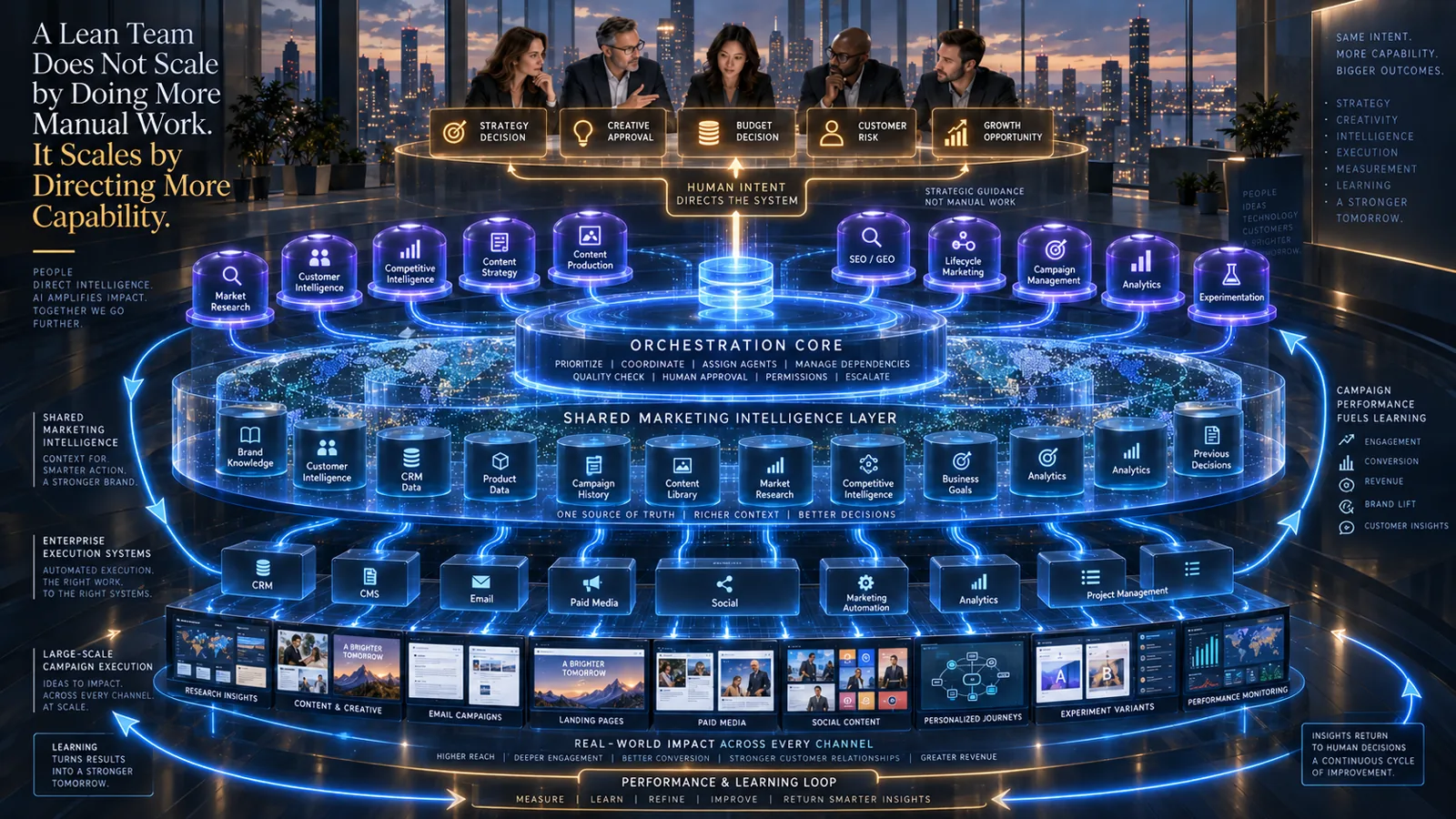
Layer 1: Shared Marketing Intelligence
The first requirement is organizational memory.
Today, critical marketing context may exist across:
brand documents;
CRM;
customer research;
campaign decks;
analytics;
Slack;
emails;
product documentation;
content libraries;
and individual employees' heads.
Every new project therefore requires people to reconstruct context.
Every new AI conversation requires another prompt.
That does not scale.
A shared marketing intelligence layer can contain authorized access to:
brand knowledge;
customer intelligence;
CRM context;
product information;
campaign history;
content libraries;
market research;
competitive intelligence;
analytics;
business objectives;
approved claims;
and previous decisions.
This creates one of the foundations of operating leverage:
context becomes reusable.
Employees no longer repeatedly explain the company to AI.
Agents do not need to begin every workflow from zero.
Layer 2: Specialized AI Agents
The next layer is specialized intelligence.
Rather than one giant marketing chatbot, different AI agents can support different capabilities.
For example:
Market Research Agent
Customer Intelligence Agent
Competitive Intelligence Agent
Content Strategy Agent
Content Production Agent
SEO/GEO Agent
Lifecycle Agent
Campaign Agent
Analytics Agent
Experimentation Agent
Each agent has:
a defined responsibility;
relevant context;
approved tools;
permissions;
quality standards;
and escalation rules.
This matters because marketing is not one job.
Different marketing decisions require different data, systems and risk boundaries.
Layer 3: Orchestration
This may be where the biggest scalability gains occur.
Someone currently coordinates marketing.
Humans decide:
what should happen next;
who needs to act;
what information they require;
whether another task is complete;
whether an approval is missing;
whether the campaign is ready;
and who needs to be notified.
This coordination cost grows as teams grow.
An orchestration layer can increasingly manage:
workflow state;
task dependencies;
agent selection;
priorities;
quality checks;
permissions;
human approvals;
exceptions;
and escalation.
That changes the architecture from:
Human → Human → Human → Software → Human
toward:
Objective → Orchestration → Agents + Automation + Humans → Outcome
BCG's 2026 work on agent-native marketing describes emerging cross-functional marketing pods of just three to five people, each supported by AI agents across strategy, content, data, activation and compliance. The point is not simply smaller teams—it is reducing the handoffs and queues that traditionally require additional organizational layers.
Layer 4: Automation and Execution Systems
AI does not need to replace every marketing platform.
CRM still matters.
CMS still matters.
Advertising platforms matter.
Email infrastructure matters.
Analytics matters.
Marketing automation matters.
The key is to stop requiring humans to manually coordinate every interaction between them.
Predictable actions should remain automated.
For example:
approved assets can move into publishing workflows;
new leads can update CRM;
customer events can trigger communications;
approved campaign configurations can propagate across systems;
standard reports can update automatically.
Use deterministic automation when the process is deterministic.
Do not use an AI agent merely because AI sounds more advanced.
Layer 5: Human Leadership
Human marketers remain deliberately concentrated at the top of the leverage stack.
They should spend disproportionate time on:
customer understanding;
positioning;
strategy;
creative judgment;
brand;
high-impact budget allocation;
commercial decisions;
relationships;
risk;
and accountability.
In other words:
Machines increase execution capacity.Humans concentrate judgment.
This is the operating model.
What Scaling Without Headcount Looks Like in Practice
Consider a company launching a new B2B product.
Traditional Model
A strategist researches the market.
Another person analyzes customers.
Someone creates a competitor deck.
Strategy creates a brief.
Content receives the brief.
Creative receives the content.
Lifecycle creates emails.
Paid media adapts the messaging.
SEO starts another workflow.
Marketing operations configures campaigns.
Project managers chase deadlines.
Leadership reviews.
Feedback returns.
Assets are revised.
The campaign launches.
Analysts create reports.
The team meets to interpret the results.
There may be excellent people throughout this process.
The problem is that humans perform nearly every handoff.
AI-Native Model
The campaign begins with a business objective.
Market, customer and competitive intelligence agents work simultaneously.
Their outputs draw from shared organizational context.
A strategy system synthesizes the findings.
Human strategists decide the campaign direction.
Once approved, orchestration activates downstream workflows.
Content, SEO, lifecycle and creative agents operate from the same approved campaign intelligence.
Quality agents check predictable standards.
Human creative leaders review consequential work.
Automation moves approved assets into execution systems.
Analytics agents continuously monitor performance.
Routine optimizations operate within predefined limits.
Material opportunities or risks escalate to human leadership.
Results feed back into organizational memory.
The humans have not disappeared.
Their work has moved.
The Biggest Opportunity Is Removing Coordination Tax
Marketing often assumes its capacity problem is production.
Sometimes it is.
But look closely at how many hours disappear into:
meetings;
status updates;
searching for information;
waiting for approvals;
moving data;
repeated briefing;
report preparation;
version management;
and chasing dependencies.
This is coordination tax.
Hiring another employee can increase productive capacity.
But it can also increase coordination tax.
A better system reduces the tax itself.
This is why the future marketing organization may become simultaneously:
more sophisticated;
more productive;
and organizationally simpler.
Use the Eliminate → Automate → Agentize → Human Framework
Before hiring another person, map the workflow creating the capacity problem.
Then classify each activity.
Eliminate
Should this work exist?
Examples:
reports nobody reads;
duplicate meetings;
unnecessary approvals;
content nobody distributes;
repeated manual updates.
Do not automate waste.
Remove it.
Automate
Does the activity have predictable rules?
Examples:
data synchronization;
notifications;
asset routing;
campaign naming;
standard reporting;
scheduled execution.
Use conventional automation.
Agentize
Does the task require some interpretation but operate within defined boundaries?
Examples:
research;
campaign monitoring;
QA;
feedback consolidation;
performance investigation;
workflow coordination;
opportunity detection.
This is increasingly where AI agents fit.
Keep Human
Does the work require:
judgment;
taste;
leadership;
relationships;
accountability;
strategic trade-offs;
or consequential decisions?
Protect human attention for it.
The goal is not maximal AI.
It is optimal allocation.
Scale Workflows Before Teams
This produces a practical hiring question.
Before opening a new role, ask:
What specifically has exceeded capacity?
Suppose the content department says it needs two additional people.
Why?
Because writing capacity is insufficient?
Or because writers spend hours waiting for briefs?
Because revisions are excessive?
Because subject-matter context is difficult to retrieve?
Because formatting is manual?
Because distribution requires repetitive work?
Because everyone spends Friday creating reports?
Those are different problems.
One may require another excellent writer.
Another may require better workflow design.
Another may require automation.
Another may require shared intelligence.
Another may disappear entirely.
Hire people for capability.Do not hire people permanently to compensate for broken coordination.
One Person Can Increasingly Direct More Capability
This may change what a marketing job actually means.
Historically, an employee largely contributed the work they could personally perform.
In an agentic organization, a marketer may increasingly direct a collection of capabilities.
Imagine a growth lead with access to:
a research agent;
customer intelligence agent;
content agent;
analytics agent;
campaign agent;
and experimentation agent.
The marketer defines the goal.
Agents gather evidence.
The marketer makes the strategic choice.
Agents execute approved workflows.
Analytics agents monitor results.
The marketer intervenes when judgment is required.
The person's impact is no longer limited to what they can personally produce during an eight-hour day.
Their role increasingly resembles director of an intelligent system.
Microsoft reports active agents in its Microsoft 365 ecosystem grew 15× year over year, and 18× in large enterprises, underscoring how quickly this model is moving from concept toward operating reality.
But AI Can Also Increase Work
There is an important warning.
More AI does not automatically mean more leverage.
AI can produce:
more content;
more reports;
more campaign variations;
more ideas;
more dashboards;
more experiments.
Every output can create downstream work.
Someone may need to:
review it;
approve it;
organize it;
distribute it;
measure it;
or choose between alternatives.
So AI can dramatically increase production while also increasing organizational overload.
That is why the objective cannot be:
maximize AI output.
It should be:
maximize useful business outcomes per unit of human attention.
That is a much better definition of productivity.
Avoid the AI Productivity Trap
Gartner reports that only around one-third of CMOs are seeing the returns they expect from AI investment. Its 2026 guidance argues that many organizations focus too heavily on time savings rather than connecting AI to measurable business outcomes.
Suppose AI saves marketing 5,000 hours per year.
Impressive.
But what did the business do with those hours?
Did marketing:
enter new markets?
increase conversion?
improve customer retention?
run more meaningful experiments?
improve creative quality?
build a stronger brand?
accelerate product launches?
generate more revenue?
Or did it simply create more mediocre content?
Time saved is not operating leverage until it produces better organizational capacity or better outcomes.
Measure Marketing Capacity Differently
The AI-native organization needs different metrics.
Campaign Capacity
How many meaningful campaigns can the team operate effectively?
Campaign Cycle Time
How quickly does an approved business opportunity reach the market?
Human Coordination Hours
How much employee time disappears into routing, follow-up and administration?
Strategic Time
What percentage of senior marketing capacity is available for high-value thinking?
Rework Rate
How much completed work must be repeated?
Automation Rate
How much predictable work proceeds without manual intervention?
Time to Insight
How quickly does marketing identify what happened?
Time to Decision
How quickly does insight become a decision?
Revenue or Pipeline per Marketing Employee
Used carefully at an organizational level, this can indicate whether the system is becoming more leveraged.
AI-Enabled Business Impact
Did the redesigned workflow improve revenue, margin, conversion, retention, customer experience or strategic speed?
These measures reveal something employee-utilization metrics cannot:
whether the system is actually becoming more capable.
Scaling Without Headcount Does Not Mean Never Hiring
This deserves emphasis.
The phrase can easily be misunderstood.
An AI-native business should still hire exceptional people.
A company entering India may require local market expertise.
A new enterprise strategy may require an experienced product marketer.
A stronger creative ambition may require an exceptional creative director.
A complex data architecture may need specialist expertise.
AI does not remove genuine capability gaps.
The better principle is:
Do not make headcount the default solution to every increase in workload.
Ask instead:
Where would another human create uniquely valuable capability?
Where can software expand existing capability?
Where is the underlying work unnecessary?
That creates a much healthier operating model than freezing hiring indiscriminately.
Smaller Teams May Become More Competitive
Historically, large companies had an enormous resource advantage.
They could hire:
more analysts;
more researchers;
larger content teams;
more designers;
more specialists;
and more agencies.
AI compresses parts of that advantage.
A smaller organization with:
excellent strategy;
deep customer understanding;
good proprietary data;
strong shared context;
well-designed agent workflows;
and decisive human leadership
can increasingly perform work that once required much larger teams.
BCG's agent-native marketing model already points toward lean cross-functional teams supported by reusable agents rather than large sequential organizations built around specialized handoffs.
This could be particularly significant for:
startups;
SaaS companies;
boutique agencies;
consultancies;
and challenger brands.
The advantage increasingly comes from leverage rather than organizational size.
The CMO Becomes an Architect of Capacity
This creates a new responsibility for marketing leadership.
The CMO is not only deciding:
which markets to enter;
which channels to fund;
which campaigns to run;
and who to hire.
They increasingly need to decide:
Which work should humans own?
Which should agents own?
Which should traditional automation own?
What organizational intelligence should be reusable?
Which workflows should disappear?
Where should humans approve?
How much autonomy should agents receive?
Which actions are reversible?
Where are the risks?
Which capability truly requires another hire?
These are operating-model questions.
And increasingly, the quality of those decisions may determine how much marketing capacity the organization can create.
A New Marketing Equation
The old equation looked roughly like:
More Marketing Output = More People
The emerging equation is more interesting:
Marketing Capacity = Human Expertise × Shared Intelligence × Automation × Agents × Orchestration
The exact mathematics obviously is not literal.
The point is multiplicative.
Give a brilliant employee terrible systems and much of their capacity disappears into coordination.
Give an average workflow more AI tools and you may simply automate chaos.
But combine excellent people with reusable intelligence, strong automation, well-designed agents and intelligent orchestration?
One employee can direct significantly more capability.
That is marketing operating leverage.
Frequently asked questions
Can marketing scale without increasing headcount?
Yes, marketing capacity can grow faster than headcount when organizations remove unnecessary work, automate predictable processes, use AI to augment skilled production and deploy agents for monitoring, coordination and analysis. Genuine capability gaps may still require additional hires.
What is marketing operating leverage?
Marketing operating leverage is the ability to increase marketing output and business impact faster than the resources and human coordination required to produce them.
How can AI increase marketing capacity?
AI can accelerate research, content, analysis, personalization and creative production. AI agents can also monitor campaigns, retrieve organizational context, perform quality checks, coordinate workflows and recommend actions.
What is the difference between AI productivity and AI scalability?
AI productivity makes an individual task faster. AI scalability changes the operating model so an organization can manage more work without increasing people and coordination at the same rate.
Should AI be used to reduce marketing headcount?
Reducing headcount should not be the default objective. The stronger use of AI is to increase organizational capability, redirect human attention toward higher-value work and avoid unnecessary hiring caused by inefficient workflows.
Which marketing activities should remain human?
Humans should retain meaningful ownership of strategy, positioning, creative judgment, important relationships, significant budget decisions, high-risk actions, brand decisions and accountability.
What does an AI-native marketing team look like?
An AI-native marketing team combines a relatively focused group of human specialists with shared organizational intelligence, specialized AI agents, deterministic automation, orchestration and human governance.