What Humans Should Still Own in an AI-Powered Marketing Organization
And increasingly, AI agents can take action inside the software companies already use.

AI can research the market.
Analyze customer conversations.
Generate campaign ideas.
Write content.
Produce creative variations.
Monitor performance.
Detect anomalies.
Recommend experiments.
Coordinate workflows.
And increasingly, AI agents can take action inside the software companies already use.
So an obvious question follows:
What is left for humans to own?
The wrong answer is:
"Whatever AI cannot do yet."
That creates a constantly shrinking definition of human value.
A better answer is to distinguish execution from ownership.
AI may execute more of the work.
Humans should continue to own the decisions where intent, judgment, accountability, values, relationships and meaningful consequences matter.
That leads to a different model of human-AI collaboration.
The marketer of the future does not need to manually perform every step of a campaign to remain responsible for the campaign.
A CMO does not personally configure paid-media campaigns today.
They still own the marketing outcome.
Similarly, as AI agents take on more execution, human responsibility moves upward.
AI can increasingly perform the work. Humans still need to decide what work deserves to happen, what good looks like, what risks are acceptable and who is accountable for the outcome.
That is the human layer of the AI-powered marketing organization.
Human Ownership Is Not the Same as Human Execution
This distinction may become one of the most important principles of the agentic era.
Consider a marketing strategy.
An AI system might:
analyze competitors;
summarize customer interviews;
identify market shifts;
model several scenarios;
find historical campaign patterns;
and recommend three strategic directions.
The human strategist does not need to manually perform every piece of research to own the strategy.
The human owns:
the choice;
the trade-offs;
the standard;
the consequences;
and the rationale.
The same principle applies elsewhere.
An AI Creative Agent might generate 50 concepts.
A human creative director chooses which creative territory represents the brand.
An Analytics Agent might identify a declining campaign and recommend moving budget.
A human marketing leader approves a major allocation change.
A Customer Agent might draft a response to an unhappy enterprise customer.
A human account leader decides what the relationship requires.
This is the future division of labor:
AI expands the range of actions available.Humans retain ownership of consequential choices.
Microsoft's 2026 research describes a similar transition. As agents absorb more execution, the highest-value human work increasingly involves setting clear intent, defining quality, applying judgment and taste, building trust, and owning outcomes.
1. Humans Should Own the Objective
AI is extremely capable of optimizing toward an objective.
But someone has to decide whether the objective is worth optimizing.
There is an enormous difference between:
Increase email engagement
and:
Increase retention among high-value customers without increasing promotional dependency.
The second objective contains business judgment.
It balances growth against customer quality.
It embeds a strategic trade-off.
It reflects what the organization values.
That should remain human territory.
Before an agentic workflow begins, a human should be able to answer:
Why are we doing this?
What business outcome are we trying to create?
What customer outcome matters?
What are we willing to sacrifice?
What are we unwilling to sacrifice?
What would success actually mean?
Agents can convert objectives into actions.
Humans should own the reason those objectives exist.
2. Humans Should Own Strategy and Trade-Offs
AI will become increasingly useful in strategic analysis.
It can process information at a scale no individual strategist can match.
It can compare scenarios.
Challenge assumptions.
Identify patterns.
Retrieve previous decisions.
Find evidence that contradicts a hypothesis.
All of that makes AI extremely valuable to strategy.
But strategy is not simply analysis.
Strategy is choosing what not to do.
Do we pursue enterprise customers or SMBs?
Growth or profitability?
Premium positioning or market penetration?
A new category or an existing one?
Short-term demand generation or long-term brand building?
One geography or five?
Those decisions involve uncertainty.
There may be no objectively correct answer.
They also create organizational consequences.
AI should improve the intelligence behind those choices.
Humans should still own the choice.
Gartner's 2026 guidance similarly argues that marketing leaders should move beyond using AI merely for task efficiency and instead build AI-supported decision systems that improve strategic judgment while preserving the operating model and governance around those decisions.
3. Humans Should Own the Customer Promise
Marketing ultimately makes promises.
Explicitly or implicitly, every campaign tells a customer:
This is what we stand for.
This is what our product can do.
This is how we will treat you.
This is why you should trust us.
AI can optimize that language.
It should not independently decide what a company is willing to promise.
That requires understanding:
product reality;
customer expectations;
brand reputation;
commercial consequences;
and organizational integrity.
An AI system might discover that making a stronger claim materially improves conversion.
That does not mean the company should make it.
Conversion is an input.
Trust is an asset.
Humans should own the boundary.
4. Humans Should Own Taste
This is one of the least measurable and most important areas.
AI can generate increasingly competent:
writing;
design;
video;
campaign concepts;
brand identities;
presentations;
and advertisements.
But competence is not the same as distinction.
When production becomes abundant, selection becomes more important.
Someone needs to say:
This is generic.
This is technically good but not us.
This feels derivative.
This is memorable.
This idea deserves investment.
This creative makes me uncomfortable in the right way.
This is aesthetically beautiful but strategically wrong.
That is taste.
Taste comes from:
experience;
culture;
references;
intuition;
customer understanding;
brand history;
and accumulated judgment.
It is difficult to reduce to a checklist.
AI can help explore the creative landscape.
Humans should still determine where the brand chooses to stand within it.
5. Humans Should Own High-Consequence Decisions
Not all marketing decisions carry the same risk.
Changing the send time of an approved email is one thing.
Changing the company's positioning is another.
Rotating an underperforming ad within an approved creative library is one thing.
Moving $5 million between markets is another.
Correcting a typo automatically is one thing.
Publishing an aggressive claim about a competitor is another.
The appropriate level of human involvement should increase with:
impact;
risk;
irreversibility;
ambiguity;
and novelty.
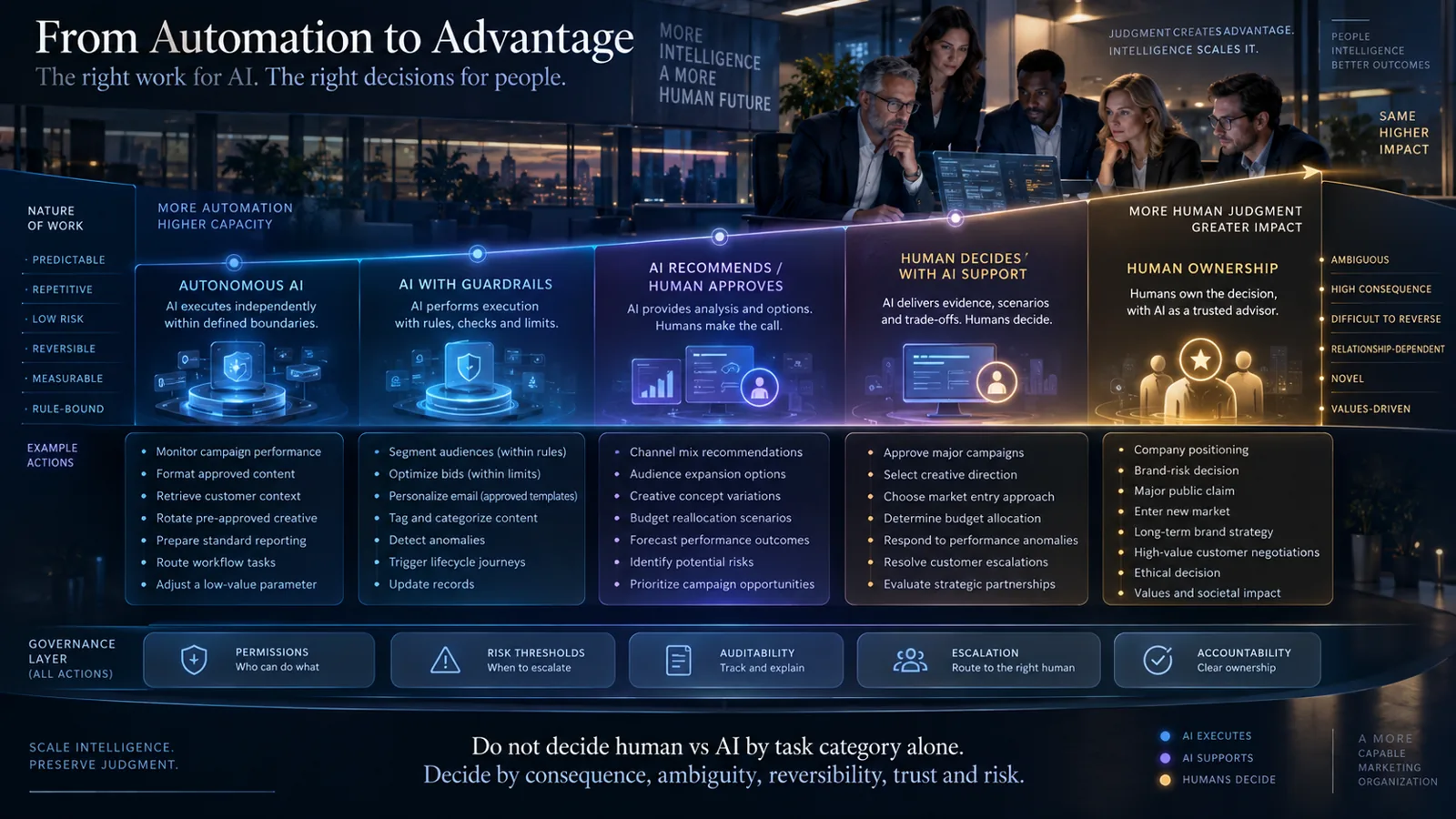
A useful autonomy model is:
Low Consequence + Reversible
AI may execute autonomously within defined rules.
Moderate Consequence
AI recommends or executes within limited thresholds.
High Consequence
AI analyzes and recommends; humans decide.
This is much more useful than saying either:
"Humans must approve everything."
or:
"Agents should become fully autonomous."
The right answer depends on the decision.
Gartner's 2026 research warns that accountability does not disappear simply because a decision becomes automated. It must be deliberately preserved in system design, particularly as organizations introduce more agentic workflows.
6. Humans Should Own Accountability
This may be the most important point.
An AI system can make a recommendation.
It cannot ultimately assume corporate responsibility for what happens.
If an AI-generated campaign creates a reputational crisis, the answer cannot be:
"The model decided."
If an agent makes a damaging customer decision, someone still owns the operating system that allowed that action.
If AI recommends an unethical targeting strategy, leadership remains responsible for deploying it.
This means every consequential AI workflow needs a clear answer to:
Who owns the outcome?
Not who typed the prompt.
Not who built the model.
Not merely who approved access.
Who within the organization is accountable for the business decision?
Gartner argues that sustainable responsible-AI programs require explicit accountability, governance structures, decision-making processes, monitoring and compliance—not simply broad ethical principles.
Agentic systems make this even more important because execution becomes less visible.
Humans may no longer touch every task.
Responsibility therefore has to be designed into the system.
7. Humans Should Own Relationships Where Trust Matters
There are many customer interactions AI can handle extremely well.
Routine questions.
Product discovery.
Status updates.
Basic onboarding.
Scheduling.
Standard support.
Personalized recommendations.
But not every relationship should be optimized for automation.
Some moments require a person.
A strategic enterprise negotiation.
A major customer escalation.
A sensitive complaint.
A partnership conversation.
A community relationship.
A conversation where the customer's problem does not fit the workflow.
A moment when someone needs to feel that the organization itself is listening.
Gartner's 2026 research on brand trust makes this distinction explicitly. It recommends identifying moments where human interaction can uniquely influence belief, emotion or decisions, including negotiations, complex service recovery and important escalations, while placing human oversight into AI-led journeys.
The future customer experience is unlikely to be completely human.
It is equally unlikely to be completely automated.
The competitive advantage may come from knowing when a human matters most.
8. Humans Should Own Values and Ethical Boundaries
AI can optimize toward what you tell it to maximize.
That creates an obvious question:
What should the organization refuse to optimize?
Suppose an algorithm discovers that fear-based messaging drives significantly higher conversion.
Should you use it?
Suppose extreme personalization increases sales but makes customers uncomfortable.
Where is the boundary?
Suppose targeting a vulnerable customer segment produces excellent economics.
Should the company do it?
Those are not optimization questions.
They are value judgments.
Companies need explicit positions on:
privacy;
manipulation;
transparency;
fairness;
customer vulnerability;
truthfulness;
synthetic content;
and acceptable persuasion.
AI can help identify ethical risks.
It cannot determine the organization's values on its behalf.
9. Humans Should Own Novel Situations
Automation performs best when the environment is understood.
Novel situations are different.
A sudden reputational crisis.
A geopolitical event.
A cultural controversy.
An unexpected competitor move.
A new regulatory interpretation.
A customer situation the company has never encountered.
These events often lack reliable precedent.
Historical optimization becomes less useful.
The cost of applying the wrong pattern increases.
AI can still provide extraordinary support:
collect information;
model scenarios;
identify comparable events;
simulate responses;
and challenge assumptions.
But humans should generally take greater control when the situation moves outside the system's validated operating conditions.
A mature AI organization should know not only when an agent is capable of acting.
It should know when the system is uncertain enough to stop.
10. Humans Should Own the System Design
There is a final responsibility that may become increasingly important for marketing leaders.
Someone has to decide:
Which agents exist?
What objectives can they pursue?
Which data can they access?
Which tools can they operate?
What can they execute autonomously?
What requires approval?
What quality standards apply?
How are agents evaluated?
What happens when they disagree?
When does an issue escalate?
How are mistakes captured?
How are workflows improved?
That is no longer ordinary task management.
It is system design.
The future marketing leader increasingly manages not just people and budgets, but the architecture through which humans and AI collaborate.
Microsoft's 2026 Work Trend Index found that more advanced AI users are substantially more likely to pause and deliberately decide which work belongs to AI versus humans, establish shared quality standards, and document agent workflows and human handoffs.
This is a valuable emerging leadership capability.
What Should AI Own?
Defining the human layer does not mean being conservative about AI.
AI should be allowed to own increasingly large portions of appropriate execution.
For example:
Continuous Monitoring
Campaigns.
Competitors.
Search.
Customer signals.
Content performance.
Budget pacing.
Information Retrieval
Finding the relevant customer history, campaign context, document, metric or past decision.
Parallel Research
Market research.
Competitive intelligence.
Customer synthesis.
Search intelligence.
First-Pass Production
Content drafts.
Creative exploration.
Campaign variations.
Summaries.
Adaptation.
Localization.
Quality Control
Brand-rule checking.
Brief adherence.
Formatting.
Duplicate detection.
Basic factual verification against trusted internal sources.
Coordination
Task routing.
Dependency monitoring.
Status tracking.
Feedback consolidation.
Workflow progression.
Low-Risk Execution
Actions that are:
well defined;
reversible;
measurable;
and constrained by clear guardrails.
The objective should not be keeping humans artificially involved in work machines can reliably perform.
That defeats the purpose.
The objective is intentional allocation of responsibility.
The Human-AI Ownership Matrix
A useful way to determine ownership is to evaluate work across five dimensions.
This is more useful than trying to create a permanent list of "AI jobs" and "human jobs."
Technology will keep changing.
The framework can remain.
Human-in-the-Loop Does Not Mean Human-in-Everything
There is another mistake companies should avoid.
Human oversight should not become a euphemism for manually checking every AI action.
If a company deploys an AI agent and then requires an employee to inspect every tiny action it performs, much of the economic value disappears.
Human-in-the-loop needs to be designed around decision importance.
For example:
An AI Content Agent fixes an obvious formatting error.
No executive approval required.
An agent adapts an approved campaign into several standard dimensions.
Probably no approval required if quality checks pass.
An agent proposes a completely new brand position.
Human decision required.
An agent recommends cancelling a major product campaign.
Human decision required.
The goal is not maximum human intervention.
It is maximum human leverage.
Gartner's recent governance research makes a related point: simply saying there is a human in the loop is not enough. Accountability and controls need to be intentionally engineered into AI workflows rather than assumed to exist because a person technically remains somewhere in the process.
Human Judgment Becomes More Valuable as Output Becomes Abundant
Generative AI creates abundance.
More ideas.
More content.
More analysis.
More strategies.
More creative options.
More scenarios.
But abundance creates another problem.
Selection.
If AI gives you one answer, creation appears valuable.
If AI gives you 1,000 good answers, the scarce capability becomes determining which answer deserves action.
That is why the importance of human judgment may increase even while the amount of human execution decreases.
Microsoft's 2026 research found that 50% of surveyed AI users identified quality control of AI output as increasingly important, while 46% selected critical thinking. Eighty-six percent said they remain responsible for the thinking rather than treating AI output as a finished answer.
That is not resistance to AI.
It is a more mature way of using it.
The CMO's Role Becomes More Human, Not Less
There is an interesting paradox here.
As marketing becomes more automated, the best marketing leadership may become more focused on distinctly human capabilities.
The CMO spends less time asking:
Did the report get prepared?
Did the campaign launch?
Did everyone receive the brief?
Did someone update the CRM?
And more time asking:
What do customers actually need?
What do we believe?
Where should we place the bet?
What should our brand stand for?
Which opportunity deserves investment?
Which risk are we willing to take?
What are we learning?
Which decision only I can make?
The operational layer becomes increasingly intelligent.
Leadership moves toward intent and judgment.
That is not a diminished role.
It is a more concentrated one.
AI Should Remove Work, Not Responsibility
This may be the simplest way to summarize the operating model.
AI can remove:
manual work;
repetitive work;
coordination work;
monitoring work;
searching work;
and increasingly some analytical work.
It should not automatically remove:
ownership;
accountability;
judgment;
or responsibility.
Those are separate things.
A mature AI organization will automate execution aggressively while becoming more explicit about human ownership, not less.
What Happens to Marketing Jobs?
The answer is unlikely to be identical across roles.
Some responsibilities will shrink.
Others will expand.
A content marketer may write fewer first drafts and spend more time on:
editorial strategy;
proprietary insight;
quality;
distribution;
and audience understanding.
An analyst may prepare fewer reports and spend more time on:
measurement design;
experimentation;
causal reasoning;
and decision support.
A marketing operations leader may configure fewer manual workflows and spend more time designing:
agent architecture;
governance;
data systems;
and orchestration.
A manager may coordinate fewer individual tasks while defining:
outcomes;
standards;
permissions;
and human-AI workflows.
Work changes.
But the direction is consistent:
from executing every task toward owning higher-level outcomes.
Frequently asked questions
What should humans still own when AI agents perform more marketing work?
Humans should retain ownership of business objectives, strategic trade-offs, creative taste, values, important customer relationships, high-consequence decisions, AI governance and ultimate accountability for outcomes.
What marketing decisions should not be fully automated?
Major positioning changes, significant budget allocations, sensitive customer communications, high-risk claims, reputational decisions, ethical questions and other difficult-to-reverse decisions should generally retain meaningful human oversight.
What is the difference between human ownership and human execution?
Human ownership means being responsible for the objective, decision, standard and outcome. Human execution means manually performing the underlying tasks. AI can increasingly execute work while humans continue owning its consequences.
What does human-in-the-loop mean?
Human-in-the-loop refers to an AI workflow in which a person provides appropriate oversight, approval or intervention. Effective human oversight should be based on risk and consequence rather than requiring manual approval of every automated action.
Will AI replace marketing judgment?
AI will increasingly support judgment by analyzing information, generating alternatives and modeling possible outcomes. However, strategic trade-offs, brand taste, values and accountability still require human ownership.
What should AI agents be allowed to do autonomously?
AI agents are best suited to autonomous actions that are predictable, low-risk, measurable, reversible and governed by clear boundaries. Human involvement should increase as decisions become more consequential, ambiguous or difficult to reverse.
Who is responsible when an AI agent makes a mistake?
Organizations remain responsible for the AI systems they deploy. Clear human and organizational accountability should be defined for consequential workflows rather than treating AI itself as the accountable decision-maker.