Marketing Is Becoming Autonomous: How AI Agents Will Run Continuous Growth Systems
These systems increased speed and scale, but they remained largely dependent on human marketers designing the journey in advance.

Marketing has spent decades becoming more automated.
Email platforms send messages when customers complete defined actions.
Advertising systems automatically adjust bids.
CRM platforms route leads according to predefined rules.
Recommendation engines personalise products.
Social tools schedule posts.
These systems increased speed and scale, but they remained largely dependent on human marketers designing the journey in advance.
A person decided:
- Which audience to target
- Which campaign to launch
- Which message to use
- Which rule should trigger an action
- Which metric should be monitored
- When optimisation should occur
The software executed the instructions.
Autonomous marketing changes this relationship.
Instead of waiting for marketers to define every step, an AI-powered system can receive a broader objective, interpret changing conditions, determine which actions are appropriate and adapt its workflow within approved boundaries.
A marketing leader might define the objective:
Increase adoption of the company’s analytics product among existing mid-market customers without increasing unsubscribe rates or exceeding the approved campaign budget.
An autonomous marketing system could then:
- 1Analyse product-usage and customer-engagement data.
- 2Identify segments with high adoption potential.
- 3Examine customer objections and support issues.
- 4Recommend a campaign strategy.
- 5Produce approved content variations.
- 6Coordinate email, in-product and sales-touch workflows.
- 7Monitor customer responses.
- 8Adjust timing or messaging within predefined limits.
- 9Escalate sensitive decisions to a human owner.
- 10Report the effect on adoption and retention.
The marketer no longer specifies every action.
They define the outcome, constraints and authority.
The system manages much of the execution.
That is the beginning of autonomous marketing.
Autonomous marketing is not marketing without humans. It is marketing in which intelligent systems can sense, decide and act while humans define strategy, permissions and accountability.
This distinction matters.
The goal is not to let AI run the brand without supervision.
The goal is to give marketing systems enough controlled autonomy to respond faster than a manually coordinated organisation.
From Automation to Autonomy
Automation and autonomy are related, but they are not the same.
Traditional Marketing Automation
Traditional automation follows rules designed in advance.
For example:
If a prospect downloads a guide, wait two days and send an email.
The system performs the action exactly as configured.
It does not decide whether:
- The email is still relevant
- The prospect already spoke with sales
- A different resource would be more helpful
- The customer’s company has changed priorities
- Communication should be delayed
Autonomous Marketing
An autonomous system works towards an objective and adapts its actions according to context.
It might determine that:
- One customer should receive an implementation guide.
- Another should be routed to sales.
- A third should not receive a message because support is handling an unresolved issue.
- A fourth should enter a product-adoption journey.
The system still operates within defined rules.
But it has greater freedom to interpret the situation.
OpenAI describes agents as systems that independently accomplish tasks on behalf of users by using models, tools and instructions to manage workflows and select actions. It also recommends layered guardrails and human intervention for sensitive or high-risk decisions.
Autonomy therefore exists on a spectrum.
It is not an on-or-off setting.
The Autonomous Marketing Maturity Model
Marketing organisations can progress through six stages.
Level 1: Manual Marketing
Humans perform almost every task.
They:
- Analyse data
- Build audiences
- Write content
- Launch campaigns
- Review results
Software provides storage and execution tools.
Level 2: Rule-Based Automation
Systems perform predictable actions triggered by predefined events.
Examples include:
- Email sequences
- Lead routing
- Scheduled publishing
- Advertising bid rules
- CRM notifications
Level 3: AI Assistance
AI supports individual tasks.
It may:
- Generate content
- Summarise reports
- Analyse feedback
- Recommend audiences
- Suggest campaign ideas
The human still moves work between stages.
Level 4: Agentic Workflows
An AI agent manages several connected steps.
For example, it may analyse performance, identify a problem, prepare a recommendation and create tasks for review.
Level 5: Controlled Autonomy
The system can take selected actions without individual approval when those actions remain within defined limits.
Examples include:
- Adjusting campaign timing
- Selecting an approved content variation
- Pausing a poorly performing low-budget experiment
- Routing a customer into the appropriate journey
Level 6: Autonomous Growth System
Multiple agents continuously coordinate research, customer engagement, campaigns, optimisation and reporting around shared business objectives.
Humans remain responsible for strategy, major investments, brand direction and exceptions.
Most companies today operate somewhere between Levels 2 and 4.
The immediate opportunity is not complete autonomy.
It is moving high-value workflows towards controlled autonomy.
Why Marketing Is Moving in This Direction
1. Customer Behaviour Changes Faster Than Campaign Cycles
Traditional campaigns are planned in stages:
- 1Research
- 2Strategy
- 3Creative development
- 4Approval
- 5Launch
- 6Reporting
- 7Optimisation
By the time this process finishes, customer behaviour may have changed.
Autonomous systems can monitor signals continuously and react more quickly.
Signals may include:
- Product usage
- Search behaviour
- Customer conversations
- Conversion changes
- Campaign engagement
- Support issues
- Competitor activity
McKinsey describes the future of marketing as a movement from isolated campaigns towards continuous growth, supported by AI capabilities across insight, creativity, personalisation, agentic commerce and optimisation.
2. Marketing Data Exceeds Human Attention
Marketing teams can access more data than they can realistically interpret.
A company may collect information from:
- Website analytics
- CRM systems
- Advertising platforms
- Product usage
- Customer support
- Social media
- Sales conversations
Humans cannot monitor every signal continuously.
AI agents can review large volumes of information, identify meaningful changes and direct human attention towards decisions that matter.
The objective is not to remove human analysis.
It is to prevent human analysts from spending most of their time collecting and organising data.
3. Personalisation Requires More Decisions
Personalisation sounds simple until it is applied at scale.
Relevant customer communication may depend on:
- Industry
- Company size
- Buying stage
- Product usage
- Previous engagement
- Customer preferences
- Commercial value
- Current support issues
A marketer cannot manually choose the best action for every customer.
Rule-based systems can create segments, but they become difficult to maintain as conditions multiply.
Autonomous systems can reason across more contextual signals while remaining subject to consent, frequency and brand controls.
Salesforce reported in February 2026 that 69% of marketers struggled to respond promptly to customers, 84% sometimes ran generic campaigns and 78% needed more personalised content than they could produce. These figures come from Salesforce’s own marketing research and should be interpreted as vendor-reported industry evidence.
4. AI Can Coordinate Different Marketing Functions
A traditional campaign may require separate teams for:
- Insights
- Content
- Creative
- Media
- Lifecycle marketing
- Operations
- Analytics
Agents can help coordinate those functions through one connected workflow.
McKinsey estimates that agentic AI could eventually power as much as two-thirds of current marketing activities, including content production, synthetic audience testing and audience-based media planning.
This does not mean two-thirds of marketers will disappear.
It means much of the work inside marketing roles may be initiated, completed or coordinated by agents.
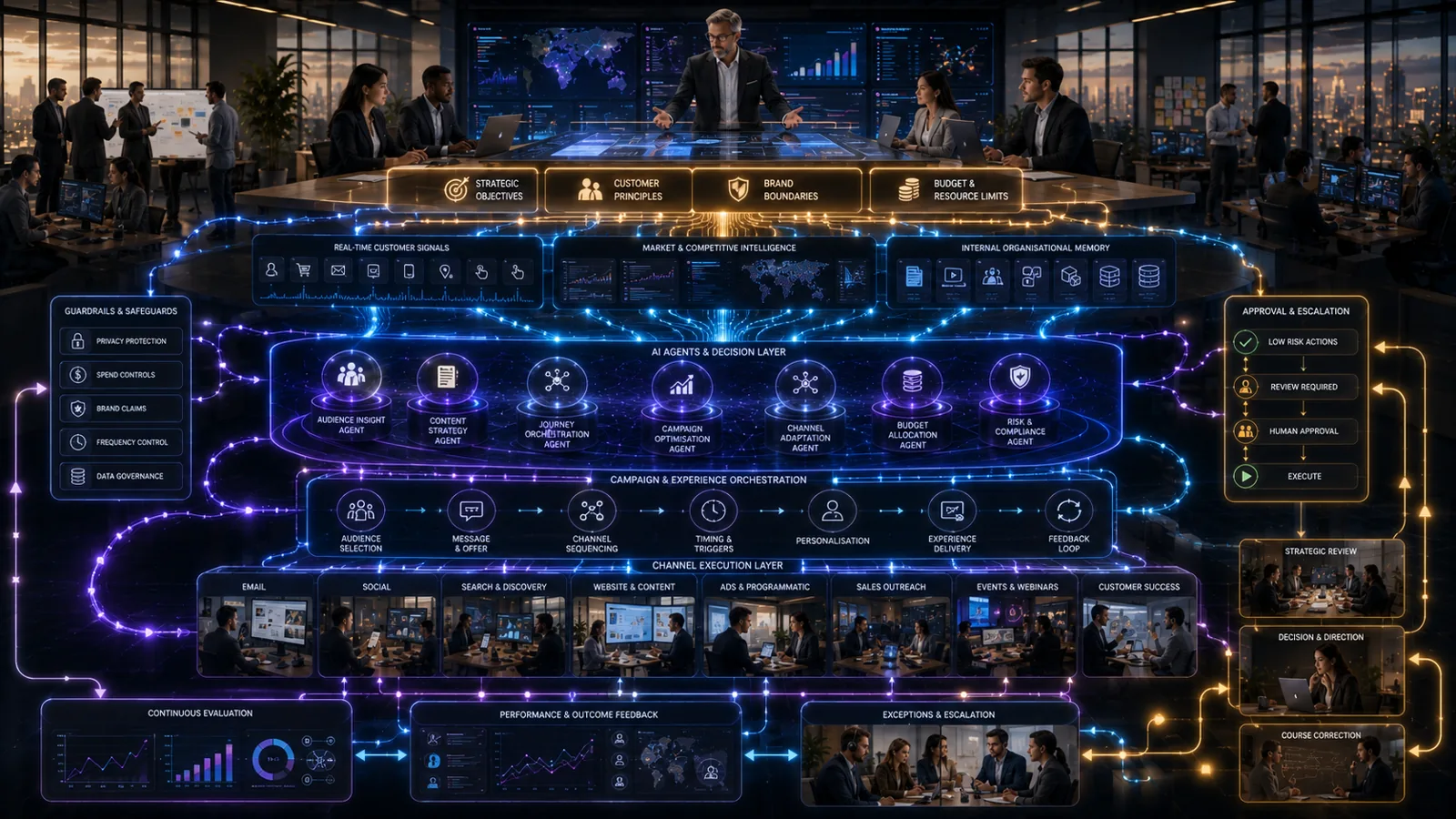
The Six Components of an Autonomous Marketing System
Autonomy requires more than a powerful model.
A dependable system needs six connected components.
1. A Clear Objective
The system must know what it is trying to improve.
Weak objective:
Improve customer engagement.
Stronger objective:
Increase 30-day product activation among newly acquired small-business customers while maintaining customer satisfaction and communication-frequency limits.
A useful objective includes:
- Target audience
- Desired outcome
- Time horizon
- Constraints
- Guardrail metrics
Without a precise objective, autonomy becomes directionless activity.
2. Continuous Signals
The system needs relevant data about the current environment.
Signals may include:
- Customer actions
- Campaign responses
- Sales activity
- Product usage
- Inventory
- Customer sentiment
- Competitor developments
- Budget consumption
Data must be:
- Current
- Consistent
- Authorised
- Traceable
McKinsey warns that agentic systems can make inconsistent decisions or propagate errors when operating on fragmented data, especially when multiple agents depend on shared information.
Autonomy built on unreliable data produces faster mistakes.
3. Decision Intelligence
The system must interpret signals and select an appropriate response.
This may involve:
- Detecting an anomaly
- Comparing possible actions
- Estimating likely effects
- Considering constraints
- Determining whether human input is required
Decision intelligence should not be confused with certainty.
The system may have confidence levels and should know when available evidence is insufficient.
4. Approved Actions
The system needs tools through which it can act.
These may include:
- CRM
- Advertising
- Content management
- Customer-data systems
- Product messaging
- Project management
- Analytics
Every tool should have clear permissions.
An agent that can recommend a media-budget change does not automatically need permission to execute it.
5. Guardrails and Escalation
The system must understand its limits.
Guardrails may control:
- Budget
- Message frequency
- Customer consent
- Data access
- Claims
- Brand tone
- Audience exclusions
- Publishing rights
High-impact actions should be escalated.
Examples include:
- Major budget changes
- Sensitive customer communication
- Public brand statements
- Regulated claims
- Crisis response
- Pricing changes
6. Evaluation and Learning
An autonomous system must be evaluated continuously.
It should record:
- Which action was taken
- Why it was selected
- What information was used
- Whether approval was required
- What outcome occurred
- Whether the result should influence future decisions
Learning should not mean that every result automatically becomes permanent policy.
Human review is required to distinguish a meaningful pattern from a temporary anomaly.
What Autonomous Marketing Looks Like in Practice
Autonomous Customer-Journey Management
A customer-journey agent can monitor behaviour across:
- Website
- Product usage
- Sales
- Support
It may choose among approved actions such as:
- Deliver education
- Recommend a feature
- Delay communication
- Notify sales
- Escalate a service issue
The agent works towards a customer outcome rather than blindly executing a fixed sequence.
Autonomous Campaign Optimisation
A campaign agent may monitor:
- Conversion
- Cost
- Audience fatigue
- Asset performance
- Sales quality
Within approved limits, it could:
- Shift delivery towards stronger assets
- Reduce exposure to fatigued audiences
- Pause a weak test
- Recommend new variations
Major budget allocation remains a human decision.
Autonomous Content Operations
A content system may:
- 1Detect a customer-information gap.
- 2Retrieve expert knowledge.
- 3Prepare a brief.
- 4Generate channel variations.
- 5Run brand and factual checks.
- 6Route the work for approval.
- 7Schedule distribution.
- 8Measure performance.
- 9Recommend an update.
The system does not independently decide the company’s worldview.
It manages the operational lifecycle of approved content.
Autonomous Market Intelligence
A research agent can monitor competitors, customers and market developments continuously.
It may alert leadership when:
- A competitor changes pricing
- Customer objections shift
- A category term gains adoption
- A regulatory change affects messaging
This moves market intelligence from periodic research to an always-on capability.
Autonomous Revenue Coordination
Marketing and sales agents can exchange signals.
For example:
- 1A marketing agent identifies increased engagement from a target account.
- 2An account agent gathers relevant public and CRM context.
- 3A sales agent prepares a briefing.
- 4The human account owner decides whether and how to engage.
Salesforce announced agentic marketing capabilities in June 2026 intended to help marketers build pipeline, create content and run campaigns through teams of collaborating agents.
Humans Still Define the Marketing Strategy
Autonomy is most useful in execution and adaptation.
It is less suitable for decisions involving the fundamental identity and direction of the organisation.
Humans should continue to own:
- Brand positioning
- Customer promises
- Market choices
- Ethical boundaries
- Major investment
- Creative ambition
- Crisis decisions
- Organisational accountability
Microsoft’s 2026 Work Trend Index describes this future as an expansion of human agency: as agents perform more execution, people gain more capacity to direct the work, make decisions and own outcomes.
The strongest autonomous marketing organisation will not have absent leadership.
It will require stronger leadership because the system can act at greater speed and scale.
The Human Control Matrix
The Risk of Autonomous Marketing
Greater autonomy creates greater leverage.
It also creates new failure modes.
Brand Drift
An agent may optimise individual messages while gradually weakening the brand’s distinctiveness.
Local Optimisation
The system may improve one metric while harming another.
For example:
- More emails improve immediate conversion but increase fatigue.
- Aggressive discounts increase sales but weaken pricing power.
- Narrow targeting improves efficiency but reduces future demand.
Data Misinterpretation
Correlation may be treated as causation.
The system may respond to an apparent pattern that resulted from incomplete or biased data.
Permission Creep
Agents may gradually gain access to systems and actions that are no longer justified.
Error Propagation
In a multi-agent system, one incorrect conclusion may be passed between agents and influence several downstream actions.
Loss of Customer Empathy
A highly optimised journey may still feel mechanical, intrusive or insensitive.
Weak Accountability
Teams may blame the system for an outcome even though humans designed its objective and permissions.
These risks do not mean autonomy should be rejected.
They mean it must be governed as an operating model.
Why “Set It and Forget It” Is the Wrong Vision
Autonomous marketing is sometimes presented as a system that runs indefinitely without human involvement.
That is unrealistic and undesirable.
Markets change.
Products change.
Customers change.
Regulations change.
Brand priorities change.
The system needs ongoing:
- Evaluation
- Supervision
- Knowledge updates
- Permission reviews
- Strategic direction
- Error analysis
The correct vision is not “set it and forget it.”
It is:
Set the objective, govern the system and intervene where human judgement matters.
The New Role of the CMO
The autonomous marketing era changes the CMO’s work.
The CMO becomes responsible for designing a system of human and machine decision-making.
Their responsibilities expand to include:
Objective Design
Defining what the autonomous system should optimise.
Constraint Design
Ensuring that growth objectives do not override trust, brand or customer experience.
Authority Design
Determining which actions agents may perform independently.
Agent Portfolio Management
Deciding which agents are required and who owns them.
Evaluation
Reviewing whether autonomous activity creates business value.
Human Capability
Ensuring employees develop stronger skills in strategy, creativity, customer understanding and supervision.
The future CMO will not manually control every campaign.
They will design the environment in which campaigns can operate intelligently.
Metrics for Autonomous Marketing
Autonomous systems should not be measured by how many actions they perform.
A useful scorecard includes five dimensions.
Business Performance
- Revenue
- Pipeline
- Retention
- Customer lifetime value
- Acquisition efficiency
Customer Performance
- Satisfaction
- Relevance
- Adoption
- Customer effort
- Complaint rate
Operational Performance
- Cycle time
- Response speed
- Manual effort reduced
- Workflow completion
- Availability
AI Performance
- Recommendation acceptance
- Error rate
- Escalation rate
- Tool-call success
- Decision consistency
Governance Performance
- Permission violations
- Unsupported claims
- Budget exceptions
- Data incidents
- Human override frequency
The goal is not maximum autonomy.
The goal is maximum responsible value.
A Roadmap Towards Controlled Autonomy
Phase 1: Observe
Allow AI to monitor data and identify patterns.
No external actions are permitted.
Phase 2: Recommend
The system proposes actions.
Humans approve or reject every recommendation.
Phase 3: Prepare
The system creates drafts, campaign structures and execution plans.
Humans review before launch.
Phase 4: Execute With Approval
The system performs the action only after explicit authorisation.
Phase 5: Execute Within Limits
The system can perform low-risk actions independently within defined budgets, audiences and communication rules.
Phase 6: Coordinate Across Workflows
Several agents collaborate across customer intelligence, content, campaigns and performance.
Human leaders supervise objectives and exceptions.
McKinsey recommends redesigning full marketing workflows around agentic capabilities rather than attaching agents to fragmented existing processes.
Common Mistakes
Mistake 1: Calling Basic Automation Autonomous
A scheduled email sequence remains rule-based automation.
Mistake 2: Automating Before Clarifying the Objective
The system cannot compensate for unclear strategy.
Mistake 3: Optimising One Metric
An autonomous system needs balanced objectives and guardrail metrics.
Mistake 4: Granting Write Access Too Early
Begin with observation, analysis and recommendation.
Mistake 5: Deploying Too Many Agents
Multi-agent complexity can make systems slower, more expensive and harder to debug.
Mistake 6: Ignoring Brand Memory
Agents need shared company context to remain consistent.
Mistake 7: Removing Human Customer Contact
Human relationships remain essential for trust, community, partnerships and sensitive situations.
Mistake 8: Treating Human Overrides as Failures
A correct escalation is evidence that the governance system is working.
A Practical First Autonomous Workflow
A strong starting point is weekly campaign-performance management.
Objective
Identify campaigns requiring attention and prepare safe optimisation actions.
Inputs
- Advertising performance
- Conversion
- CRM quality
- Budget pacing
- Audience fatigue
- Previous decisions
Agent Responsibilities
- Detect significant changes
- Explain likely causes
- Recommend actions
- Prepare approved adjustments
- Escalate major budget decisions
Initial Permissions
- Read data
- Create reports
- Prepare recommendations
- Draft changes
Later Permissions
After reliable testing, the system may be allowed to:
- Pause a low-budget test exceeding a loss threshold
- Adjust approved delivery schedules
- Select among pre-approved creative variations
Human Responsibilities
- Set commercial objectives
- Approve budget thresholds
- Review strategic changes
- Assess wider brand and customer effects
Key Takeaways
- Marketing is moving from rule-based automation towards controlled autonomy.
- Autonomous systems can interpret signals, make contextual decisions and execute authorised actions.
- Autonomy exists on a spectrum, from observation to coordinated multi-agent execution.
- The goal is not to eliminate human marketers.
- Humans must define objectives, constraints, authority and accountability.
- Autonomous marketing requires reliable data, tools, guardrails, evaluations and escalation paths.
- Personalisation, optimisation and continuous customer journeys are strong autonomy use cases.
- Brand strategy, ethical judgement, relationships and major investments should remain human-led.
- Multi-agent systems introduce coordination and error-propagation risks.
- The best autonomous system is not the one that acts most frequently, but the one that creates the most responsible customer and business value.
Conclusion: Marketing Will Run Continuously, but It Must Remain Human-Led
Traditional marketing operates through campaigns.
Teams gather information, create a plan, launch activity and review the results.
That model will not disappear completely.
But it will increasingly be surrounded by autonomous systems working continuously.
These systems will:
- Monitor markets
- Interpret customer behaviour
- Coordinate content
- Personalise journeys
- Optimise campaigns
- Surface decisions
- Learn from outcomes
This creates a marketing organisation capable of responding at machine speed.
But speed without direction is dangerous.
An autonomous system can execute a weak strategy faster.
It can scale an inaccurate assumption.
It can optimise a metric that damages customer trust.
It can create hundreds of individually rational actions that collectively weaken the brand.
Human leadership therefore becomes more important, not less.
The future marketing leader must decide:
- What the system should optimise
- Which trade-offs are unacceptable
- Where autonomy creates value
- Where human judgement must remain
- How accountability will be preserved
Marketing is becoming autonomous.
But the brand cannot become ownerless.
The customer relationship cannot become merely an optimisation problem.
The CMO cannot delegate responsibility to an algorithm.
The winning model will be controlled autonomy:
AI systems sensing, deciding and acting continuously—inside a strategy, culture and governance model defined by humans.
Actionable Next Steps
- 1Map your current marketing automation and identify where human coordination creates delays.
- 2Select one recurring workflow with a measurable objective.
- 3Define the data and tools required.
- 4Establish business and customer guardrail metrics.
- 5Begin with AI observation and recommendations.
- 6Record human approvals and corrections.
- 7Test the system against unusual and sensitive scenarios.
- 8Grant limited execution rights only after reliability is demonstrated.
- 9Assign one accountable human owner.
- 10Expand autonomy based on evidence rather than enthusiasm.
Frequently asked questions
What is autonomous marketing?
Autonomous marketing uses AI agents to interpret data, make contextual decisions and perform approved marketing actions while operating within human-defined objectives and controls.
How is autonomous marketing different from marketing automation?
Marketing automation follows predefined rules. Autonomous marketing can interpret changing conditions, select actions and adapt its workflow towards an objective.
Will autonomous marketing replace marketers?
It will automate and coordinate parts of marketing execution. Humans will remain essential for strategy, creativity, customer relationships, ethical judgement and accountability.
Which marketing activities can become autonomous first?
Strong early use cases include market monitoring, campaign reporting, customer-journey routing, content operations and low-risk campaign optimisation.
Can autonomous AI control marketing budgets?
It may eventually control limited budgets within strict thresholds. Major allocations and strategic investments should remain under human approval.
What data does autonomous marketing require?
It may use customer behaviour, campaign performance, CRM information, product usage, support signals and approved company knowledge, subject to data and privacy controls.
What are the main risks of autonomous marketing?
Risks include brand drift, local optimisation, incorrect data interpretation, permission creep, error propagation and reduced customer empathy.
How should autonomous marketing be measured?
Measure business outcomes, customer experience, operational efficiency, AI reliability and governance performance rather than the number of automated actions. 20 aug-The marketing operating system