The End-to-End AI Marketing Campaign: How One Campaign Moves From Strategy to Optimization
The more interesting future emerges when one marketing objective can move through the entire system while retaining its context, decisions, dependencies and history.
Most companies are already using AI somewhere in marketing.
A marketer uses AI to research competitors.
Someone else generates copy.
The design team experiments with generative creative.
An analyst uses AI to summarize performance.
Sales uses another assistant.
Lifecycle marketing uses another platform.
Technically, AI appears throughout the organization.
But the campaign itself is still coordinated almost entirely by humans.
Someone has to transfer the research into the brief.
Someone has to explain the brief to content.
Someone has to tell creative what content decided.
Someone has to send approved assets to paid media.
Someone has to update lifecycle.
Someone has to ensure sales knows what launched.
Someone has to monitor analytics.
Someone has to turn those numbers into recommendations.
This is AI-assisted marketing.
It is not yet AI-orchestrated marketing.
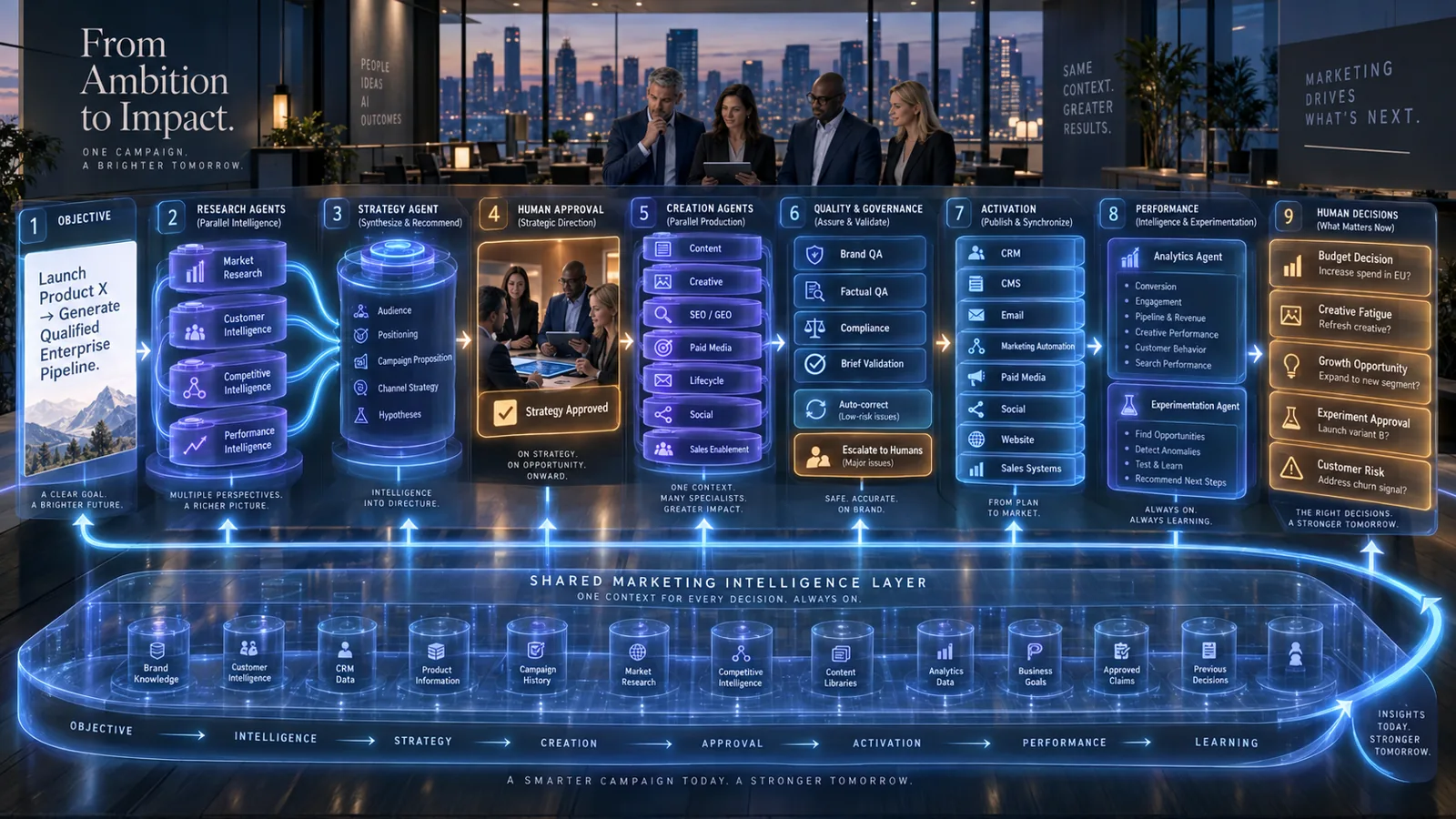
The more interesting future emerges when one marketing objective can move through the entire system while retaining its context, decisions, dependencies and history.
Research informs strategy.
Strategy informs content.
Content informs creative.
Approved creative flows into activation.
Customer signals influence personalization.
Analytics watches what happens.
Performance changes trigger investigation.
New insights improve the campaign.
Those learnings return to organizational memory.
The campaign becomes a connected system rather than a chain of disconnected tasks.
That is the idea behind an end-to-end AI marketing campaign workflow.
What Is an End-to-End AI Marketing Campaign?
An end-to-end AI marketing campaign is a connected marketing workflow in which humans, AI agents, automation and enterprise software collaborate across the complete campaign lifecycle—from research and strategy through creation, activation, measurement and optimization—using shared context and coordinated decision-making.
The important phrase is end-to-end.
AI generating the headline is not end-to-end.
AI creating an audience segment is not end-to-end.
AI summarizing analytics is not end-to-end.
Those are isolated capabilities.
An end-to-end system connects them.
Instead of thinking:
Research AI
Content AI
Analytics AI
think:
One campaign objective moving through a coordinated network of intelligence.
Why Today's Campaign Workflow Is So Fragmented
Consider a fairly normal product launch.
The strategy team researches the market.
Product marketing creates the positioning.
Content writes the messaging.
Creative develops assets.
Paid media adapts them.
SEO builds search content.
Lifecycle prepares emails.
Social creates posts.
Marketing operations configures campaigns.
Sales gets enablement material.
Analytics prepares tracking.
Leadership approves major decisions.
All of these functions may use excellent software.
The problem appears between them.
Each team receives only part of the context.
The brief gets summarized.
Then summarized again.
Then interpreted.
Then changed.
Then another team works from an older version.
Feedback lives in different tools.
Customer insights discovered by one function never reach another.
A campaign can therefore begin with one strategic idea and gradually drift as it moves through the organization.
The primary coordination mechanism remains:
people talking to other people.
This works.
But it scales poorly.
BCG describes a typical large-enterprise legacy campaign process as taking 60 to 90 days from initial strategy to launch, involving 20 or more people and numerous handoffs.
The problem is not that those people lack skill.
It is that the operating model requires human coordination at almost every stage.
One Campaign Should Have One Persistent Context
The first architectural change is deceptively simple.
A campaign should not become a new document every time it changes departments.
It should have a persistent intelligence object.
Imagine every campaign carrying structured context including:
business objective;
target audience;
customer problem;
positioning;
product information;
offer;
approved messaging;
brand guidelines;
budget;
channels;
KPIs;
historical performance;
competitive intelligence;
customer research;
approval decisions;
risk constraints;
and current workflow state.
That information stays attached to the campaign throughout its lifecycle.
When the Content Agent works, it receives the relevant campaign context.
When the Paid Media Agent works, it receives the same approved strategy.
When the Analytics Agent evaluates performance, it knows what the campaign was trying to achieve.
This sounds obvious.
Most marketing organizations do not operate this way today.
Context is repeatedly reconstructed.
And every reconstruction introduces the possibility of drift.
Stage 1: The Campaign Begins With an Objective
Every campaign should start with a business problem.
Not:
"We need five LinkedIn posts."
Not:
"We need an email campaign."
Not:
"We need 20 new creatives."
Those are outputs.
A stronger starting point is:
Increase qualified enterprise pipeline for Product X by 15% among CFOs at companies with more than 1,000 employees over the next quarter.
Now the system understands an outcome.
That objective can anchor every downstream decision.
What customers matter?
What research is needed?
What proposition should be tested?
Which channels make sense?
What content should exist?
How should success be measured?
This is an important principle for agentic marketing:
Agents should receive objectives, not merely tasks.
Tasks can then be derived from the objective.
Stage 2: Research Agents Work in Parallel
Traditional campaign research is often sequential.
A strategist researches competitors.
Then customers.
Then search.
Then market trends.
That may take days or weeks.
Specialized AI agents can increasingly perform parts of this work simultaneously.
For example:
Market Research Agent
Analyzes:
category trends;
market changes;
relevant industry research;
emerging topics;
and demand signals.
Customer Intelligence Agent
Analyzes:
CRM;
customer interviews;
support conversations;
sales calls;
reviews;
survey findings;
and behavioral data.
Competitive Intelligence Agent
Analyzes:
competitor positioning;
campaign activity;
content;
offers;
product changes;
and public messaging.
Search Intelligence Agent
Examines:
search demand;
keyword patterns;
AI-search questions;
content gaps;
and customer language.
Performance Intelligence Agent
Retrieves:
previous campaign performance;
historically strong channels;
audience response;
creative learnings;
and unsuccessful experiments.
These agents do not need to produce five independent decks.
Their outputs should move into a common campaign intelligence layer.
The objective is not more research.
It is better synthesized intelligence.
Stage 3: Strategy Synthesizes the Intelligence
Research itself does not create strategy.
Someone—or some system—must decide what the evidence means.
A Strategy Agent could synthesize the different research streams into:
market opportunity;
target audience;
customer tension;
campaign proposition;
messaging territory;
recommended channels;
potential risks;
and strategic hypotheses.
But this is an important human decision gate.
Senior marketers should examine questions such as:
Is this actually the right market opportunity?
Is this proposition distinctive?
Does it align with company strategy?
Are we comfortable making this claim?
Is this the right audience?
Does the campaign deserve investment?
AI can improve the quality and speed of information reaching strategists.
It should not create the illusion that strategic accountability disappeared.
So the workflow becomes:
Research Agents → Strategy Synthesis → Human Strategic Approval
Once approved, the strategy becomes a locked upstream decision.
Downstream agents should operate from it.
Stage 4: The Strategy Becomes a Content Architecture
Once strategy is approved, the system should not immediately ask AI to:
"Write some content."
Instead, a Content Strategy Agent can determine what information architecture the campaign requires.
For a B2B product launch, that might include:
one central campaign narrative;
pillar article;
landing page;
executive point-of-view content;
product proof;
customer story;
sales enablement;
comparison content;
email sequence;
LinkedIn content;
search content;
paid media messaging;
and remarketing assets.
Each piece serves a defined role.
This is much stronger than generating random content because AI makes content inexpensive.
The campaign objective determines the content architecture.
Stage 5: Specialized Agents Create in Parallel
After the content architecture is approved, production can increasingly become parallel.
A Content Agent develops long-form material.
An SEO/GEO Agent structures search and answer-engine content.
A Lifecycle Agent creates the nurture sequence.
A Social Agent adapts core ideas into platform-native content.
A Paid Media Agent develops advertising variants.
A Creative Agent prepares visual concepts.
A Sales Enablement Agent converts campaign intelligence into material for sales.
The crucial point is that all of them work from the same approved campaign intelligence.
They do not independently invent:
the audience;
the value proposition;
the brand voice;
the product claims;
or the CTA.
They inherit them.
This creates consistency without forcing every asset to look identical.
Stage 6: Quality Agents Check the Work Before Humans Do
One of the worst ways to scale AI marketing is to generate 10 times more work and then require humans to manually review all of it.
That simply moves the bottleneck.
Before content reaches senior reviewers, quality-control agents can check predictable requirements.
Brand Agent
Checks:
tone;
terminology;
visual standards;
messaging rules;
and approved claims.
Brief Compliance Agent
Checks whether the asset actually answers the campaign objective and audience need.
Factual QA Agent
Checks:
product facts;
statistics;
sources;
dates;
claims;
and internal consistency.
Compliance Agent
Where appropriate, checks:
required disclaimers;
regulated wording;
permissions;
and policy restrictions.
Duplication Agent
Checks whether the organization has already produced something materially similar.
Humans can then focus on questions AI is less suited to answer:
Is this interesting?
Does it have taste?
Would our customer care?
Is the creative distinctive?
Does this represent our point of view?
This is the difference between human review and human quality control.
AI can increasingly absorb the latter.
Stage 7: Human Approval Happens at Defined Gates
AI-native does not mean approval-free.
The better model is risk-based human involvement.
A low-risk social variation derived from an already approved campaign may require little additional review.
A major brand film may require:
creative leadership;
brand leadership;
legal;
and executive approval.
A new financial claim may require compliance.
A major budget reallocation may require the CMO.
Human involvement should therefore depend on:
risk;
impact;
novelty;
reversibility;
and organizational policy.
Instead of every stakeholder approving everything, the orchestration layer determines which approvals are required for each asset.
Adobe Campaign already reflects this general workflow principle: marketing workflows can coordinate segmentation, execution and human participation, including approvals, while tracking each stage as part of the process.
Stage 8: Activation Should Not Require Rebuilding the Campaign
This is where many campaign processes break.
The strategy is approved.
Content is ready.
Creative is finished.
Then execution teams manually rebuild everything inside channel tools.
Audience segments are recreated.
Tracking parameters are added.
Files are renamed.
Content is uploaded.
Emails are configured.
Paid campaigns are built.
Social posts are scheduled.
CRM campaigns are created.
Humans check launch spreadsheets.
This is precisely where deterministic automation should do much of the work.
Once assets and audiences are approved:
automation can create folders;
apply metadata;
route assets;
configure standard campaign structures;
synchronize approved data;
and prepare execution environments.
Adobe describes modern connected content workflows in similar terms: strategy and project kickoff can connect through execution and reporting, while automation manages assignments, metadata, content activation and downstream processes.
AI should not be used simply because AI exists.
If something follows predictable rules, traditional automation may remain the better tool.
Stage 9: The Campaign Activates Across Multiple Channels
Now one approved campaign begins appearing across the market.
But not as identical content everywhere.
The core strategy remains consistent while execution adapts by channel.
Search
The SEO/GEO system publishes content around customer questions and high-intent queries.
Paid Media
Campaign variants are deployed across relevant audiences and platforms.
Email and Lifecycle
Different customers enter journeys based on lifecycle stage and behavior.
Social
Core campaign ideas become platform-specific posts, video, graphics and discussions.
Website
Landing pages adapt messaging around the approved campaign proposition.
Sales
Sales teams receive the campaign narrative, objections, proof points and customer context.
Customer Success
Existing customers may receive different messaging from prospects.
The campaign behaves as one system.
Not seven departments independently publishing around the same product.
Stage 10: Analytics Agents Monitor Continuously
Traditional marketing reporting frequently happens after the fact.
The campaign runs.
A week passes.
Analysts prepare the report.
Someone notices a problem.
A meeting gets scheduled.
A recommendation is made.
By then, significant budget may already have been spent.
AI analytics agents create the possibility of continuous monitoring.
They can watch:
conversion;
traffic;
customer behavior;
creative performance;
media efficiency;
content engagement;
pipeline;
revenue;
search visibility;
email behavior;
and campaign pacing.
Most changes do not deserve human attention.
The system should suppress normal variation.
But when something material happens, it can investigate.
For example:
Paid conversion decreased 17%.
The Analytics Agent asks:
Was traffic quality different?
Did the landing page change?
Did creative fatigue increase?
Did CPM rise?
Did one audience drive the decline?
Did a competitor launch something?
Did pricing change?
The goal is not:
alert the marketer that a number moved.
It is:
investigate before interrupting the marketer.
Stage 11: The Campaign Optimizes Itself Within Guardrails
Now we reach the more agentic part of the model.
Suppose the system discovers:
Creative Set A is fatigued.
Audience B is outperforming.
Landing Page C performs particularly well for enterprise traffic.
One email subject line significantly improves qualified response.
The system can recommend actions.
Low-risk actions could eventually execute automatically.
For example:
rotate an approved creative;
adjust send timing;
shift a limited amount of budget within pre-approved thresholds;
pause an obviously malfunctioning asset;
or launch a previously approved test.
Higher-impact actions escalate.
Recommended: move 30% of regional budget into Segment B.
That may require human approval.
This creates a governed autonomy spectrum:
Monitor → Recommend → Approve → Execute
or, for lower-risk actions:
Monitor → Decide Within Guardrails → Execute → Report
The important point is not autonomy for its own sake.
It is reducing the amount of routine campaign management requiring constant human attention.
Salesforce's current agentic marketing model similarly describes agents working across campaign planning, content, optimization and customer experience while carrying context across interactions.
Stage 12: Performance Returns to Shared Intelligence
This is the stage most marketing workflows miss.
The campaign ends.
A report is produced.
A presentation is stored.
The team moves on.
Six months later, another team launches something similar and starts researching from scratch.
That is organizational amnesia.
An AI-native campaign should leave behind structured knowledge.
What audience performed best?
What proposition resonated?
Which creative failed?
Which objections appeared?
Which search queries converted?
Which channels worked together?
Which decision improved results?
Which experiment failed?
What did customers say?
Which assumptions were wrong?
Those learnings should return to the shared marketing intelligence layer.
The next campaign can then begin from accumulated organizational experience.
This creates a loop:
STRATEGY→ EXECUTION→ PERFORMANCE→ LEARNING→ BETTER STRATEGY
McKinsey describes the emerging marketing model similarly—as an integrated growth engine connecting insights, content, commerce and performance in a continuous loop, with agentic systems coordinating decisioning, content, media, experimentation and optimization across the marketing ecosystem.
The Campaign Is No Longer a Sequence of Departments
This is probably the biggest organizational change.
Traditional campaign architecture follows the org chart.
Strategy hands to content.
Content hands to creative.
Creative hands to operations.
Operations hands to analytics.
The customer does not experience your org chart.
They experience one brand.
An AI-native workflow should therefore organize around the campaign outcome, not departmental boundaries.
Different specialists still matter.
But they participate in a common workflow.
The campaign becomes the unit of orchestration.
Parallel Work Changes Campaign Speed
Agentic systems also change something fundamental:
work does not always need to happen sequentially.
Traditional:
Research → Strategy → Content → Creative → Lifecycle → Activation
An intelligent system can execute appropriate work in parallel.
Three research agents can work simultaneously.
Once strategy is approved:
content;
creative exploration;
SEO planning;
lifecycle architecture;
media planning;
and analytics setup
can begin in parallel where dependencies allow.
Orchestration becomes responsible for understanding which tasks:
can start;
must wait;
depend on another decision;
or require approval.
This is how campaign speed improves structurally.
Not because every employee types faster.
Because the workflow spends less time waiting.
The Orchestrator Is the Missing Layer
Once multiple agents, people and systems participate, coordination becomes critical.
Someone needs to know:
what the campaign objective is;
what stage the campaign is in;
which decisions are approved;
which tasks are complete;
which agents should act;
which tools they may access;
what dependencies exist;
which outputs failed quality checks;
and when a human needs to intervene.
That is the orchestration layer.
Think of it as the campaign's control plane.
Without orchestration, multiple AI agents simply create another fragmented organization.
BCG's 2026 CMO survey makes this distinction especially clear: leading organizations are moving beyond isolated point tools toward multi-agent orchestration across strategy development, insights, briefing, content creation, activation and optimization.
The important capability is not the number of agents.
It is their ability to collaborate around one objective.
One Campaign Might Use Ten Agents
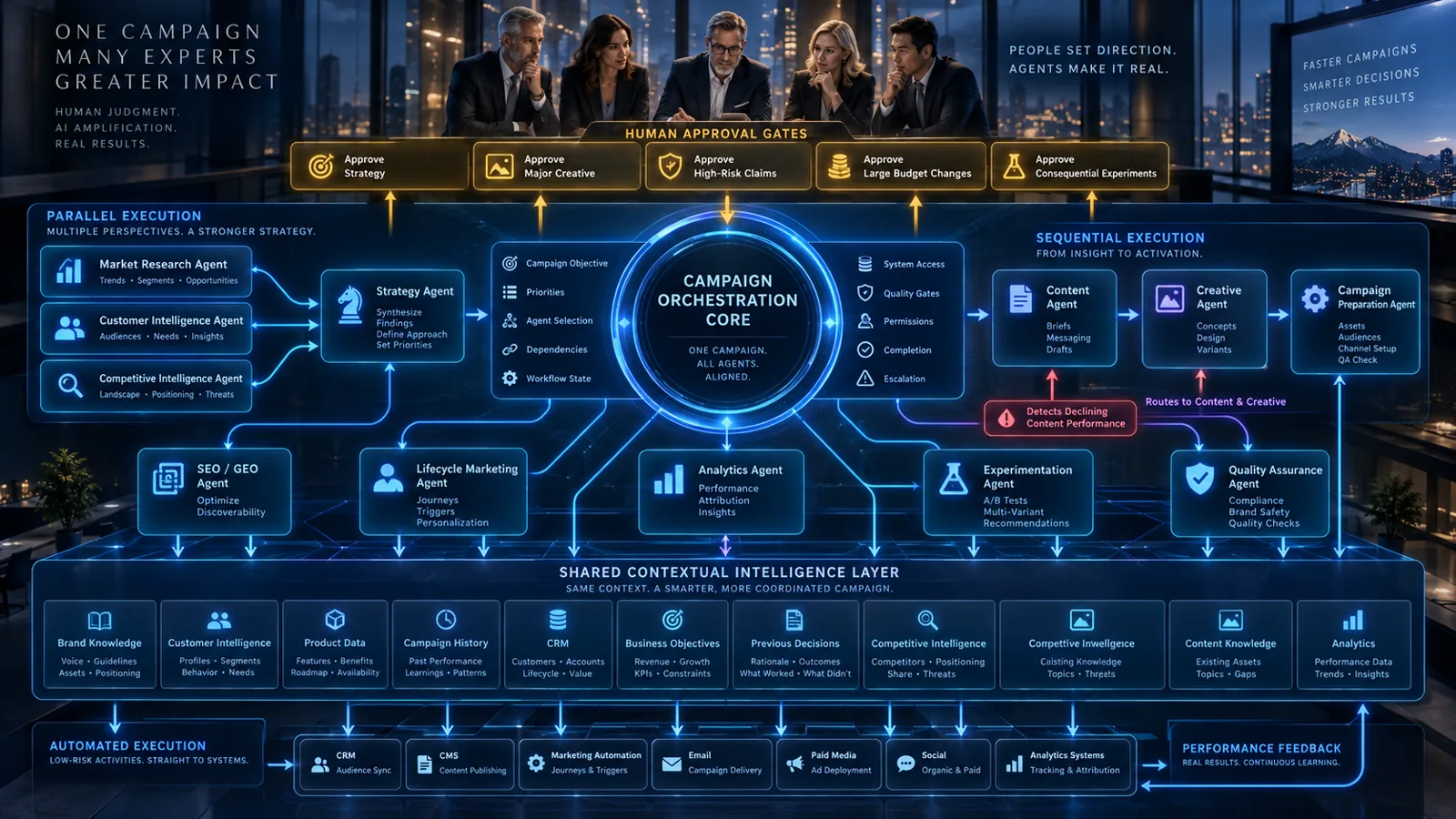
A sufficiently complex campaign could involve:
1. Market Research Agent
Understands market change.
2. Customer Intelligence Agent
Understands audience needs and behavior.
3. Competitive Intelligence Agent
Understands competitive positioning.
4. Strategy Agent
Synthesizes intelligence into campaign direction.
5. Content Agent
Develops campaign narratives and assets.
6. Creative Agent
Creates and adapts visual execution.
7. SEO/GEO Agent
Builds search and AI-discovery opportunities.
8. Lifecycle Agent
Develops customer journeys.
9. Campaign Management Agent
Coordinates execution across channels.
10. Analytics and Experimentation Agent
Monitors performance and recommends improvement.
But ten agents do not mean ten separate AI conversations.
They should behave like one marketing system.
Humans Move From Handoffs to Decisions
Notice what happens to the human marketing team.
They do less:
copying;
status checking;
context transfer;
report preparation;
task routing;
dashboard monitoring;
and routine configuration.
They spend more time on:
strategy;
customer understanding;
creative judgment;
brand;
commercial decisions;
experimentation;
relationships;
and interpreting meaningful exceptions.
This is not about removing the marketer.
It is about removing the marketer from being the API between marketing systems.
The Marketing Brief Becomes Executable
There is also a deeper product-design implication.
Today, a campaign brief is usually a document.
Humans read it.
Then turn it into work.
In an agentic operating model, the brief can increasingly become machine-readable campaign context.
For example:
Objective: Increase enterprise-qualified pipeline 15%.
Audience: CFOs and finance transformation leaders.
Primary proposition: X.
Approved claims: A, B, C.
Restricted claims: D.
Channels: Search, LinkedIn, email, website.
Budget: $500,000.
Approval requirements: Brand + Legal + CMO for major creative.
Success metrics: Pipeline, CAC, qualified conversion.
Autonomy: Media optimization ±10% without additional approval.
The brief becomes more than an instruction.
It becomes part of the campaign's operating logic.
What Should Remain Human?
Not every stage should become autonomous.
Human leadership remains especially valuable in:
strategic positioning;
brand direction;
large budget decisions;
sensitive claims;
creative taste;
ethical decisions;
reputational risk;
new market entry;
major customer communication;
and decisions where being wrong is expensive.
A mature AI marketing system should therefore optimize not for:
maximum autonomy
but for:
appropriate autonomy.
The right automation level depends on the decision.
How to Build This Without Rebuilding Marketing Overnight
Do not begin by trying to automate the entire department.
Choose one campaign.
Then map it.
Step 1: Document the Current Workflow
From initial request through reporting.
Step 2: Identify Every Handoff
Where does context move from one human to another?
Step 3: Identify Repeated Context
What information gets explained repeatedly?
Step 4: Identify Deterministic Steps
What can conventional automation handle?
Step 5: Identify Reasoning Steps
Where could agents help?
Step 6: Define Human Decision Gates
What requires judgment or accountability?
Step 7: Connect the Campaign Data
Ensure performance signals return to the same campaign context.
Step 8: Capture Learnings
Make the next campaign smarter than the previous one.
One successful end-to-end workflow is more valuable than 25 disconnected AI pilots.
Measure the Entire Campaign, Not Individual AI Tasks
A content-writing agent might save three hours.
Useful.
But if the campaign still takes eight weeks because of handoffs, the transformation is limited.
Measure:
Campaign Cycle Time
Objective to launch.
Handoff Count
How many manual transfers are required?
Approval Waiting Time
How much of the campaign lifecycle is spent waiting?
Rework Rate
How much completed work must be redone?
Human Coordination Hours
How much time is spent managing work?
Time to Insight
How quickly is performance understood?
Time to Action
How quickly does an insight produce a decision?
Campaign ROI
Did the operating model improve the business result?
This is why end-to-end workflow redesign matters more than individual task productivity.
McKinsey reports that one organization redesigning core marketing workflows around reusable agents achieved roughly 35% to 50% time savings in campaign activation while reducing external spend by around 20%.
The unit of AI value is moving from:
task
to:
workflow.
Campaigns May Eventually Become More Continuous
There is one final implication.
The model described above still assumes a traditional campaign:
start;
run;
finish.
But agentic marketing may gradually blur those boundaries.
Agents can continuously monitor:
customer behavior;
market changes;
performance;
competitor activity;
inventory;
search demand;
and lifecycle signals.
Instead of waiting for the next quarterly campaign, the system can continuously identify new opportunities.
BCG goes further, arguing that much of mature agent-native marketing may eventually move beyond fixed campaign calendars toward continuous next-best-action systems, while major brand campaigns and product launches remain planned events.
So the end-to-end AI campaign may ultimately become a stepping stone.
From:
isolated marketing tasks
to:
connected campaigns
to:
continuous marketing intelligence and execution.
Frequently asked questions
What is an end-to-end marketing campaign workflow?
An end-to-end marketing campaign workflow connects the complete campaign lifecycle, including research, strategy, planning, content, creative, approvals, activation, analytics and optimization, into a coordinated process.
Can AI agents manage an entire marketing campaign?
AI agents can increasingly support multiple stages of a campaign, including research, content creation, quality assurance, campaign setup, monitoring and optimization. Strategic and high-risk decisions should retain appropriate human oversight.
How do multiple AI marketing agents work together?
Specialized agents perform different roles while sharing campaign context. An orchestration layer manages dependencies, agent selection, workflow state, permissions, quality checks and human approvals.
What is marketing campaign orchestration?
Marketing campaign orchestration is the coordination of people, AI agents, automation, data and marketing systems across a campaign so that tasks happen in the correct sequence, context is retained and actions work toward the same objective.
What is the difference between campaign automation and campaign orchestration?
Automation executes predefined tasks or rules. Orchestration coordinates multiple tasks, systems and agents across a larger workflow and determines what needs to happen next based on context.
Which campaign decisions should remain human?
Strategic positioning, major creative direction, significant budget decisions, sensitive claims, brand-risk decisions and other high-impact or difficult-to-reverse actions should generally retain meaningful human oversight.
Why is shared context important for AI marketing agents?
Shared context prevents every agent from independently reconstructing the business situation. It allows different agents to work from the same approved customer insights, campaign objectives, brand rules, product information and previous decisions.