The 10 Biggest AI Marketing Shifts: From Content Generation to Autonomous Growth
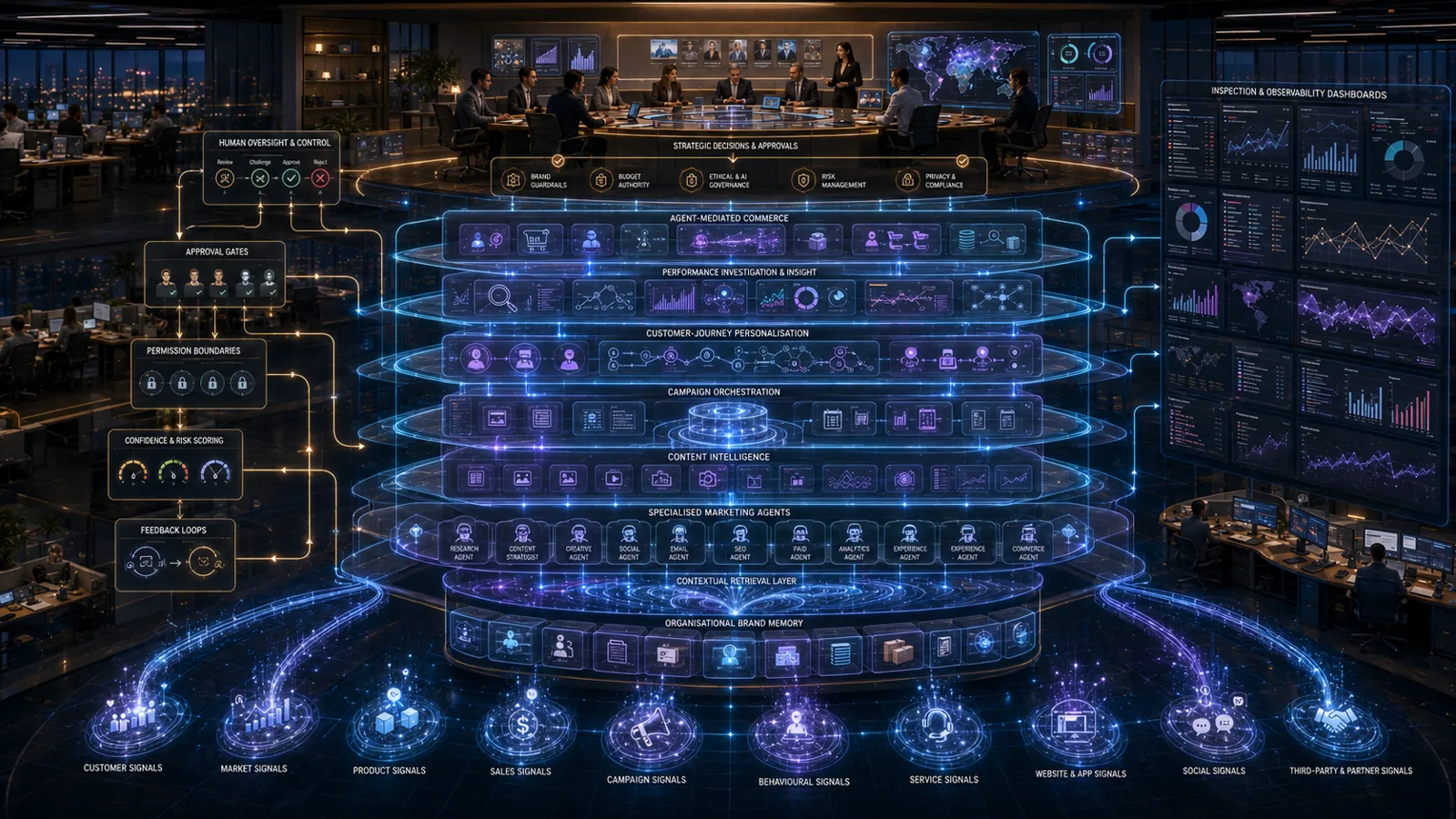
Artificial intelligence is moving from a tool inside marketing work towards an operating layer across marketing.

The first phase of AI marketing was easy to recognise.
Marketers opened a generative AI tool and asked it to:
- Write an article
- Create social posts
- Summarise research
- Suggest campaign ideas
- Rewrite an email
- Analyse a report
The technology accelerated individual tasks.
But the marketing organisation around those tasks remained largely unchanged.
Employees still gathered the context.
They decided which prompt to use.
They copied the output into another platform.
They coordinated reviews.
They launched the campaign.
They assembled the performance report.
The next phase is more significant.
Artificial intelligence is moving from a tool inside marketing work towards an operating layer across marketing.
Agents can increasingly retrieve company context, use connected tools, perform multi-step workflows and continue working towards defined objectives. OpenAI describes agentic workflows as systems capable of coordinating tasks, using tools and adapting in real time while following organisational rules and approval requirements.
Marketing is therefore experiencing several transformations simultaneously:
- Assistants are becoming agents.
- Prompts are becoming persistent context.
- Campaigns are becoming continuous workflows.
- Dashboards are becoming decision systems.
- Content production is becoming abundant.
- Search and commerce are becoming agent-mediated.
- Marketing teams are becoming human–agent organisations.
These are not independent trends.
They are parts of one structural transition.
The biggest shift in AI marketing is from using AI to produce marketing outputs towards using AI to operate coordinated marketing systems.
The following ten shifts explain how this transformation is unfolding and what marketing leaders should do about it.
Shift 1: From AI Assistance to AI Delegation
The first AI marketing tools were assistants.
They responded to individual instructions:
Summarise this report.
Draft a campaign email.
Suggest five article topics.
The user remained responsible for initiating and coordinating every stage.
Agents introduce a different operating model.
Instead of requesting one output, the organisation can assign a continuing responsibility:
Review new customer conversations each week, identify meaningful changes in objections, compare them with previous findings and prepare a briefing for product marketing.
OpenAI’s workspace agents are designed around repeatable workflows that teams would otherwise perform manually, including gathering information from different tools and repeating established processes.
Why This Matters
Assistance improves individual productivity.
Delegation creates organisational capacity.
The marketer moves from completing every stage personally to:
- Defining the objective
- Providing the right context
- Establishing permissions
- Reviewing exceptions
- Evaluating results
This is closer to management than prompting.
What Leaders Should Do
Identify one recurring workflow that currently depends on an employee manually initiating the same sequence every week.
Strong starting points include:
- Customer-conversation analysis
- Competitor monitoring
- Content repurposing
- Campaign reporting
- Account research
Give the agent ownership of the repeatable flow while keeping consequential decisions human-controlled.
Shift 2: From Prompt Engineering to Context Engineering
Early AI adoption created an obsession with perfect prompts.
Teams built templates containing:
- Roles
- Tone instructions
- Customer personas
- Product descriptions
- Formatting rules
- Examples
- Prohibited phrases
These prompts often attempted to carry the company’s entire identity inside one conversation.
That approach does not scale.
Important product facts become outdated.
Employees use different prompt versions.
Customer information is copied manually.
The system starts every interaction with incomplete memory.
The next model depends less on asking every employee to write enormous prompts and more on automatically providing the right context.
That context may include:
- Current business objectives
- Brand positioning
- Product truth
- Customer evidence
- Previous campaign decisions
- Approved examples
- Tool outputs
- Workflow status
Why This Matters
A powerful model with weak context will produce polished but generic work.
A capable model with current company knowledge can produce work that is more accurate, consistent and useful.
The most important question becomes:
What does the AI need to know at this moment to perform this task correctly?
What Leaders Should Do
Separate company knowledge from individual prompts.
Create governed sources for:
- Brand
- Product
- Customers
- Campaign learning
- Compliance
- Strategic decisions
Give each source an owner, version and review date.
Shift 3: From Content Generation to Content Intelligence
AI marketing became popular because content generation was immediately visible.
A model could produce ten posts in seconds.
But faster generation exposed a larger problem.
Most companies did not lack content.
They lacked:
- Distinctive insight
- Customer evidence
- Consistent positioning
- Distribution
- Editorial judgement
- Content lifecycle management
As production becomes easier, the value shifts towards deciding:
- Which content should exist
- Which customer problem it should address
- What evidence it requires
- Which format is appropriate
- Where it should be distributed
- How it should influence the customer journey
The future content system will not begin with the instruction:
Write an article about AI marketing.
It will begin with:
Which customer decision is limiting our current business objective, and what information could help that customer move forward?
Why This Matters
Content generation optimises output.
Content intelligence optimises relevance and outcomes.
The strongest AI CMO may sometimes recommend:
- Updating an existing article
- Repurposing a webinar
- Creating sales enablement
- Improving distribution
- Producing no new content
That is a more intelligent decision than generating another asset automatically.
What Leaders Should Do
Require every important content brief to define:
- Business objective
- Audience
- Customer decision
- Central insight
- Evidence
- Distribution
- Next action
- Success metric
Shift 4: From Generic AI Output to Persistent Brand Memory
AI-generated content often sounds generic because the system has access to general knowledge but not the organisation’s accumulated judgement.
A company’s real voice is shaped by:
- What it believes
- Which customers it prioritises
- Which claims it refuses to make
- Which arguments leaders have approved
- Which messages customers have rejected
- How experts explain the product
- Which examples represent the brand well
These decisions usually remain scattered across documents, messages, meetings and individual memories.
Future marketing systems will convert them into persistent brand memory.
Brand memory may contain:
- Positioning
- Product facts
- Customer language
- Approved terminology
- Editorial behaviours
- Successful examples
- Rejected messages
- Campaign history
- Strategic exclusions
Why This Matters
The system no longer needs a marketer to re-explain the brand during every task.
Agents across research, content, campaigns and customer journeys can work from shared organisational context.
Brand memory also reduces the risk that different AI tools create different versions of the company.
What Leaders Should Do
Treat edits and rejections as data.
When a senior leader changes a draft, determine whether the feedback represents:
- A one-time preference
- A campaign-specific rule
- A product correction
- A permanent brand principle
Only durable, approved learning should enter long-term memory.
Shift 5: From Marketing Automation to Controlled Autonomy
Traditional marketing automation follows predefined rules.
For example:
If a customer downloads a guide, wait two days and send an email.
The system executes the route chosen by the marketer.
Autonomous marketing systems can interpret changing context and select among approved actions.
A customer-journey agent may consider:
- Previous engagement
- Product usage
- Sales activity
- Support issues
- Customer segment
- Communication frequency
It may decide that:
- One customer should receive education.
- Another should be routed to sales.
- A third should receive no message.
- A fourth should enter a product-adoption workflow.
Google describes AI agents as systems capable of pursuing goals through reasoning, planning, memory and adaptive decision-making.
Why This Matters
Automation executes instructions.
Controlled autonomy works towards an objective within boundaries.
This can create faster and more relevant customer experiences, but it also creates greater governance requirements.
What Leaders Should Do
Use an autonomy ladder:
- 1Observe
- 2Analyse
- 3Recommend
- 4Prepare
- 5Execute after approval
- 6Execute independently within strict limits
Do not move directly from experimentation to broad execution rights.
Shift 6: From Campaigns to Continuous Growth Systems
Marketing has traditionally operated through campaign cycles.
Teams plan, launch, measure and repeat.
That structure will continue for major launches and brand moments, but AI is enabling a more continuous operating model.
Systems can monitor:
- Customer behaviour
- Product usage
- Market developments
- Competitor activity
- Campaign performance
- Sales conversations
When a meaningful signal appears, the appropriate workflow can begin.
McKinsey identifies five connected capabilities shaping the future of marketing: insights, creativity, personalisation, agentic commerce and optimisation. Together, they support a transition from isolated campaigns towards continuous growth.
Example
A customer-intelligence agent identifies a rise in implementation concerns.
The system then:
- 1Verifies the trend across sales and support.
- 2Connects it to a current product-adoption objective.
- 3Retrieves approved implementation evidence.
- 4Prepares a content and customer-education recommendation.
- 5Routes the strategy to human leaders.
- 6Coordinates approved execution.
- 7Measures whether the objection declines.
The marketing system responds while the signal is still relevant.
What Leaders Should Do
Keep the annual calendar, but add an adaptive layer containing:
- Live customer signals
- Triggered workflows
- Active experiments
- Agent recommendations
- Human decisions
- Continuous learning
Shift 7: From Dashboards to Decision Intelligence
Marketing leaders have access to more dashboards than ever.
Yet a dashboard still requires someone to:
- Open it
- Notice the change
- Compare other systems
- Develop an explanation
- Decide whether to act
The next analytics experience will be proactive.
A decision system will continuously:
- Validate metrics
- Detect anomalies
- Identify affected segments
- Gather campaign and customer context
- Generate possible explanations
- Recommend the next investigation
- Escalate a decision to the correct person
The executive may receive:
Enterprise demo conversion declined materially after the pricing-page update. The change is concentrated in paid-search visitors, while traffic quality remained stable. Review the page change before increasing media investment.
The charts remain available.
But they become an inspection layer behind the decision.
Why This Matters
Dashboards answer:
What happened?
Decision systems add:
- Why might it have happened?
- Why does it matter?
- What should happen next?
- How certain is the explanation?
What Leaders Should Do
Organise operating reviews around decisions rather than channels.
Replace the sequence:
- Social report
- Search report
- Email report
- Paid report
With:
- What changed?
- What did we learn?
- Which decision is required?
- What will happen next?
- How will we evaluate it?
Shift 8: From Human-Only Teams to Human–Agent Organisations
Marketing departments have traditionally expanded capacity by hiring people or agencies.
Future teams will combine human talent with portfolios of specialised agents.
Microsoft’s 2026 Work Trend Index describes an agency equation in which agents perform more execution while humans gain more room to direct work, exercise judgement and own outcomes.
A future marketing function may include agents for:
- Market intelligence
- Customer analysis
- Content strategy
- Creative adaptation
- Campaign coordination
- Customer journeys
- Performance monitoring
- Marketing operations
Humans will remain responsible for:
- Strategy
- Creative direction
- Customer relationships
- Ethical judgement
- Major investment
- Final accountability
Why This Matters
The structure of the team changes.
A marketer may manage several agent workflows without managing a large number of human direct reports.
The most valuable skill becomes directing capacity rather than personally completing every task.
What Leaders Should Do
Create an agent charter for every deployed agent.
Define:
- Mission
- Inputs
- Tools
- Outputs
- Permissions
- Prohibited actions
- Human owner
- Escalation rules
- Evaluation criteria
Shift 9: From Marketing to Humans Towards Marketing to Humans and Agents
Marketing has historically been designed for human audiences.
But AI systems are increasingly mediating discovery, comparison and purchase decisions.
McKinsey reports that shopping assistants and purchasing agents are beginning to rank products, compare alternatives and, in some cases, complete transactions for users. It also reports that more than 90% of surveyed advertisers use AI across areas such as media planning, budgets, targeting or creative production.
This creates a second audience:
The machine evaluator.
Humans may respond to:
- Emotion
- Narrative
- Identity
- Community
- Creative distinction
AI agents may depend on:
- Structured product information
- Clear specifications
- Verifiable evidence
- Transparent pricing
- Current availability
- Reliable documentation
- Trusted citations
Why This Matters
A brand may be emotionally compelling but difficult for AI systems to interpret.
Another may be technically legible but forgettable to humans.
Future marketing must serve both.
What Leaders Should Do
Develop two connected layers.
Human Experience Layer
- Story
- Design
- Community
- Brand personality
- Emotional relevance
Machine Knowledge Layer
- Structured data
- Product feeds
- Documentation
- Clear claims
- APIs
- Current policies
- Evidence
The future website will be both a persuasive experience and a trusted knowledge source.
Shift 10: From Activity Metrics to Business and Customer Outcomes
AI makes it easy to produce more activity.
Agents can create more:
- Content
- Variations
- Reports
- Campaigns
- Experiments
- Customer interactions
This makes activity a weaker indicator of progress.
An AI marketing system should not be rewarded because it completed 5,000 tasks.
It should be evaluated on whether it improved:
- Qualified pipeline
- Revenue
- Customer acquisition efficiency
- Product adoption
- Retention
- Customer satisfaction
- Brand demand
- Marketing cycle time
Salesforce’s 2026 State of Marketing research found widespread AI adoption but continuing barriers to connected, personalised execution. The company reports that marketers using AI agents show greater satisfaction with cross-functional data access, although that relationship does not prove the agents alone caused the improvement.
Why This Matters
The value of AI is not the number of outputs generated.
It is the business improvement created after accounting for:
- Model costs
- Integration
- Human review
- Errors
- Maintenance
- Governance
What Leaders Should Do
Use a balanced AI marketing scorecard.
Business Outcomes
- Revenue
- Pipeline
- Retention
- Expansion
- Acquisition efficiency
Customer Outcomes
- Relevance
- Satisfaction
- Adoption
- Reduced effort
- Journey progression
Operational Outcomes
- Time from insight to execution
- Human review time
- Workflow completion
- Cost per approved outcome
Agent Outcomes
- Accuracy
- Escalation quality
- Tool success
- Error rate
- Human override rate
Governance Outcomes
- Permission violations
- Unsupported claims
- Data incidents
- Budget exceptions
These Shifts Are Connected
The ten changes should not be treated as separate software projects.
They form a sequence.
Persistent Context Enables Better Agents
Agents perform more reliably when they have access to brand, product and customer memory.
Better Agents Enable Workflow Ownership
Once agents can retrieve context and use tools, they can own recurring processes.
Workflow Ownership Enables Controlled Autonomy
Reliable workflows can gradually receive limited execution permissions.
Controlled Autonomy Enables Continuous Marketing
The system can respond to customer and market signals without waiting for every stage to begin manually.
Continuous Marketing Requires Decision Intelligence
Leaders need prioritised decisions rather than more dashboards and alerts.
Decision Intelligence Changes the Team
People spend less time assembling information and more time directing, evaluating and improving the system.
The New Team Requires New Measurement
Agent activity must be connected to customer and business outcomes.
This is the emerging AI marketing operating model.
What Has Not Changed
The tools are changing quickly.
Several fundamentals remain.
Strategy Still Requires Human Choice
AI can develop options and gather evidence.
Humans must choose:
- Which customers matter
- Which position to own
- Which risk to accept
- Which opportunities to reject
Brands Still Need Distinction
When every competitor can generate polished content, recognisable ideas and credible expertise become more valuable.
Customers Still Need Trust
Automation does not remove the importance of:
- Honesty
- Reliability
- Privacy
- Empathy
- Clear limitations
Creativity Still Requires Taste
AI can generate possibilities.
Humans determine which possibility deserves attention.
Accountability Remains Human
An agent may recommend or execute an action.
A person and organisation remain responsible for the result.
What CMOs Should Build Now
The complete transformation will not happen through one large implementation.
It should begin with foundational work.
1. Clarify the Strategy
Define:
- Priority customer
- Customer problem
- Positioning
- Advantage
- Strategic exclusions
- Business outcome
Agents multiply the direction they receive.
2. Build Authoritative Memory
Create governed sources for:
- Brand
- Product
- Customers
- Campaign learning
- Approved claims
- Governance
3. Select One Workflow
Choose a recurring process with:
- Clear inputs
- Measurable outputs
- High manual effort
- Limited initial risk
- A named owner
4. Add Evaluation Before Autonomy
Test the workflow against:
- Missing data
- Conflicting information
- Sensitive claims
- Unusual customer cases
- Tool failures
- Permission limits
5. Preserve Human Decision Rights
Document which actions the system may:
- Read
- Analyse
- Recommend
- Prepare
- Execute
6. Measure the Complete Economics
Include:
- Model usage
- Software
- Integration
- Human review
- Maintenance
- Error correction
7. Reinvest Human Capacity
Use the time released by AI for:
- Customer research
- Strategy
- Creative quality
- Relationships
- Experiment design
- Leadership
Common Mistakes
Adding AI to Every Tool
More AI interfaces can create more fragmentation.
Calling Content Generation a Transformation
Faster drafting is useful but does not redesign marketing.
Automating Before Standardising Knowledge
Agents cannot operate reliably using conflicting product and metric definitions.
Giving Agents Broad Goals
Objectives such as “increase engagement” can produce undesirable local optimisation.
Deploying Too Many Agents
Complexity increases coordination and evaluation costs.
Treating Human Review as Temporary
Important strategic and reputational decisions will continue to require people.
Measuring Production
An AI system can produce large volumes of work that customers neither need nor trust.
Key Takeaways
- AI marketing is moving from individual assistance to delegated workflow ownership.
- Persistent company context is becoming more important than elaborate manual prompts.
- Content intelligence will matter more than content generation.
- Brand memory will become core marketing infrastructure.
- Rule-based automation is evolving into controlled autonomy.
- Campaign-led marketing is becoming more continuous and responsive.
- Dashboards will move behind AI-powered decision systems.
- Marketing teams will include both human employees and specialised agents.
- Brands will increasingly communicate with human customers and AI intermediaries.
- AI marketing performance must be connected to customer and commercial outcomes.
- Strategy, creativity, relationships and accountability remain human responsibilities.
Conclusion: The Biggest Shift Is From AI Tools to AI Marketing Systems
The marketing industry has spent several years asking what AI can generate.
That question produced:
- More articles
- More advertisements
- More images
- More videos
- More ideas
The next question is more important:
How should marketing operate when intelligent systems can monitor, reason, coordinate and execute continuously?
Answering that question requires more than a new model.
It requires:
- Clear strategy
- Organisational memory
- Connected data
- Well-designed tools
- Specialised agents
- Workflow orchestration
- Governance
- Human leadership
- Outcome measurement
The companies that simply add AI to existing tasks will become more productive.
The companies that redesign marketing around these capabilities may become fundamentally more responsive and scalable.
They will detect customer changes earlier.
They will convert company knowledge into campaigns faster.
They will coordinate channels more consistently.
They will direct human attention towards the decisions that require judgement.
But the purpose of the system must remain clear.
AI should not produce more marketing for the sake of producing more marketing.
It should help the organisation:
- Understand customers better
- Make clearer choices
- Execute more consistently
- Learn faster
- Create stronger business outcomes
The future will not belong to the company with the most AI tools.
It will belong to the company with the strongest system around those tools.
That is the biggest AI marketing shift of all.
Actionable Next Steps
- 1Audit where your team currently uses AI for isolated tasks.
- 2Identify one task that should become an end-to-end workflow.
- 3Create authoritative brand, product and customer context.
- 4Assign a named human owner to the workflow.
- 5Define what the agent may read, recommend and execute.
- 6Establish quality and safety evaluations.
- 7Measure human correction and workflow economics.
- 8Connect the workflow to a customer or business outcome.
- 9Expand autonomy only after reliable performance.
- 10Build towards one coordinated marketing operating system rather than a collection of disconnected AI tools.
Frequently asked questions
What are the biggest AI marketing shifts?
The largest shifts include the movement from assistants to agents, prompts to context, content generation to content intelligence, automation to autonomy and dashboards to decision systems.
How is agentic marketing different from generative AI marketing?
Generative AI primarily creates outputs. Agentic marketing uses AI systems that can retrieve context, use tools and complete multi-step workflows towards defined objectives.
Will AI replace marketing teams?
AI will absorb many repeatable tasks and workflows. Humans will remain essential for strategy, creativity, customer relationships, ethical judgement and accountability.
What is brand memory?
Brand memory is a governed knowledge layer containing positioning, product truth, customer definitions, approved claims, editorial standards and previous decisions.
What is controlled autonomous marketing?
It allows AI agents to analyse, recommend and perform approved low-risk actions within defined permissions, budgets and escalation rules.
Will traditional campaigns disappear?
No. Major campaigns will remain, but they will operate alongside continuous workflows responding to changing customer, market and performance signals.
What will replace marketing dashboards?
AI decision systems will increasingly surface material changes, explanations, recommendations and approvals, while dashboards remain available for inspection.
How should companies measure AI marketing?
They should measure business outcomes, customer value, operational efficiency, agent reliability, human review requirements and governance performance.