The Marketing Operating System of the Future: How Humans, Data and AI Agents Will Work as One
Content is scattered across document folders, project-management tools and content-management systems.

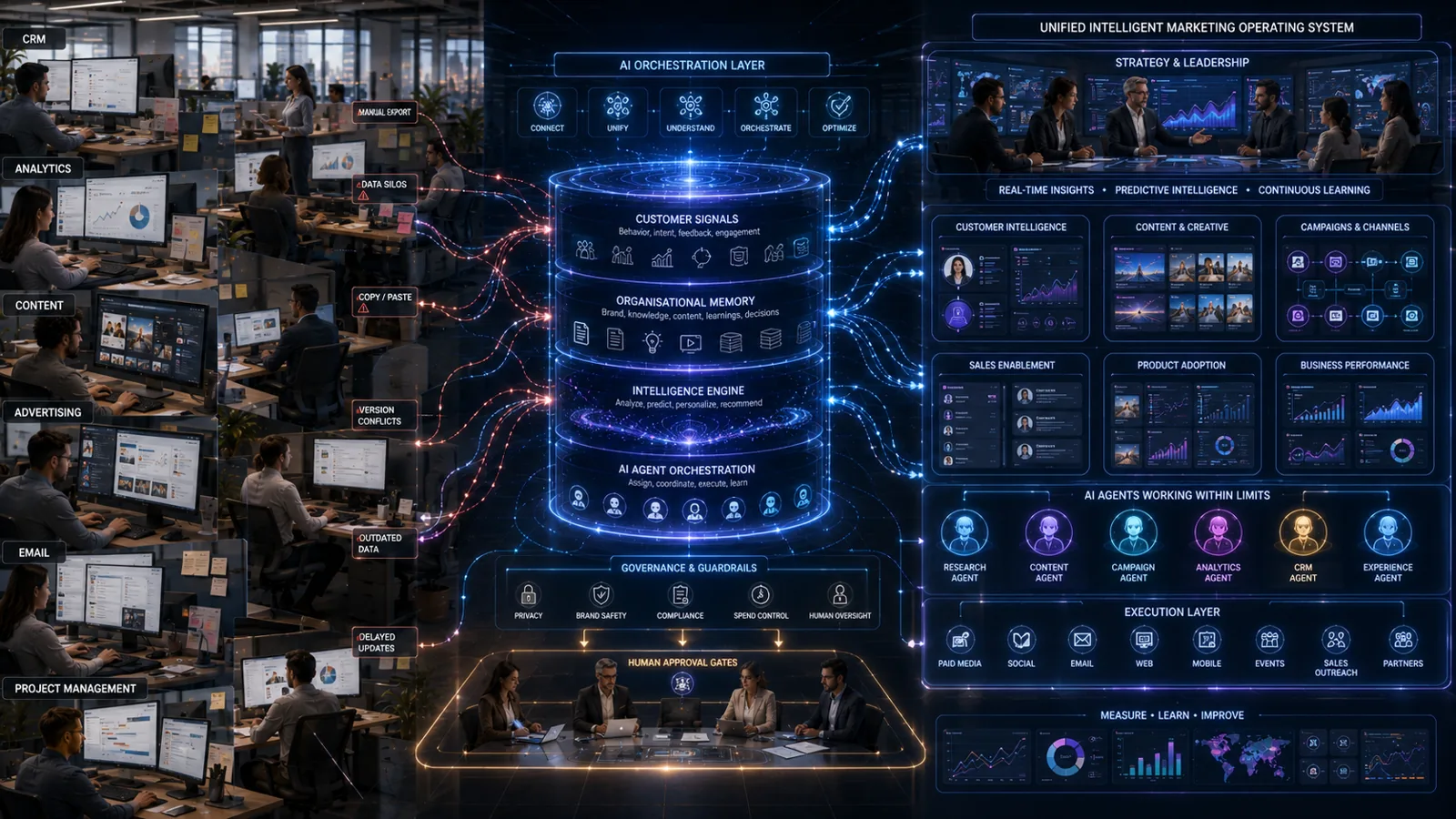
Most companies do not have a marketing operating system.
They have a marketing technology collection.
Customer information sits in a CRM.
Campaign performance lives inside advertising platforms.
Content is scattered across document folders, project-management tools and content-management systems.
Customer feedback is stored in support platforms, sales-call recordings, surveys and spreadsheets.
Brand guidelines live in a presentation that many employees have not opened recently.
Each system may work well independently.
The problem appears when the organisation attempts to make one coordinated marketing decision.
A campaign leader wants to know:
- Which customer problem should we address?
- Which segment should we prioritise?
- What has performed previously?
- Which product claims are approved?
- What content already exists?
- Which channels should be used?
- What can be automated?
- Which decisions require approval?
- How will success be measured?
Answering these questions can require meetings, exports, manual research and several disconnected dashboards.
Artificial intelligence will not solve this fragmentation merely by adding chat interfaces to every platform.
The next stage requires something more fundamental:
A marketing operating system.
A marketing operating system is the shared intelligence and workflow layer through which the organisation understands customers, makes decisions, coordinates execution and learns from results.
It connects:
- Customer and market data
- Brand and organisational memory
- Human teams
- AI agents
- Business tools
- Approval systems
- Measurement
- Governance
The marketing operating system of the future will not replace every existing platform.
It will sit across them, turning disconnected systems into one coordinated marketing environment.
The future marketing advantage will not come from owning the most tools. It will come from operating those tools, people and agents as one intelligent system.
Why the Existing Martech Stack Is Not an Operating System
A marketing technology stack is a collection of tools.
A marketing operating system coordinates how work moves through those tools.
This distinction matters.
A company may use:
- A CRM
- A customer-data platform
- An analytics suite
- An advertising platform
- An email system
- A social publishing platform
- A project-management tool
- A content-management system
Yet employees may still need to move information manually between them.
A martech stack tells the team what software is available.
An operating system defines:
- How signals enter the organisation
- How insights are created
- How decisions are made
- Who or what performs each task
- Where approval occurs
- How work is executed
- How outcomes return as learning
Without this coordination layer, adding more technology often creates more operational complexity.
The company gains capabilities but loses clarity.
The Operating System Analogy
A computer operating system connects applications, hardware, memory, users and permissions.
It does not perform every task itself.
It provides the environment in which those tasks can happen reliably.
A marketing operating system performs a similar function.
It connects:
Inputs
- Customer behaviour
- Market developments
- Campaign results
- Sales conversations
- Product usage
- Support feedback
Intelligence
- Human analysis
- AI reasoning
- Organisational knowledge
- Performance models
Execution
- Content
- Campaigns
- Advertising
- Customer journeys
- Sales enablement
- Community engagement
Controls
- Budgets
- Permissions
- Brand standards
- Legal requirements
- Human approvals
Learning
- Customer outcomes
- Commercial results
- Experiment findings
- Operational feedback
The result is not simply faster marketing.
It is a more connected decision system.
Why the Marketing Operating System Is Emerging Now
1. AI Can Interpret Unstructured Marketing Information
Traditional systems worked best with structured information such as:
- Contact records
- Campaign costs
- Conversion rates
- Email activity
Much of marketing knowledge is unstructured.
It appears inside:
- Customer interviews
- Sales calls
- Creative briefs
- Strategy documents
- Reviews
- Support tickets
- Executive feedback
Modern AI systems can interpret this information and connect it with structured data.
That allows the operating system to understand not only what happened, but what customers and employees are saying about it.
2. AI Agents Can Coordinate Complete Workflows
Early generative AI tools produced individual outputs.
An agent can manage a sequence of work using a model, instructions and approved tools. OpenAI’s agent guidance describes both single-agent workflows and manager-style orchestration, where one central agent coordinates specialised agents assigned to different domains.
This allows a marketing objective to trigger several connected activities rather than one isolated response.
3. Organisations Need Human–Agent Operating Models
Microsoft’s 2026 Work Trend Index describes a shift towards organisations where agents handle more execution while human judgement remains central to consequential work. The report is based partly on a survey of 20,000 knowledge workers who use AI at work across ten markets.
For marketing, this means the operating system must coordinate two types of capacity:
- Human judgement
- Agent execution
The organisation must decide which work belongs to each.
4. Customer Journeys Require Cross-Functional Coordination
Customers do not experience:
- The content team
- The sales team
- The lifecycle team
- The support team
They experience one company.
The operating system must therefore connect signals and actions across organisational boundaries.
Salesforce’s 2026 agentic marketing platform announcement similarly emphasised the unification of customer data, content, conversations and workflows across marketing, sales, service and commerce.
The Nine Layers of the Future Marketing Operating System
Layer 1: Business Objectives
The operating system begins with business direction.
Possible objectives include:
- Enter a new market
- Increase qualified pipeline
- Improve product adoption
- Reduce customer churn
- Strengthen brand authority
- Improve campaign efficiency
Every major marketing workflow should connect to an approved objective.
Without this layer, AI and automation simply increase activity.
A useful objective should specify:
- The audience
- The intended outcome
- The time horizon
- Constraints
- Success metrics
For example:
Increase adoption of the analytics module among existing mid-market customers during the next quarter without increasing unsubscribe or support complaint rates.
This gives the system a goal and clear boundaries.
Layer 2: Customer and Market Signals
The operating system continuously receives information from:
- CRM records
- Website behaviour
- Search activity
- Advertising
- Product usage
- Customer support
- Sales calls
- Reviews
- Surveys
- Competitor monitoring
- Industry research
The system should distinguish between:
- Raw data
- Meaningful signals
- Verified insights
A sudden decline in website conversion is data.
A pattern showing that enterprise visitors are abandoning a newly redesigned pricing page is a signal.
The conclusion that the pricing structure is confusing is an insight that still requires evidence and interpretation.
AI can accelerate this analysis.
Human specialists must remain responsible for determining what it means strategically.
Layer 3: Organisational and Brand Memory
The future marketing system cannot rely on employees copying brand guidelines into prompts.
It needs persistent organisational memory.
That memory may include:
- Brand positioning
- Customer definitions
- Product truth
- Approved claims
- Previous decisions
- Campaign history
- Customer language
- Creative standards
- Legal restrictions
- Performance learning
OpenAI describes business context as a way of connecting agents with enterprise systems, including CRM tools, data warehouses and internal applications, while building durable institutional memory over time.
This layer prevents every campaign from beginning at zero.
It gives agents and employees access to the company’s accumulated knowledge.
However, memory requires governance.
Every important record should have:
- A source
- An owner
- A version
- A review date
- An authority level
Otherwise, the operating system may retrieve outdated or conflicting information.
Layer 4: The Customer Intelligence Engine
The customer intelligence engine converts fragmented information into a shared view of customer needs.
It may analyse:
- Buying triggers
- Objections
- Desired outcomes
- Product-adoption barriers
- Churn reasons
- Support themes
- Buying-committee roles
Its role is not merely to create personas.
It should help answer:
- What is changing?
- Which customer problem matters now?
- Which segment deserves attention?
- What evidence does the buyer need?
- Which message is no longer working?
This layer ensures that campaigns begin with customer reality rather than internal assumptions.
Layer 5: Human Decision-Making
A future marketing operating system must make human ownership visible.
Humans should continue to decide:
- Market strategy
- Brand direction
- Customer promises
- Major budgets
- Ethical boundaries
- Creative ambition
- Sensitive communication
- Organisational priorities
The operating system should not hide these decisions inside meetings or message threads.
It should capture:
- What was decided
- Why it was decided
- Who approved it
- Which evidence was used
- When the decision should be reviewed
This transforms human judgement into reusable organisational context.
Microsoft describes emerging organisations as human-led, agent-operated and outcome-driven, with people retaining ownership of the decisions that matter.
Layer 6: The AI Agent Workforce
Specialised AI agents perform defined roles inside the operating system.
These may include:
Market Intelligence Agent
Monitors competitors, market developments and category changes.
Customer Intelligence Agent
Analyses customer conversations, support cases and behaviour.
Content Strategy Agent
Recommends topics and campaign narratives based on customer and business priorities.
Creative Production Agent
Produces approved channel adaptations and asset variations.
Campaign Orchestration Agent
Coordinates tasks, assets, channels and approvals.
Growth Agent
Identifies opportunities across acquisition, activation and retention.
Performance Agent
Monitors results and prepares decision-ready explanations.
Each agent requires:
- A mission
- An accountable human owner
- Approved tools
- Defined knowledge
- Permission limits
- Evaluation criteria
- Escalation rules
The objective is not to deploy the maximum number of agents.
It is to create the smallest agent portfolio capable of operating important workflows reliably.
Layer 7: The Orchestration Engine
The orchestration engine coordinates the agents, people and tools involved in a workflow.
Consider a product-launch request.
The orchestration engine may:
- 1Retrieve the approved launch objective.
- 2Activate the market and customer-intelligence agents.
- 3Ask the strategy agent to prepare positioning options.
- 4Route the options to human leaders.
- 5Send the approved direction to content and creative agents.
- 6Perform brand and compliance checks.
- 7Route major assets for approval.
- 8Prepare execution across connected channels.
- 9Monitor performance.
- 10Return learning to organisational memory.
OpenAI notes that agent workflows require a run loop that continues until an exit condition is reached. More complex systems may use a manager agent that coordinates several specialised agents through tool calls.
Orchestration prevents the organisation from replacing tool sprawl with agent sprawl.
Layer 8: Governance and Permissions
A marketing operating system may influence:
- Public communication
- Customer data
- Advertising expenditure
- Product claims
- Customer journeys
It therefore needs enforceable controls.
These include:
Data Permissions
Which information can each user and agent access?
Action Permissions
Which tools can an agent read or change?
Financial Limits
How much budget can be adjusted without approval?
Communication Rules
Which messages can be sent automatically?
Approval Gates
Which decisions always require a human?
Audit Logs
Can the organisation reconstruct what happened?
OpenAI’s workspace-agent controls allow administrators to define which tools and actions an agent may access and to review logs showing how workflows were executed.
Governance should not be a document employees are expected to remember.
It should be embedded into the system.
Layer 9: Outcomes and Learning
The final layer measures whether the operating system improved the business.
It should connect:
- Marketing activity
- Customer behaviour
- Sales progression
- Product adoption
- Retention
- Revenue
- Brand impact
The system must also capture operational performance:
- Workflow cycle time
- Human review time
- Agent errors
- Cost per completed workflow
- Approval delays
- Data-quality issues
A marketing operating system is not successful because it generates more campaigns.
It is successful when the organisation:
- Learns faster
- Makes better decisions
- Serves customers more effectively
- Produces stronger business results
How the Marketing Operating System Works in Practice
Consider the objective:
Increase qualified demand for an enterprise AI product.
Step 1: Objective Definition
Human leaders define:
- Target accounts
- Commercial goal
- Brand position
- Budget
- Constraints
Step 2: Signal Collection
The operating system analyses:
- Search demand
- Competitor messaging
- Customer interviews
- Sales objections
- Existing campaign data
Step 3: Opportunity Detection
The customer intelligence engine identifies that buyers are less concerned about model capability and more concerned about governance and implementation.
Step 4: Strategic Decision
Human leaders approve a campaign based on trusted deployment rather than technological novelty.
Step 5: Agent Execution
Agents prepare:
- Campaign architecture
- Research briefs
- Content
- Channel adaptations
- Sales enablement
- Customer journeys
Step 6: Governance
The system checks:
- Claims
- Brand standards
- Data access
- Budget limits
- Approval requirements
Step 7: Distribution
Approved assets move into:
- Search
- Social channels
- Advertising
- Sales workflows
- Partner campaigns
Step 8: Performance Monitoring
The system detects which messages and audiences are producing qualified commercial engagement.
Step 9: Human Review
Marketing leaders decide whether to:
- Expand the campaign
- Change the message
- Adjust investment
- Stop a weak programme
Step 10: Organisational Learning
The results are stored as reviewed campaign memory.
The next workflow begins with better context.
What the User Interface Will Look Like
The marketing operating system should not present users with endless dashboards.
It should organise work around decisions.
A CMO may see:
Executive Decision Inbox
- Budget changes requiring approval
- Market developments requiring interpretation
- Campaign risks
- Strategic opportunities
Customer Intelligence Feed
- Emerging objections
- Changes in customer language
- Adoption barriers
- Retention concerns
Campaign Workspace
- Objective
- Audience
- Strategy
- Assets
- Approvals
- Performance
- Learning
Agent Control Centre
- Active agents
- Current assignments
- Permissions
- Costs
- Escalations
- Reliability
Business Outcome Scorecard
- Pipeline
- Revenue influence
- Retention
- Brand demand
- Customer outcomes
- Operating efficiency
The interface should answer:
- 1What is happening?
- 2Why does it matter?
- 3Which decision is required?
- 4What can the system do next?
The Marketing Calendar Becomes an Operating Canvas
Traditional marketing calendars show when content will be published.
The future operating canvas will show:
- Business objectives
- Customer opportunities
- Active campaigns
- Agent assignments
- Human owners
- Dependencies
- Approval status
- Distribution
- Performance
- Learning
It will connect the reason for the work with its execution and result.
The calendar will no longer be only a publishing schedule.
It will become a visual representation of the marketing system in motion.
The New Role of Marketing Operations
Marketing operations will become one of the most strategic functions in the department.
It will no longer focus only on:
- Tool administration
- Lead routing
- Campaign setup
- Reporting
The future marketing operations team will own:
- Agent orchestration
- Workflow architecture
- Brand-memory systems
- Data access
- Evaluation
- Permission design
- Observability
- AI economics
- Cross-functional coordination
Salesforce’s 2026 guidance for CMOs similarly argues that marketing leadership must combine the art and science of marketing with operational excellence and governance across a hybrid workforce of people and agents.
Marketing operations becomes the architecture of how marketing works.
Build or Buy?
Most companies will not build the complete marketing operating system from the ground up.
They will combine:
- Existing martech platforms
- AI models
- Agent frameworks
- Data systems
- Custom workflows
- Company-specific knowledge
Buy When
- The workflow is standard.
- The platform already integrates with core systems.
- Governance and security are adequate.
- Differentiation is limited.
Build When
- The workflow is strategically distinctive.
- Proprietary knowledge creates an advantage.
- Existing platforms cannot represent the operating model.
- Deeper control is required.
The strongest approach may be hybrid.
Use commercial infrastructure for standard capabilities.
Build custom intelligence and workflows where the company’s strategy is unique.
Common Mistakes
Mistake 1: Starting With the Interface
A polished dashboard cannot compensate for fragmented data and unclear workflows.
Mistake 2: Connecting Every Tool Immediately
Begin with one measurable workflow and the minimum integrations required.
Mistake 3: Building Too Many Agents
Complexity should be earned through demonstrated value.
Mistake 4: Ignoring Brand Memory
Agents without shared organisational context will produce inconsistent work.
Mistake 5: Automating Undefined Processes
A broken workflow becomes a faster broken workflow.
Mistake 6: Treating Governance as an Add-On
Permissions and approvals must be designed from the beginning.
Mistake 7: Measuring Output
More content, tasks and campaigns do not prove business value.
Mistake 8: Removing Human Ownership
The operating system must strengthen accountability rather than obscure it.
A 90-Day Implementation Roadmap
Days 1–30: Map the Current System
Document:
- Marketing objectives
- Customer signals
- Data sources
- Tools
- Recurring workflows
- Human decisions
- Approval bottlenecks
- Measurement gaps
Choose one workflow where fragmentation creates significant cost or delay.
Days 31–60: Build the Intelligence Layer
For the selected workflow:
- Connect approved data
- Establish organisational memory
- Define the human owner
- Introduce one agent or AI capability
- Create approval rules
- Establish baseline metrics
Days 61–90: Add Orchestration and Learning
- Connect workflow steps
- Add monitoring
- Record decisions
- Measure business and operational outcomes
- Review failures
- Store approved learning
- Decide whether to expand
Do not begin by attempting to rebuild the entire marketing department.
Begin by proving that one connected operating workflow outperforms the fragmented alternative.
Metrics for the Marketing Operating System
Business Metrics
- Revenue influenced
- Qualified pipeline
- Retention
- Expansion
- Customer acquisition efficiency
Customer Metrics
- Relevance
- Satisfaction
- Product adoption
- Reduced customer effort
- Journey completion
Operational Metrics
- Time from insight to execution
- Approval turnaround
- Manual work reduced
- Workflow completion
- Cost per campaign
Intelligence Metrics
- Insight acceptance
- Agent accuracy
- Recommendation adoption
- Escalation quality
- Data completeness
Governance Metrics
- Permission violations
- Unsupported claims
- Budget exceptions
- Data incidents
- Human overrides
The goal is not maximum automation.
It is coordinated, accountable business performance.
Key Takeaways
- A martech stack is a collection of tools; a marketing operating system coordinates how marketing decisions and work move through those tools.
- The future system will combine business objectives, customer signals, organisational memory, humans, AI agents and execution platforms.
- Brand memory gives the system continuity and prevents every workflow from starting at zero.
- Specialised agents can perform research, content, campaign, growth and performance work.
- An orchestration layer coordinates agents, humans, tools and approvals.
- Human leaders must retain ownership of strategy, brand, budgets and sensitive decisions.
- Governance must be enforced through permissions, limits, approval gates and audit logs.
- Marketing operations will evolve into a strategic workflow and human–AI architecture function.
- Companies should begin with one important workflow rather than attempting a full transformation immediately.
- Success must be measured through customer and business outcomes, not agent activity.
Conclusion: Marketing Will Become One Connected Intelligence System
The marketing department of the past was organised around channels and tools.
The marketing department of the future will be organised around intelligence, decisions and outcomes.
Customer signals will flow into a shared system.
Organisational memory will preserve what the company knows and has decided.
AI agents will analyse information, prepare work and coordinate execution.
Human leaders will define objectives, approve important decisions and remain accountable for the brand and customer relationship.
The operating system will connect the entire cycle:
Sense → understand → decide → execute → measure → learn
This is more than a technology upgrade.
It is a redesign of how marketing works.
Companies that continue adding isolated AI tools may produce more activity while increasing fragmentation.
Companies that build a coherent operating system will create something more valuable:
- Faster learning
- Better customer understanding
- More consistent execution
- Stronger governance
- Clearer accountability
- Better allocation of human attention
The marketing operating system of the future will not be fully autonomous.
It will be human-led, agent-operated and outcome-driven.
Its purpose will not be to remove marketers from the process.
Its purpose will be to remove the operational friction that prevents marketers from understanding customers, making strong decisions and executing those decisions effectively.
The future advantage will not be AI access.
Every competitor will have access to powerful models.
The advantage will be the quality of the system around those models:
- The company’s data
- Its memory
- Its workflows
- Its judgement
- Its governance
- Its capacity to learn
That system will become the real marketing asset.
Actionable Next Steps
- 1Map your current marketing technology and workflows.
- 2Identify where information is repeatedly copied or lost.
- 3Define the first business outcome the operating system should improve.
- 4Create authoritative sources for brand, customer and product knowledge.
- 5Choose one AI agent or capability for a controlled workflow.
- 6Assign a named human owner.
- 7Build permissions and approval gates before execution access.
- 8Connect the workflow to customer and commercial metrics.
- 9Capture approved decisions and learning in organisational memory.
- 10Expand the operating system only after the first workflow demonstrates value.
Frequently asked questions
What is a marketing operating system?
A marketing operating system is the intelligence and workflow layer connecting customer data, organisational knowledge, people, AI agents, tools, approvals and business outcomes.
How is a marketing operating system different from a martech stack?
A martech stack is a collection of platforms. A marketing operating system coordinates how information, decisions and work move across those platforms.
Does a marketing operating system replace the CRM?
No. It connects with the CRM and other existing systems, using them as sources of information and execution.
What role do AI agents play?
AI agents can analyse customer and market signals, create content, coordinate campaigns, monitor performance and prepare recommendations within defined permissions.
Does the system operate autonomously?
Some low-risk workflows may operate autonomously within strict limits. Strategy, major budgets, sensitive communication and brand decisions should remain human-controlled.
What is brand memory?
Brand memory is structured organisational knowledge containing positioning, customer definitions, product information, approved claims, previous decisions and campaign learning.
Who should own the marketing operating system?
The CMO should own its strategic objectives. Marketing operations, data, technology, brand and governance teams should share responsibility for its implementation and performance.
How should a company begin building one?
Begin with one important, repeatable workflow. Connect the minimum required data, assign ownership, introduce controlled AI support and measure whether it improves a business outcome.