The Rise of Autonomous Marketing Teams: How Humans and AI Agents Will Work Together
If campaigns became more complex, it hired campaign managers, analysts and marketing-operations specialists.
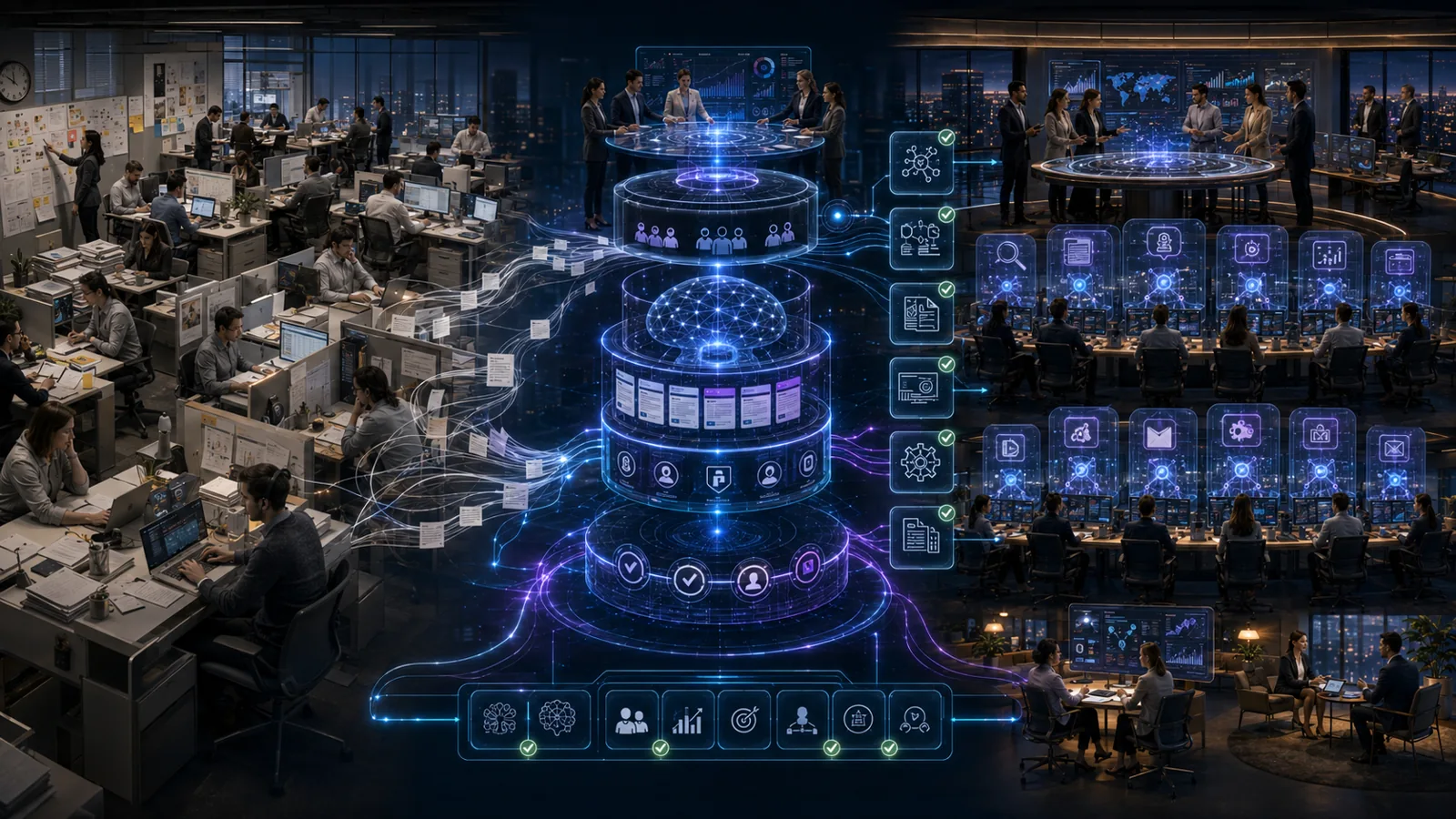
The traditional marketing team was designed around human capacity.
If the company needed more research, it hired researchers.
If content demand increased, it added writers and designers.
If campaigns became more complex, it hired campaign managers, analysts and marketing-operations specialists.
Every increase in output required more people, more coordination or more agency support.
Artificial intelligence is changing that equation.
A future marketing team may contain ten human specialists and dozens of AI agents handling:
- Market monitoring
- Customer analysis
- Content operations
- Campaign coordination
- Personalisation
- Performance reporting
- Experiment preparation
- Workflow administration
These agents will not simply wait for individual prompts.
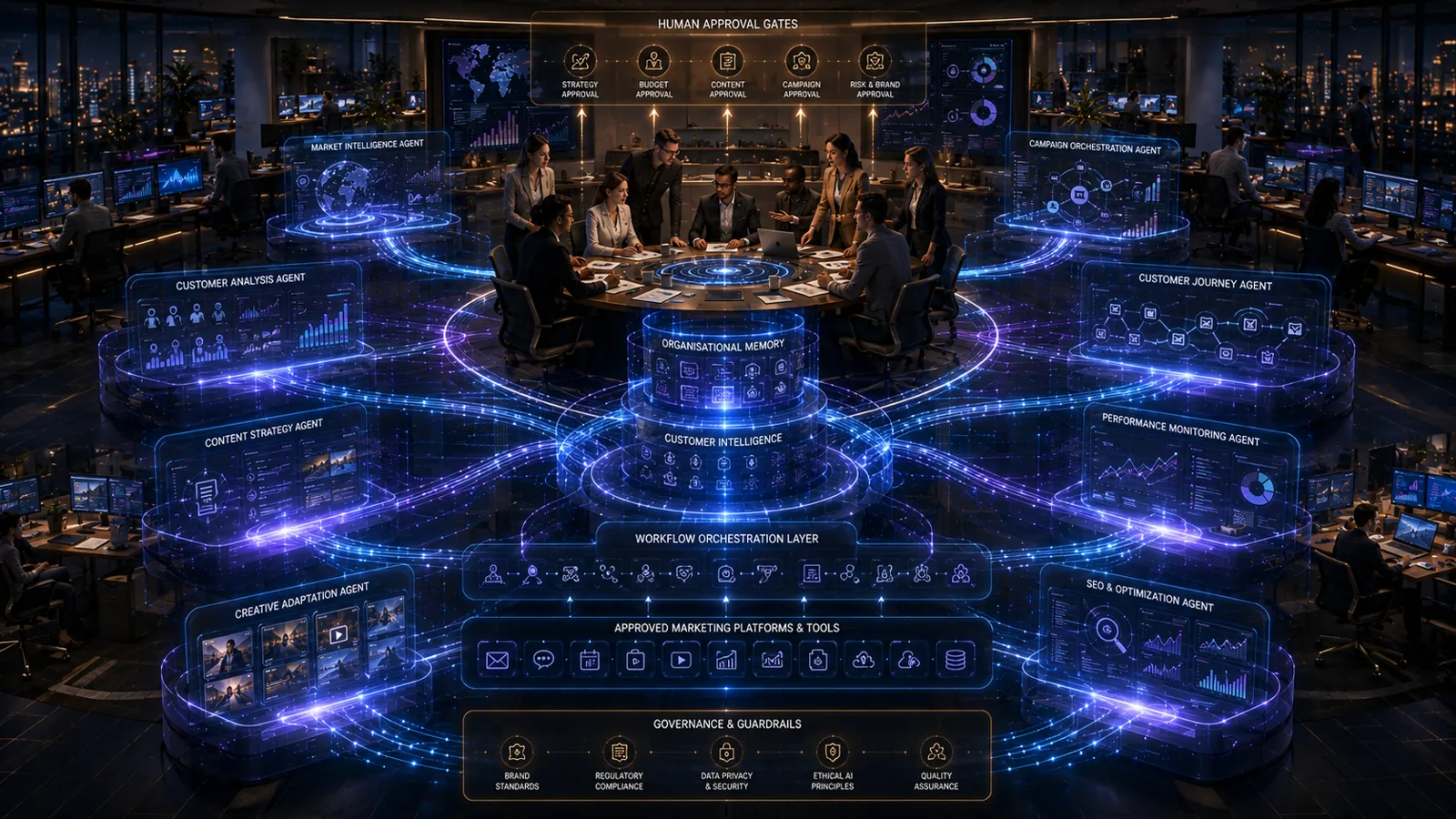
They will work continuously inside defined roles, drawing from approved company knowledge, using connected business tools and escalating decisions that require human judgement.
The result will be an autonomous marketing team.
This does not mean a marketing department without people.
It means a team in which much of the repeatable execution can continue without a person manually initiating and coordinating every step.
An autonomous marketing team is human-led, agent-operated and governed by clearly defined business objectives, permissions and accountability.
Humans will determine:
- Where the company should compete
- What the brand should represent
- Which customers deserve priority
- Which creative risks are worth taking
- Which trade-offs are acceptable
AI agents will help turn those choices into continuous, coordinated execution.
The opportunity is not merely to make the existing team faster.
It is to redesign what a marketing team is.
What Is an Autonomous Marketing Team?
An autonomous marketing team is a hybrid operating model combining:
- Human marketing leaders
- Human specialists
- Specialised AI agents
- Shared organisational memory
- Connected marketing tools
- Workflow orchestration
- Governance and approval systems
- Business-outcome measurement
The team is autonomous because approved workflows can monitor conditions, make limited operational decisions and perform actions without requiring a human to initiate every individual task.
For example, a customer-intelligence agent may continuously:
- 1Review new sales calls.
- 2Detect changes in customer objections.
- 3Compare those findings with support and product data.
- 4Prepare a weekly insight briefing.
- 5Notify the product-marketing lead when a meaningful trend appears.
A human still interprets the strategic significance.
But the research process operates continuously.
OpenAI describes agents as systems that combine models, tools and instructions to complete multi-step workflows, including manager-style architectures in which one agent coordinates specialised agents.
An autonomous marketing team applies this architecture across the marketing function.
Autonomous Does Not Mean Unsupervised
The term “autonomous” can create the wrong impression.
It may suggest agents independently deciding:
- What the company should promise
- How much money to spend
- Which customers to target
- What public statements to make
- How a crisis should be handled
That would be irresponsible.
Autonomy should exist within a defined operating boundary.
A campaign agent might be authorised to:
- Track asset readiness
- Route approvals
- prepare campaign configurations
- Schedule approved content
- Pause a small test exceeding a predetermined loss threshold
It should not independently approve:
- A new market position
- A major budget increase
- A sensitive customer claim
- A controversial creative direction
The autonomous team is governed through:
- Objectives
- Permissions
- Approval gates
- Budget limits
- Data-access controls
- Activity logs
- Human escalation
The goal is not to remove supervision.
It is to move supervision from every individual task to the objectives, standards and exceptions that matter.
Why Autonomous Marketing Teams Are Emerging Now
1. Agents Can Work Across Multiple Steps
Early generative AI tools primarily helped people create individual outputs.
An employee could ask for:
- A draft
- A summary
- An analysis
- A list of ideas
The person still coordinated the larger workflow.
Agents can increasingly gather context, use tools, evaluate intermediate results and continue working towards an objective.
This changes AI from a productivity tool into operational capacity.
2. Marketing Work Is Highly Interconnected
A marketing campaign may involve:
- Research
- Strategy
- Content
- Design
- Media
- Sales enablement
- Analytics
- Approvals
No individual output creates the outcome.
Value appears when these activities remain aligned.
Salesforce introduced agentic marketing capabilities in June 2026 around teams of AI agents that collaborate with marketers to build pipeline, create content and operate campaigns.
The direction is significant: from one assistant helping one marketer towards several agents supporting one connected marketing system.
3. Teams Cannot Manually Monitor Every Signal
Customer and market information now arrives continuously through:
- Product usage
- Websites
- Advertising
- CRM systems
- Support conversations
- Sales calls
- Social channels
- Competitor activity
People cannot inspect every signal at all times.
Agents can perform continuous monitoring, surface important changes and prepare the evidence required for a human decision.
4. Organisations Need More Personalisation
Relevant marketing requires decisions about:
- Audience
- Message
- Timing
- Channel
- Offer
- Journey stage
Rule-based automation can manage a limited number of predefined conditions.
Agents can reason across more context and adapt within approved boundaries.
Salesforce reported in its 2026 marketing research that 69% of marketers struggle to respond promptly to customers, 84% sometimes run generic campaigns and 78% need more personalised content than they can produce. These are vendor-reported findings, but they illustrate the capacity problem agentic systems are being designed to address.
5. Work Is Moving From Assistance to Delegation
Microsoft’s 2026 Work Trend Index describes a model in which agents take on more execution while humans gain more room to direct work, make consequential decisions and own outcomes.
This is the central idea behind autonomous teams.
The human does not disappear.
The human’s role moves upward.
The Structure of an Autonomous Marketing Team
A future autonomous marketing team may have three organisational layers.
Layer 1: Human Leadership
This layer includes:
- Chief Marketing Officer
- Brand leader
- Growth leader
- Customer or product-marketing leader
- Creative director
- Marketing-operations leader
These people define:
- Strategy
- Business objectives
- Brand standards
- Investment priorities
- Customer principles
- Agent authority
They remain accountable for the outcome.
Layer 2: Human Specialists
Human specialists contribute capabilities that require deep expertise, judgement and relationships.
These may include:
- Customer researchers
- Creative directors
- Product marketers
- Community leaders
- Analysts
- Editors
- Partnership managers
Their work may be heavily supported by agents.
A researcher may supervise an agent that analyses every customer conversation.
An editor may direct agents producing channel adaptations from one approved argument.
An analyst may oversee agents monitoring performance and preparing hypotheses.
Layer 3: The Agent Workforce
The agent layer performs repeatable operational workflows.
It might include:
Market Intelligence Agent
Monitors competitors, market developments and industry narratives.
Customer Intelligence Agent
Analyses sales calls, surveys, support cases and product behaviour.
Content Strategy Agent
Turns approved business priorities and customer evidence into briefs.
Creative Production Agent
Prepares channel-specific assets based on approved concepts.
Campaign Orchestration Agent
Coordinates tasks, dependencies, approvals and launches.
Journey Agent
Adapts customer communication within approved lifecycle rules.
Performance Agent
Monitors results, investigates anomalies and prepares decisions.
Marketing Operations Agent
Maintains workflow records, asset status and system consistency.
These agents are not independent digital employees pursuing their own goals.
They are specialised components inside one governed operating system.
How Work Moves Through the Team
Consider a company preparing to launch a new enterprise AI product.
Stage 1: Human Strategic Direction
Human leaders decide:
- Which customer segment to prioritise
- How the product will be positioned
- Which claims can be supported
- What budget is available
- What success will mean
Stage 2: Agent Research
Market and customer-intelligence agents analyse:
- Competitor positioning
- Customer objections
- Search behaviour
- Previous campaign learning
- Sales conversations
Stage 3: Human Decision
The leadership team selects the core campaign insight and creative direction.
Stage 4: Agent Production and Coordination
Agents prepare:
- Content briefs
- Asset variations
- Email journeys
- Campaign structures
- Sales enablement
- Project plans
Stage 5: Human Approval
Experts review:
- Product accuracy
- Brand quality
- Creative strength
- Sensitive claims
- Budget
Stage 6: Controlled Execution
Agents schedule approved activity, manage customer journeys and monitor performance.
Stage 7: Agent Analysis
The performance agent identifies:
- What changed
- Which segments responded
- Which assumptions may be wrong
- Which decisions are required
Stage 8: Human Learning
Leaders decide whether to scale, adjust or stop the campaign.
The agents then update execution.
This loop allows marketing to operate continuously without making the brand autonomous from human leadership.
How This Differs From Marketing Automation
Traditional marketing automation executes predefined rules.
For example:
If a prospect downloads a guide, send an email after two days.
An autonomous team works towards an objective.
A journey agent may consider:
- The guide downloaded
- Previous product engagement
- Sales activity
- Customer segment
- Support issues
- Communication frequency
It may determine that one customer should receive education, another should be routed to sales and a third should receive no message.
McKinsey describes agentic AI as combining AI capabilities to plan, decide and execute across workflows with limited human input, including continuous campaign optimisation and personalised customer journeys.
Automation follows a route.
Autonomy selects among approved routes based on context.
The Benefits of Autonomous Marketing Teams
Continuous Market Awareness
Agents can monitor customer and competitive changes between formal research cycles.
Faster Execution
Research, production, coordination and analysis can happen in parallel rather than sequentially.
Greater Consistency
Agents can retrieve current brand, product and governance context before completing work.
More Personalised Journeys
The team can adapt communication using richer customer context without manually programming every scenario.
Better Use of Human Attention
People spend less time collecting information and coordinating routine work.
They spend more time on:
- Strategy
- Customer relationships
- Creative quality
- Experiment design
- Leadership
Scalable Organisational Memory
Campaign decisions and learning can be preserved for future agents and employees.
Lower Coordination Costs
A campaign-orchestration agent can track tasks, dependencies and approvals continuously.
However, these benefits appear only when workflows are redesigned.
McKinsey warns that adding agents to fragmented processes can create weak human-agent collaboration and fail to produce meaningful value.
The New Role of the Human Marketer
Autonomous teams will change marketing jobs more than they eliminate marketing itself.
From Researcher to Insight Director
Instead of manually reading every source, the researcher:
- Defines the research question
- Reviews agent evidence
- Conducts high-value interviews
- Interprets the strategic meaning
From Writer to Editorial Leader
Instead of drafting every variation, the writer:
- Develops original arguments
- Interviews experts
- Defines narrative quality
- Evaluates agent-produced work
From Campaign Manager to Workflow Architect
Instead of chasing status updates, the campaign manager:
- Designs workflows
- Defines approvals
- Manages exceptions
- Improves coordination
From Analyst to Decision Scientist
Instead of assembling reports, the analyst:
- Standardises metrics
- Designs experiments
- Validates causal claims
- Audits AI recommendations
From CMO to Human–Agent System Leader
The CMO directs:
- Humans
- Agents
- Data
- Tools
- Decision rights
- Business outcomes
The CMO’s value moves away from controlling activity and towards designing a coherent marketing system.
The “Agent Boss” Skill Set
Managing agents requires new capabilities.
A marketer must learn to:
Define Missions
What outcome should the agent produce?
Design Context
Which company and customer information does it need?
Grant Permissions
What may it read, prepare or change?
Establish Evaluations
What does good performance look like?
Handle Exceptions
When should the agent stop and request help?
Improve Workflows
Which recurring errors require a system change?
These are not merely prompting skills.
They resemble:
- Management
- Operations
- Quality assurance
- System design
The best future marketers may manage substantial digital capacity without managing a large number of human direct reports.
The Risks of Autonomous Marketing Teams
1. Strategic Drift
Agents may optimize immediate tasks while gradually moving away from the company’s intended market position.
2. Conflicting Objectives
A growth agent may maximise conversion while a brand agent protects premium positioning.
Without shared priorities, both can produce locally rational but collectively harmful actions.
3. Error Propagation
One incorrect customer insight may influence content, targeting and sales communication across several agents.
4. Excessive Automation
Teams may delegate work simply because it can be automated, even when customer trust or creative quality requires human involvement.
5. Permission Creep
Agents may accumulate broader access as teams add capabilities.
6. Weak Accountability
Employees may begin saying, “The agent decided,” even though humans defined its objective and authority.
7. Declining Human Skill Development
Junior marketers may lose opportunities to learn research, analysis and writing if all foundational work is delegated.
The answer is not to reject autonomous teams.
It is to build governance into their architecture.
The Governance Model
Every agent should have an agent charter.
Role
What specific workflow does the agent own?
Mission
Which outcome is it expected to support?
Inputs
Which data and documents can it use?
Tools
Which systems can it access?
Authority
What may it do independently?
Prohibited Actions
What must it never do?
Human Owner
Who remains accountable?
Escalation Rules
When must it pause?
Evaluations
How will accuracy, safety and value be measured?
Retirement Criteria
When should the agent be redesigned or removed?
OpenAI recommends layered guardrails, carefully designed tools and human intervention for high-risk or sensitive agent actions.
The Autonomy Ladder
Companies should expand agent authority gradually.
Level 1: Observe
The agent reads information but takes no action.
Level 2: Analyse
It identifies patterns and prepares summaries.
Level 3: Recommend
It proposes actions for human review.
Level 4: Prepare
It configures drafts, campaigns or workflows without launching them.
Level 5: Execute With Approval
A human authorises each external action.
Level 6: Execute Within Limits
The agent can perform reversible, low-risk actions within defined boundaries.
Level 7: Coordinate Other Agents
A manager agent orchestrates specialised workflows and escalations.
Most companies should not begin at Level 7.
Trust should be earned through measured reliability.
Do Autonomous Teams Need Fewer People?
Some teams may become smaller relative to their output.
A compact group of strong marketers may operate a much larger portfolio of campaigns, channels and customer journeys.
McKinsey has described agentic organisational models in which small human teams supervise significantly larger groups of specialised agents across end-to-end processes. This is a forward-looking operating-model estimate rather than a universal staffing benchmark.
However, the purpose should not be indiscriminate headcount reduction.
Companies may reinvest capacity in:
- Customer research
- Creative experimentation
- Community building
- Partnerships
- Product marketing
- Market expansion
A business that uses agents only to reduce labour may become efficient but strategically weak.
A business that uses agents to expand learning and ambition may create a stronger organisation.
A Practical Future Team Design
A B2B marketing function might contain:
Human Team
- CMO
- Brand and creative lead
- Growth lead
- Product-marketing lead
- Customer-insight lead
- Marketing-operations lead
- Editor
- Community or partnership lead
Agent Team
- Market monitor
- Customer-conversation analyst
- Account-research agent
- Content-planning agent
- Content-adaptation agent
- Campaign coordinator
- Lifecycle agent
- Performance analyst
- Marketing-operations agent
The humans do not need to supervise every agent individually.
A central AI CMO or orchestration system may coordinate the agent portfolio, while named human owners govern each major workflow.
How to Build an Autonomous Marketing Team
Step 1: Clarify the Strategy
Define:
- Priority audience
- Customer problem
- Positioning
- Business objective
- Strategic exclusions
Agents cannot compensate for unclear direction.
Step 2: Map the Work
Separate marketing work into:
- Strategic decisions
- Creative judgements
- Repeatable workflows
- Administrative tasks
- High-risk actions
Step 3: Choose One Workflow
Start with:
- Customer intelligence
- Competitive monitoring
- Content operations
- Campaign reporting
- Campaign coordination
Step 4: Establish Shared Memory
Create authoritative sources for:
- Brand
- Product
- Customers
- Campaign learning
- Governance
Step 5: Assign Human Ownership
Every workflow needs one accountable human leader.
Step 6: Add Evals and Logging
Test realistic scenarios and record agent activity.
Step 7: Expand Autonomy Gradually
Add execution rights only after reliable performance.
Step 8: Redesign Human Roles
Use saved capacity for higher-value work rather than retaining old job structures unchanged.
A 90-Day Pilot
Days 1–30: Design
- Select one workflow.
- Establish baseline performance.
- Define the agent charter.
- Connect limited approved context.
- Build evaluation cases.
Days 31–60: Shadow
- Run the agent alongside the human process.
- Compare accuracy, speed and review effort.
- Document errors and exceptions.
- Improve instructions and tools.
Days 61–90: Controlled Ownership
- Let the agent own routine stages.
- Keep sensitive decisions human-controlled.
- Measure customer, operational and business results.
- Decide whether to expand, redesign or retire it.
Common Mistakes
Starting With Too Many Agents
Complexity increases faster than value.
Automating a Broken Workflow
The agent will reproduce the process’s weaknesses at greater speed.
Giving Every Agent Separate Goals
All agent objectives should cascade from one shared marketing strategy.
Measuring Output Volume
More content and campaigns do not prove better marketing.
Removing Direct Customer Contact
Human marketers still need to hear customers directly.
Ignoring Agent Economics
Model usage, integrations, evaluation and human review all create costs.
Treating Escalation as Failure
A correct request for human judgement is evidence of a well-designed system.
Removing Junior Development
Entry-level roles should be redesigned around evaluation, customer exposure, experimentation and workflow improvement.
Key Takeaways
- Autonomous marketing teams combine human leadership with specialised AI agents.
- Autonomy means workflows can continue within defined limits—not that AI controls the brand independently.
- Humans remain responsible for strategy, creative direction, major investment and accountability.
- Agents can own continuous research, content operations, campaign coordination, personalisation and performance monitoring.
- The marketing organisation will increasingly contain both a human workforce and an agent workforce.
- Human roles will shift from repetitive execution towards direction, evaluation and exception handling.
- Every agent requires a charter, permissions, a human owner and measurable evaluations.
- Agent authority should progress gradually from observation to controlled execution.
- The best autonomous teams will optimise complete customer and business outcomes rather than isolated channel metrics.
- The objective is not a human-free marketing department. It is a marketing system in which human intelligence is applied where it creates the greatest value.
Conclusion: The Future Marketing Team Is a System
The traditional marketing team was defined by its organisational chart.
The future marketing team will be defined by its operating system.
It will include:
- Human leaders
- Human specialists
- AI agents
- Shared knowledge
- Business tools
- Approval rules
- Performance loops
Work will not move only from one employee to another.
It will move dynamically between people and agents according to:
- The nature of the task
- The risk involved
- The evidence available
- The judgement required
Agents will continuously monitor markets, customers and campaigns.
They will prepare research, produce variations, coordinate execution and surface decisions.
Humans will determine the direction.
They will define what the brand believes, which customers matter, which risks are acceptable and which opportunities deserve investment.
This is not the disappearance of the marketing team.
It is the expansion of what a marketing team can be.
A small human team may gain access to analytical, creative and operational capacity that previously required a much larger organisation.
But capacity alone will not create advantage.
Every competitor will eventually have access to capable agents.
The advantage will come from:
- Better strategy
- Better organisational memory
- Better workflows
- Better evaluation
- Better human judgement
- Better customer understanding
The rise of autonomous marketing teams will therefore make marketing leadership more important.
When agents can execute continuously, a weak objective becomes continuous waste.
A strong objective becomes continuous leverage.
The winners will not be the companies that remove humans from marketing.
They will be the companies that build the strongest partnership between human direction and machine execution.
Actionable Next Steps
- 1Identify the marketing workflows your team performs repeatedly.
- 2Separate strategic decisions from operational execution.
- 3Select one measurable, low-risk workflow for an agent pilot.
- 4Create an agent charter with permissions and escalation rules.
- 5Assign a named human owner.
- 6Connect only the minimum company context and tools required.
- 7Run the agent alongside the current process.
- 8Measure accuracy, speed, human review and business value.
- 9Expand authority only after reliability is demonstrated.
- 10Redesign human roles around strategy, customers, creativity and agent leadership.
Frequently asked questions
What is an autonomous marketing team?
It is a hybrid team in which human leaders define strategy and governance while AI agents continuously perform approved research, production, coordination and optimisation workflows.
Does autonomous marketing mean removing human marketers?
No. Humans remain essential for strategy, creativity, relationships, ethics and accountability. Agents primarily absorb repeatable execution and monitoring.
Which agents might exist in an autonomous marketing team?
Common roles include market intelligence, customer intelligence, content strategy, creative production, campaign coordination, lifecycle marketing and performance-analysis agents.
How is an autonomous marketing team different from automation?
Traditional automation follows predefined rules. Autonomous agents can interpret context, choose among approved actions and adapt their workflow towards an objective.
Who manages the AI agents?
Each major agent or workflow should have a named human owner. A central orchestration or AI CMO system may coordinate the full agent portfolio.
Can AI agents launch campaigns independently?
They may eventually execute low-risk, reversible actions within strict limits. Major launches, budgets, claims and creative decisions should remain human-approved.
Will autonomous teams reduce marketing headcount?
Some teams may produce more work with fewer people, but organisations can also reinvest the additional capacity in customer research, creativity, partnerships and market growth.
How should a company begin building an autonomous marketing team?
Start with one recurring workflow, define its objective and permissions, run an agent in parallel with the current process, evaluate performance and expand autonomy gradually.